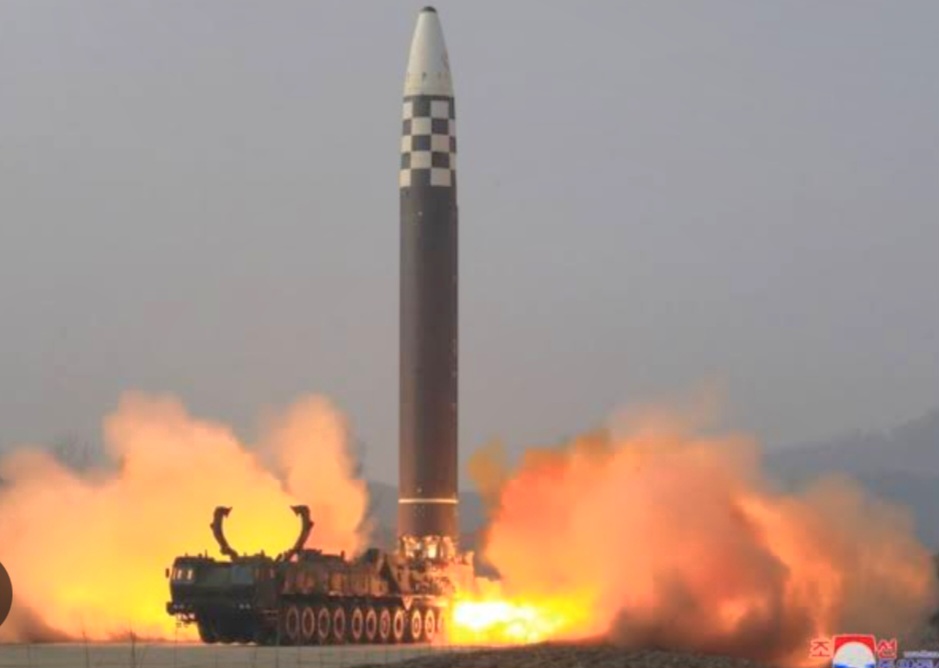
North Korea’s attempt to launch a satellite failed on Wednesday, with the rocket crashing into the sea, according to the state-run Korean Central News Agency, KCNA.
A statement carried by KCNA disclosed that the rocket carrying the “military reconnaissance satellite’’ crashed off the Korean Peninsula’s western coast after “losing thrust due to abnormal starting’’ of the second-stage engine as the failure was due to the “low reliability and stability’’ of a new engine system,” it said.
The statement said scientists were examining the cause of the failure and a second launch would take place as soon as possible.
The U.S. government strongly condemned the launch.
A spokesman for the White House’s National Security Committee, Adam Hodge said: “This claimed space launch involved technologies that are directly related to the, North Korean, intercontinental ballistic missile program
“The door has not closed on diplomacy but Pyongyang must immediately cease its provocative actions and instead choose engagement,’’ Hodge said.
The launch brought about tensions in the region and could destabilize the security situation, and is a brazen violation of multiple UN Security Council resolutions.
Hodge said that Washington would take all necessary measures to ensure the security of the U.S., South Korea and Japan.
The launch also caused uncertainty in the metropolis of Seoul, the South Korean General Staff said.
Sirens were heard in the South Korean capital and in text messages, citizens were asked to go to shelters if necessary.
News agency Yonhap later cited the Interior Ministry as saying that the alert was sent by mistake.
South Korean military said that the projectile flew over the Yellow Sea between the Korean Peninsula and China and did not affect the Seoul metropolitan area. Yonhap also reported.
The Japanese Coast Guard on Monday said it has been informed by North Korea that Pyongyang was planning a satellite launch between May 31, and June 11 in spite of criticism.
It said that it would violate UN resolutions prohibiting North Korea from testing ballistic missiles.
Credible News reports that the Nuclear Weapon Ban Treaty, is the first legally binding international agreement to comprehensive prohibit nuclear weapon with the ultimate goal being their total elimination. It was adopted on 7 July 2017, opened for signature on 20 September 2017, and entered into force on 22 January 2021.
For those nations that are party to it, the treaty prohibits the development, testing, production, stockpiling, stationing, transfer, use and threat of use of nuclear weapons, as well as assistance and encouragement to the prohibited activities. For nuclear armed states joining the treaty, it provides for a time-bound framework for negotiations leading to the verified and irreversible elimination of its nuclear weapons programme.