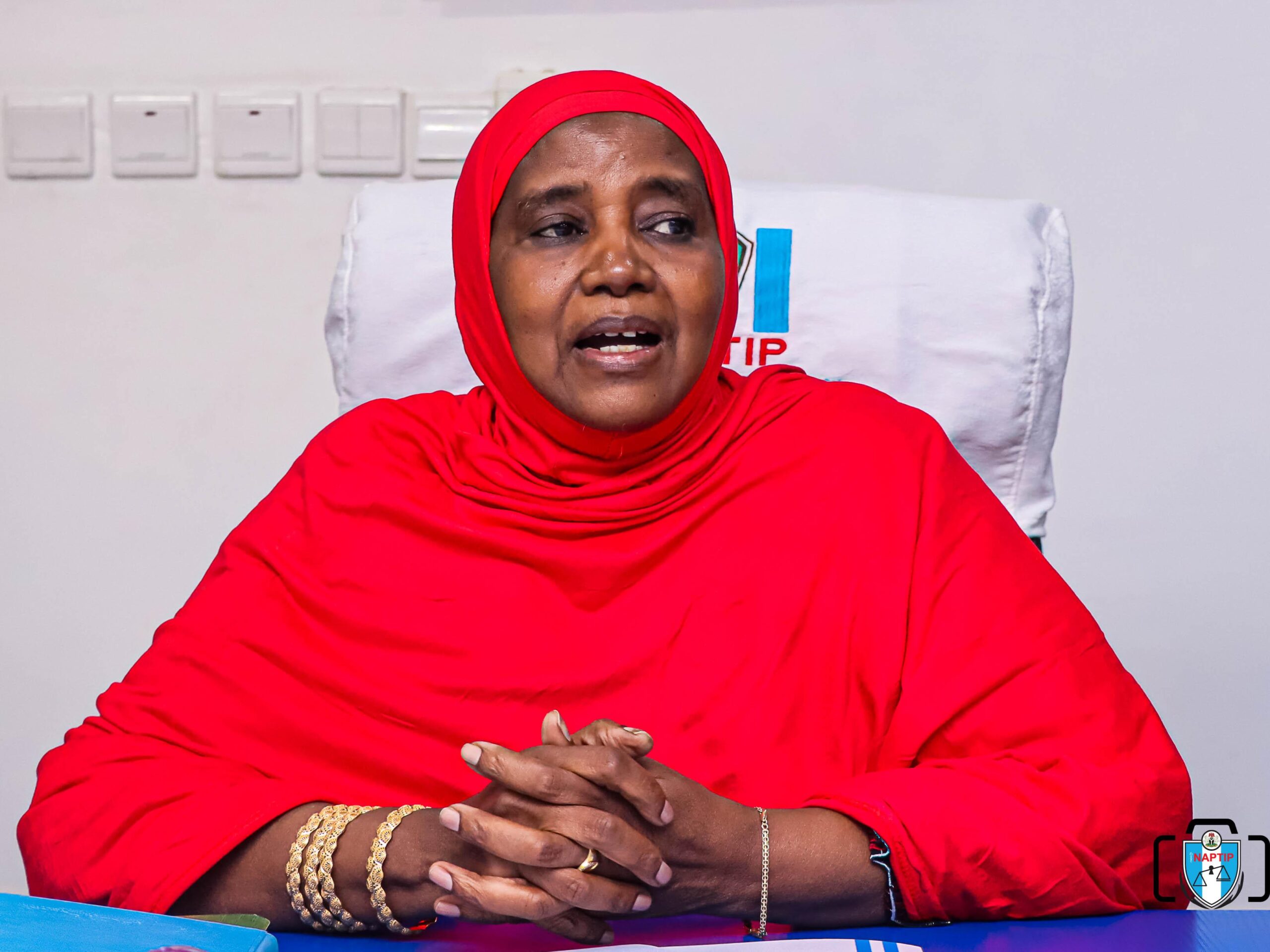
The National Agency for the Prohibition of Trafficking in Persons,NAPTIP, warns human trafficking threatens national security,NAPTIP, has raised alarm that human trafficking poses a grave threat to Nigeria’s national security and public safety by fueling organised crime and social decay.
NAPTIP Director-General, Hajiya Binta Adamu-Bello, mhade this known in Dutse during the launch of a programme aimed at supporting and empowering women and children from Jigawa State who are engaged in street begging across the country.
The initiative, implemented by Hamadan Kasiran Orphan,Vulnerable and Children,OVC, Foundation in collaboration with the Children Education Support Initiative in Arewa, CESIA, is championed by Hajiya Amina Namadi, wife of the Jigawa State Governor.
It seeks to create opportunities that will help vulnerable individuals improve their livelihoods and break the cycle of poverty.
Adamu-Bello, represented by the agency’s Commander in Jigawa, Mr. Abdulkadir Turajo, said NAPTIP—established in 2003—remains Nigeria’s only focal agency mandated to combat human trafficking and related forms of exploitation nationwide.
She noted that child beggars are among the most vulnerable groups, as many are recruited for forced labour, organ harvesting, sexual exploitation, or even used in armed conflict.
“Reports and findings show high rates of recruitment into terrorism and armed conflict among victims of trafficking who are moved daily from rural to urban areas or across borders for prostitution and hazardous labour,” she said.
Describing human trafficking as one of the world’s greatest threats to national stability, Adamu-Bello listed its consequences, including public sector corruption, irregular migration, human capital erosion, social breakdown, rights violations, disease spread, and a tarnished national image.
READ ALSO: NAPTIP, media unite against human trafficking stigma
She lamented that trafficking has re-emerged as a modern form of slavery, involving the recruitment, transportation, and harbouring of persons through deception, coercion, or debt bondage for forced labour, prostitution, or street begging.
“The law recognises this as a grave violation of children’s rights. Under the Trafficking in Persons (Prohibition) Enforcement and Administration Act of 2015, Sections 13, 15, 19, and 20, offenders face a minimum sentence of seven years imprisonment without an option of fine,” she stated.
Adamu-Bello revealed that NAPTIP recently rescued 13 young women trafficked from Babura town in Jigawa to Maiduguri for forced labour and begging. Since its establishment in 2023, the Jigawa Command has rescued and reunited 221 victims with their families.
She reaffirmed NAPTIP’s commitment to collaboration with partners to support victims and address the root causes of human trafficking.
“I commend the Hamadan Kasiran OVC Foundation and CESIA for their dedication to this cause. Together, we can ensure that children and vulnerable populations are protected, empowered, and given the opportunities they deserve,” she said.
The director-general urged communities to intensify awareness on the dangers of child begging and engage traditional and religious leaders to help curb the practice.
Earlier, the National President of OVC Foundation and CESIA, Mr. Sa’idu Kaptan, lauded the Jigawa governor’s wife for her compassion and leadership in championing the welfare of vulnerable women and children.
“Your leadership is a beacon of hope and a reminder that meaningful change begins with empathy and action,” Kaptan said.
Representatives of Dutse and Ringim Emirate Councils, Alhaji Yusuf Turaki and Alhaji Muktar Wada, also commended the foundation for its efforts in protecting vulnerable groups within the society.
NAN