Nosmot Gbadamosi
An estimated 200,000 people have fled fighting in the eastern Democratic Republic of the Congo just days after U.S. President Donald Trump hailed a “historic” peace deal to end the conflict brokered in Washington last Thursday.
Congolese President Félix Tshisekedi and his Rwandan counterpart, Paul Kagame, formally signed the accord in a ceremony attended by Trump and several African leaders. But, as in previous peace efforts, the talks did not include the Rwanda-backed M23 militant group, which has driven much of the fighting this year.
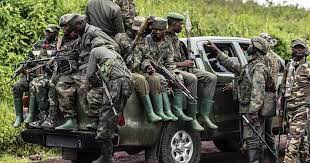
In recent days, M23 launched a fresh offensive in Congo’s South Kivu province, sparking the latest wave of displacement. On Wednesday, M23 fighters said they had seized the strategic city of Uvira near the Burundi border after Burundian soldiers fighting alongside the Congolese army were unable to hold them back.
“Signing an agreement and not implementing it is a humiliation for everyone, and first and foremost for President Trump,” Burundian Foreign Minister Edouard Bizimana told AFP. He added that “several trucks full of soldiers” had come from Rwanda to support M23.
Underpinning the U.S.-brokered peace accord is critical minerals deal with Congo and Rwanda, which the Trump administration said will bring billions of dollars of private U.S. investment to both nations.
As part of the deal, the Congolese government agreed to provide the United States with a list of critical minerals and gold assets, ripe for exploration by U.S. companies, in exchange for U.S. support in “security, defense, and protection of critical infrastructure.” Rwanda would also see private U.S. investments in minerals processing.
But regional experts suggest that the peace deal largely overlooks M23’s growing autonomy and strengthened military force.
M23 emerged from a rebel group called the National Congress for the Defence of the People (CNDP). It takes its name from a March 23, 2009, peace agreement that laid out a plan for rebels to be given amnesty and integrated into the Congolese army. After the agreement was never fully implemented, former CNDP fighters formed M23 in 2012. Its members are largely Congolese Tutsi, the same ethnic group as Rwanda’s ruling government.
Other rebel groups have joined M23’s cause in the past couple of years to overthrow Congo’s federal government under a broader political coalition called the Congo River Alliance, led by Corneille Nangaa, a former president of Congo’s electoral commission.
Now, M23 operates a parallel proxy government across the territories it has captured since January, where it has heavily recruited civilians and installed local leaders.
The group also collects taxes from mining operations—including at the Rubaya mines, which it seized in April 2024. Rubaya produces around 15 percent of the world’s coltan, a critical ore for the production of tantalum, which is used in everything from smartphones to electric vehicles.
One of the problems with Trump’s plan is that M23 is involved in separate Qatar-mediated peace talks with the Congolese government in Doha, said Jason Stearns, a former coordinator of the United Nations Group of Experts on the Congo and author of The War That Doesn’t Say Its Name: The Unending Conflict in the Congo.
“That creates a structural problem,” Stearns said. “You can advance in the Washington process, but if things stall in the Doha process, then fighting will continue on the ground.”
While Stearns thinks that the Washington process in theory has “the ability to bring about a peace deal,” he said that “the economic incentives were both not enough, and they were very long term.” He added that no party to the conflict is currently facing adequate sanction threats to prevent them from violating peace terms.
Fighting in eastern Congo has endured for more than three decades and has displaced at least 7 million people. M23 only has a few more territories to seize before Rwanda would no longer share a border with territories under the control of Congo’s government. It is little surprise that, while engaging with its own peace talks in Doha, it has continued to launch offensives.
African Brief