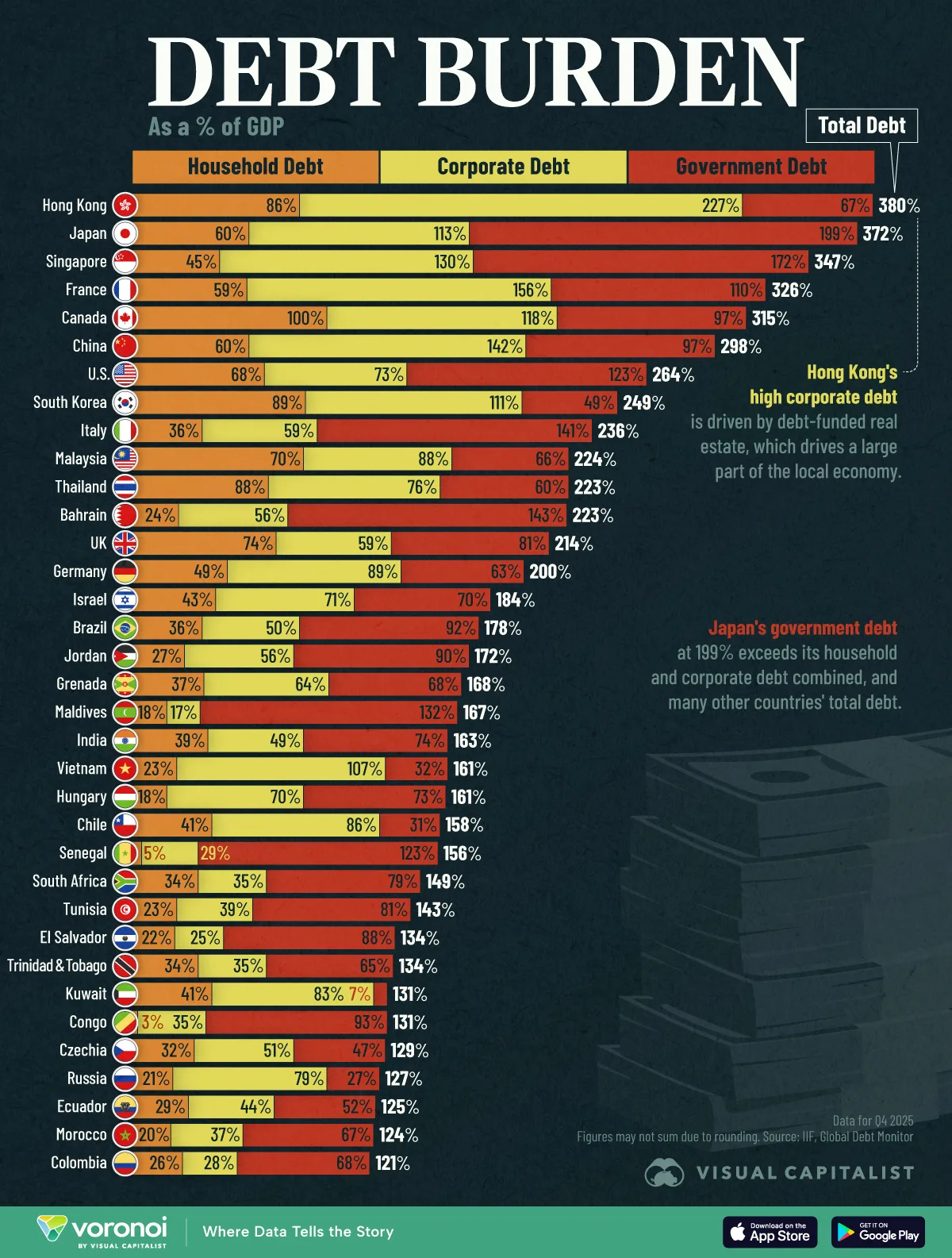
Q4 2025 data from the Institute of International Finance’s Global Debt Monitor, has indicated that several leading economies now have total debt exceeding 300% of their GDP, indicating that the combined household, corporate, and government borrowing amounts to more than three years’ worth of economic output.
This visualisation ranks 35 countries by their total debt-to-GDP ratios, combining household, corporate, and government borrowing into one measure.
Hong Kong Tops the Ranking
With a total debt burden of 380%, Hong Kong has the world’s highest total debt. This small special administrative region of China is highly developed and urbanised, with roughly 7.5 million inhabitants.
While its government debt is a relatively slim 67% and its total household debt of 86% hovers around global developed-country standards, Hong Kong’s corporate debt is a staggering 227% of GDP, making up nearly the entirety of its total debt burden.
Also Read: Tinubu angry over huge contract debts
The table below shows the total debt burden and breakdowns for household, corporate,
| Country | Household Debt (% GDP) | Nonfinancial Corporate Debt (% GDP) | Government Debt (% GDP) | Total Debt (% GDP) |
| 🇭🇰 Hong Kong | 86 | 227 | 67 | 380 |
| 🇯🇵 Japan | 60 | 113 | 199 | 372 |
| 🇸🇬 Singapore | 45 | 130 | 172 | 347 |
| 🇫🇷 France | 59 | 156 | 110 | 326 |
| 🇨🇦 Canada | 100 | 118 | 97 | 315 |
| 🇨🇳 China | 60 | 142 | 97 | 298 |
| 🇺🇸 United States | 68 | 73 | 123 | 264 |
| 🇰🇷 South Korea | 89 | 111 | 49 | 249 |
| 🇮🇹 Italy | 36 | 59 | 141 | 236 |
| 🇲🇾 Malaysia | 70 | 88 | 66 | 224 |
| 🇹🇭 Thailand | 88 | 76 | 60 | 223 |
| 🇧🇭 Bahrain | 24 | 56 | 143 | 223 |
| 🇬🇧 United Kingdom | 74 | 59 | 81 | 214 |
| 🇩🇪 Germany | 49 | 89 | 63 | 200 |
However, Hong Kong’s high corporate debt can best be explained by the SAR’s real estate business, in which high-debt transactions are standard. The dynamic real estate sector and related activities contribute roughly a quarter to Hong Kong’s GDP.
Japan’s Government Debt Nears 200% of GDP
In contrast, Japan’s corporate debt (113%) is relatively in line with other OECD and developed peers; however, the government’s sprawling debt of just shy of 200% of GDP is higher than many countries’ total debt burden.
Government debt woes began to take off following the Lost Decades of economic stagnation, which followed the collapse of the Japanese asset price bubble in 1991.
As years of sluggish growth turned into decades, Japanese policymakers opted to incorporate quantitative easing, a policy by which the central bank bought government bonds in order to stimulate economic activity in the country, driving up the country’s national debt in the process.
Today the Bank of Japan owns roughly half of the national debt, while the other half is held in large part by domestic banks and insurance companies.
Debt in the Developed World
Japan is not the only country to have had to accrue debt in response to tough times. Back-to-back crises have forced governments to borrow extensively in recent years, from global COVID-19 stimulus responses to more recent industrial and defense purchases across Europe.
Many governments continue to run large fiscal deficits, while households and businesses face rising borrowing costs amid economic uncertainty.
Visual Capitalist