Players at the World Cup could face a red card if they cover their mouths when speaking to opponents during confrontations.
The decision was taken during a special meeting of the International Football Association Board, Ifab, in Vancouver, Canada, on Tuesday, where two Fifa-proposed law amendments were approved.
Players who leave the pitch in protest at a referee’s decisions could also now face a red card, following ugly scenes at the Africa Cup of Nations final between Morocco and Senegal.
Both law changes have been approved as competition opt-ins by the Ifab and Fifa has confirmed they will be adopted at this summer’s World Cup.
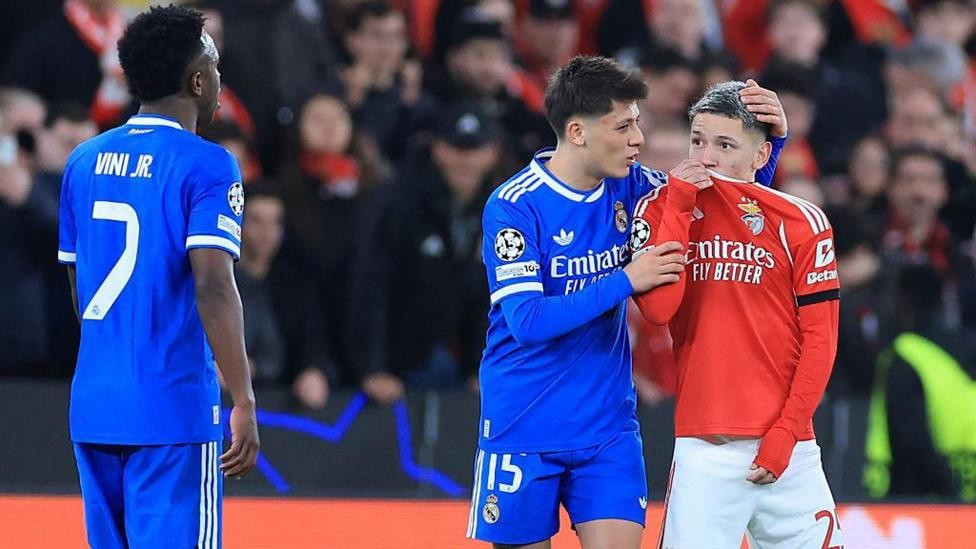
The issue of players covering their mouths became high profile in February when Benfica winger Gianluca Prestianni raised his shirt while speaking to Real Madrid’s Vinicius Jr during a Champions League game.
The Argentina international was accused of racist abuse and provisionally banned for one match. Following a Uefa investigation, Prestianni was found guilty of homophobic conduct and banned for six matches – three of which were suspended.
The issue was discussed at the Ifab annual general meeting in Wales later that month where it was agreed members would reconvene ahead of this week’s Fifa Council in Vancouver.
The decision remains at the absolute discretion of the referee, who will consider all circumstances before issuing a red card.
Fifa president Gianni Infantino said he wanted to bring in something which has “a deterrent effect” and backed a red card.
Infantino said: “If a player covers his mouth and says something, and this has a racist consequence, then he has to be sent off, obviously.
“There must be a presumption that he has said something he shouldn’t have said, otherwise he wouldn’t have had to cover his mouth.
“If you do not have something to hide, you don’t hide your mouth when you say something. That’s it, as simple as that.”
Also Read: FIFA president Infantino defends World Cup ticket prices
In the final of the Africa Cup of Nations, Senegal left the field and returned to the changing rooms in protest at a penalty awarded to Morocco.
When the players eventually returned Brahim Diaz chipped his Panenka penalty into the hands of goalkeeper Edouard Mendy, and Senegal went on to win 1-0.
But the Confederation of African Football, Caf, has since stripped Senegal of the title and awarded Morocco a 3-0 win.
This new rule will also apply to any team official who incites players to leave the pitch.
A team that causes a match to be abandoned will, in principle, forfeit the match.
Fifa also confirmed a second yellow card amnesty for the World Cup, wiping all bookings at the end of the group stage as well as after the quarterfinals.
Without a change to the regulations, Fifa feared that many more players would be walking a suspension tightrope at the newly expanded World Cup by playing six fixtures through to the last eight.
In addition, Fifa announced increased funding for all 48 competing nations.
Concerns were raised that the high costs of being in the United States, Mexico and Canada could mean national football associations lost money by being at the World Cup.
Fifa has reacted by raising its contribution by 15% to $871m, £645m, which breaks down as:
-
Preparation money: from $1.5m, £1.1m to $2.5m, £1.85m
-
Qualification money: from $9m, £6.6m to $10m, £7.4m
-
Subsidies for team delegation costs now $16m, £11.85m
BBC NEWS