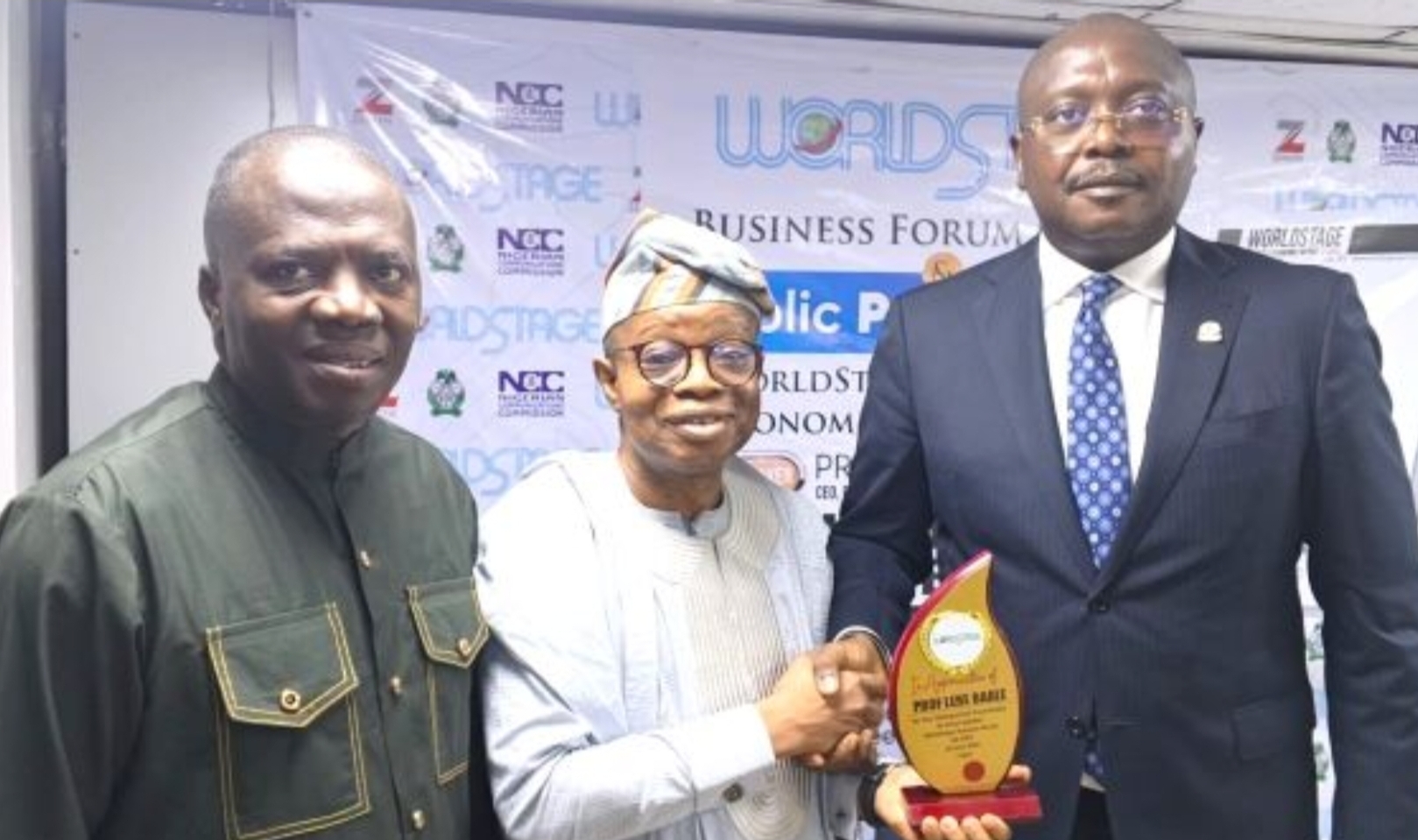
Prof. Lere Baale, Chief Executive Officer of Business School Netherlands International, has urged Nigerian organisations to build corporate cultures anchored on responsiveness, respect, reliability, responsibility and relationships, warning that poor stakeholder engagement and corporate arrogance are undermining trust and competitiveness.
Baale spoke at the WorldStage Business Forum Q2 2026 and the public presentation of the WorldStage Nigeria Economic Report Q1 2026, where he delivered a lecture on the theme, “Nigeria’s Corporate Culture and Global Standard.”
According to him, organisations seeking to compete globally can no longer afford to treat culture as a secondary issue, as leading institutions across Europe, North America, Asia and emerging economies have consistently invested in culture as a strategic asset.
Baale said his invitation to the forum specifically asked him to address what has been described as “corporate terrorism” — a pattern in which large organisations fail to extend basic courtesy to the public, small businesses and the media through ignored correspondence, unanswered calls, inaccessible executives and poor response to business inquiries.
“While the phrase ‘Corporate Terrorism’ may be provocative, the concern is real,” he said.
He said many stakeholders had experienced situations in which emails remain unanswered for months, customer complaints go unresolved, business proposals receive no acknowledgement and media inquiries are treated with disdain.
“The irony is that many of these organisations were once small businesses themselves,” he said.
Baale described culture as the experience people have when they interact with an organisation, saying it shapes decision-making, customer treatment, employee value and leadership behaviour.
“Culture is the invisible force that ultimately becomes visible in performance,” he said.
He warned that in an age of transparency and heightened stakeholder scrutiny, organisations can no longer hide behind size, bureaucracy or market dominance.
Also Read: Tinubu in France, woos global investors
“The organisations that will win in the future are not necessarily the biggest. They are the most trusted,” he said.
Baale also argued that many organisations misunderstand global standards by equating them with expensive buildings, imported furniture, sophisticated websites, foreign accents or international awards.
According to him, global standards are fundamentally about behaviour, discipline and mindset.
He said the world’s most respected organisations share common traits: they respond, communicate, respect people, keep promises, listen, remain accountable, embrace transparency, solve problems and create value.
“If a multinational organisation can acknowledge an email within hours, why should a local organisation take months?” he asked.
On the issue of trust, Baale said declining confidence remains one of the biggest challenges in Corporate Nigeria, stressing that trust is the currency of sustainable business.
“Trust is earned through consistency. It is built through integrity. It is strengthened through transparency. And it is maintained through responsiveness,” he said.
He added that every ignored stakeholder interaction amounts to a withdrawal from an organisation’s trust account, while every fulfilled commitment is a deposit.
Baale said customer experience has now become a stronger competitive advantage than product, price or quality alone, as customers, suppliers, employees and communities remember how they are treated.
“Customer experience is no longer a department, it is a culture,” he said.
On leadership, he said corporate culture does not emerge by accident but is created intentionally, with employees often reflecting what leaders tolerate.
“If leaders ignore stakeholders, employees will ignore stakeholders. If leaders are inaccessible, employees will become inaccessible,” he said.
He also stressed the human side of business, saying efficiency must be balanced with empathy because behind every email, complaint, application or supplier relationship is a human being deserving dignity.
Baale warned companies not to allow technology to erase humanity, saying automation should improve efficiency, not replace courtesy.
To illustrate the impact of strong corporate culture, he shared an experience from Pfizer, where he said a seriously ill manager was supported with overseas dialysis, family relocation, dedicated medical equipment in Nigeria and home-based care. He said the experience changed his own career plan, extending his stay with the company from five years to 25 years.
According to him, strong corporate culture strengthens employee loyalty, improves stakeholder relationships and supports long-term organisational prosperity.
As a way forward, Baale urged Nigerian organisations to intentionally build culture around five pillars: responsiveness, respect, reliability, responsibility and relationships.
“Every stakeholder deserves acknowledgement. Not every request requires approval, but every request deserves a response,” he said.
He added that respect must be non-negotiable, promises must be kept, leaders must own outcomes and organisations must prioritise relationships over transactions.
Drawing from global best practices, Baale said successful organisations invest in culture, train their people, measure customer satisfaction, encourage feedback, embrace transparency and pursue continuous improvement.
“The future belongs to organisations that learn faster, adapt faster and serve better,” he said.
Despite the challenges, Baale said he remains optimistic about Nigeria’s potential, citing the country’s talent, entrepreneurial resilience and examples of organisations already operating at world-class levels.
“The issue is not capability. The issue is consistency. The issue is scale. The issue is culture,” he said.
He called for a new corporate social contract in which customers are respected, employees are valued, suppliers are treated fairly, communities are engaged responsibly, media professionals are treated as partners and stakeholder trust is protected.
“This is not merely good ethics. It is good business,” he said.
In his opening remarks, President and Chief Executive Officer of World Stage Limited, Mr. Segun Adeleye, said the forum was designed to examine whether there is truly a global standard in corporate conduct or whether the business environment has become a jungle where only the strongest survive.
“Maybe if we discuss this, some of the big organisations that are guilty may have a rethink,” Adeleye said.
Referring to recent remarks by Vice President Kashim Shettima that micro, small and medium enterprises account for 90 per cent of businesses and 60 million jobs in Nigeria, Adeleye said many of those smaller firms remain at the receiving end of oppressive corporate behaviour.
“The big businesses of today hardly remember that they once started small,” he said.
The forum attracted senior corporate and media executives, including Chief Emeka Obegolu, President of the Abuja Chamber of Commerce and Industry, and Lagos State Commissioner for Economic Planning and Budget, Hon. Mosopefoluwa George, who was represented by Mr. Olufemi Orojimi, Director of Budget.
Crediblenewsng.com