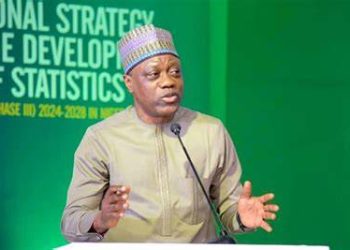
Former Kwara State Governor Abdulfatah Ahmed has called for stronger intelligence gathering, community policing and policies that address unemployment, arguing that Nigeria’s prolonged insecurity is closely tied to economic hardship and failures of governance.
In an interview, Ahmed said Nigeria had faced difficult economic and security conditions since he left office in 2019, warning that insecurity was undermining efforts to improve living standards.
“Security is almost everything. Because no matter what resources you have, you can’t truly put them to optimal use if there is insecurity,” Ahmed said.
The former governor said Nigeria’s security crisis should not be viewed solely through religious or ethnic lenses. He argued that it involved organised criminal networks, possible external connections and internal complicity, while stressing that those assertions were his personal assessment.
“Insecurity cannot happen without connivance. It cannot happen without complicity,” he said, adding that access to arms, information and other resources suggested “serious coordination.”
Ahmed said the government should improve intelligence capabilities and deepen community policing to obtain the information needed to counter insurgency. He said Nigeria’s armed forces remained capable but faced the difficulty of fighting adversaries operating through asymmetric tactics and local networks.
Also Read: Akume defends Tinubu’s capacity to end insecurity
“When the enemy is fighting asymmetrically and there is so much complicity, it makes a mockery of the military system that you have,” he said.
On the rehabilitation of former insurgents, Ahmed said deradicalisation and skills-acquisition programmes could help reintegrate young people who were recruited because of limited economic opportunities.
However, he warned that a poorly implemented programme could be counterproductive and leave participants vulnerable to renewed radicalisation.
He also linked insecurity to youth unemployment, saying governments must create credible alternatives for young people who might otherwise be drawn into criminal activity.
Assessing the economy, Ahmed said the simultaneous removal of fuel subsidies and the floating of the exchange rate had intensified pressure on Nigerians because the country remained heavily dependent on petrol and imports.
“We’re also an economy that’s heavily import dependent,” he said, noting that higher fuel costs and exchange-rate pressures affect agriculture, transportation, trade and service delivery.
Ahmed called for a broader push toward commercial agriculture, saying mechanisation, reliable agricultural financing, registered land, quality seeds, infrastructure and organised markets were necessary to turn farming into a major source of jobs and economic growth.
He said government interventions had often focused too heavily on inputs without adequately measuring results.
“We are largely concerned with input, input, input. We don’t have output and impact measurement mechanisms,” he said.
Ahmed cited Kwara State’s experience with the Shonga/Zimbabwean farmer scheme, saying commercial agriculture could work when supported by sound policy and financing. But he warned against policy inconsistency, describing abrupt changes in direction as “policy somersault.”
Crediblenewsng.com