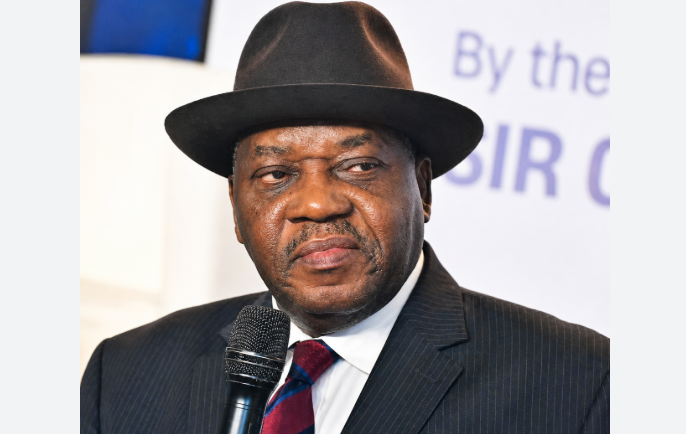
The National Chairman of the Pan Niger Delta Forum, PANDEF, Godknows Igali, has called for the restoration of true fiscal federalism and greater devolution of powers, arguing that Nigeria’s highly centralized governance structure has weakened productivity, security and accountability.
Igali made the call on Monday at the Concerned Citizens Assembly, organized by the Citizens Rebirth and Awareness Initiative, C-RAIN, in Abuja, where stakeholders gathered under the theme, “A Nation Built on Consent, Strengthened by Strong Regions and United for Peace, Prosperity and Progress,” to examine issues surrounding governance, federalism, national development and national unity.
Igali said Nigeria’s over-centralized system had limited the ability of the federating units to develop according to their resources and peculiar needs.
He also criticized state governors for failing to translate regional cooperation into concrete economic development that would improve the living conditions of citizens.
The PANDEF chairman stressed that restructuring should not be interpreted as a call for the breakup of Nigeria, but rather as an effort to strengthen the federation and improve its capacity to deliver development.
According to him, PANDEF’s position is aimed at preserving the country while advocating reforms that would make the different federating units more productive and accountable.
Igali recalled that Nigeria’s founding fathers negotiated a federal system in which regions had significant responsibilities and were able to develop according to their resources, priorities and circumstances without excessive dependence on the Federal Government.
He cited the achievements of the former regions, including the Western Region’s free primary education and Cocoa House, the Eastern Region’s industrial development, and the Northern Region’s investments in agriculture and education.
He said the achievements demonstrated the potential of a federal structure in which regions have sufficient autonomy and resources to pursue their development priorities.
“The regions also developed educational institutions and other productive sectors. They achieved significant progress without waiting for monthly allocations from the centre or direct federal intervention,” Igali said.
He argued that the original vision was to have strong and productive federating units that contributed to a limited but effective central government.
Also Read: Nigeria’s Evolving Federalism and Local Government Administration
To achieve this, Igali called for constitutional amendments to devolve powers, strengthen fiscal federalism, restore greater resource control and guarantee local government autonomy.
He also advocated stronger regional cooperation among Nigeria’s federating units as a means of promoting sustainable economic development.
Igali, however, cautioned against allowing discussions on restructuring to create divisions along ethnic or religious lines.
He urged Nigerians to maintain national unity while engaging in constructive discussions about reforms that could make the federation more effective, accountable and productive.
“Let us not separate ourselves under ethnicity, let us not separate ourselves under religion, or under those lines. Those lines should be the basis for constructive discussion,” he said.
The Convener of the Concerned Citizens Assembly, Deacon Owolabi Oladejo, described restructuring as a national survival strategy rather than merely a political option.
Oladejo argued that Nigeria’s highly centralized political structure had become increasingly incapable of responding effectively to the realities and challenges of the country’s diverse population.
He said changing political leaders alone would not resolve Nigeria’s challenges, stressing that the underlying architecture of governance must also be reviewed.
According to him, Nigeria requires a new federal compact based on consent, stronger regions, fiscal responsibility and constitutional reforms to strengthen democratic governance and national development.
“Nigeria needs restructuring, not as a political slogan, but as a national survival strategy,” Oladejo said. He stressed the urgency of fundamental reforms to Nigeria’s governance structure and development priorities.
Similarly, the General Secretary of the Rebirth Group and Citizens for Restructured Nigeria, Ali Ocheni, said consultations conducted across Nigeria’s six geopolitical zones showed widespread concerns over excessive centralization of political power.
Ocheni said the groups consulted citizens in Ibadan, Kaduna, Enugu, Gombe, Port Harcourt and Jos between May 2024 and March 2026 on Nigeria’s political future, governance reforms and development.
He said the consultations identified excessive concentration of executive authority at the federal level as one of the major factors contributing to poor economic performance and weakening national cohesion.
Ocheni called for greater devolution of powers to sub-regional federating units, supported by separate but mutually administered federal and regional constitutions.
He said participants in the consultations were favorably disposed to returning to a regional federal structure similar to the system established under the 1963 Constitution, which gave regions greater autonomy and developmental responsibilities.
According to him, greater regional autonomy would encourage healthy competition and cooperation among the federating units while allowing them to develop policies suited to their specific economic and social needs.
The stakeholders maintained that restructuring, fiscal federalism and devolution of powers could provide a framework for improving productivity, strengthening accountability and addressing some of Nigeria’s longstanding governance challenges.
NAN