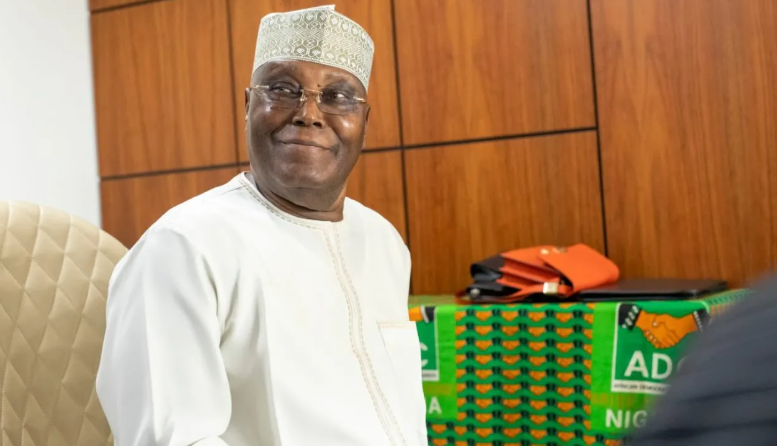
A former Lagos State APC spokesman, Seye Oladejo, has criticized former Vice President Atiku Abubakar over his reported promise to restore fuel subsidy if elected president in 2027.
Oladejo, in a statement on Saturday, questioned the consistency of the African Democratic Congress, ADC, presidential candidate’s position on fuel subsidy, recalling his previous support for its removal.
According to the APC chieftain, Atiku had during the 2023 presidential election campaign described subsidy removal as inevitable and supported the policy.
He therefore challenged the former vice president to explain why he now favored restoring the subsidy if he previously considered its removal necessary.
“There is a point at which political criticism ceases to be constructive opposition and becomes a comedy of contradictions,” Oladejo said. “Former Vice President Atiku Abubakar may have crossed that line with his latest position on fuel subsidy.”
Oladejo argued that if Atiku’s objection was not to subsidy removal itself but to the manner in which the policy was implemented, he should provide Nigerians with details of the alternative approach he intends to adopt.
He said a policy as significant as fuel subsidy should not be treated as an electoral slogan that could be reversed depending on political circumstances.
According to him, Nigerians deserve clarity about the economic philosophy behind major policy proposals, particularly those with direct consequences for household incomes and the national budget.
Oladejo acknowledged that the removal of fuel subsidy had caused significant hardship, particularly through higher transportation costs and increased pressure on household finances.
Also Read: Atiku’s fuel subsidy policy provokes backlash
He, however, cautioned against returning to what he described as an unsustainable subsidy regime that placed considerable pressure on government finances.
“Let us be clear: the removal of fuel subsidy has imposed real hardship on Nigerians. No responsible government should pretend otherwise,” he said. “But acknowledging the pain should not compel us to romanticize the old system.”
The APC chieftain maintained that Nigeria could not indefinitely devote scarce public resources to keeping fuel prices artificially low while critical sectors such as infrastructure, education, healthcare and security required greater investment.
He credited President Bola Tinubu with taking what he described as a politically difficult decision by ending the subsidy regime in 2023, saying leadership sometimes required taking difficult decisions rather than pursuing only popular choices.
Oladejo, however, stressed that the government must remain accountable for the additional resources generated by the reform and ensure that Nigerians could see tangible benefits.
“The removal of subsidy created fiscal space. Nigerians have every right to demand that the resulting resources translate into tangible improvements in their lives,” he said. “More revenue must mean more development.”
He also called on state and local governments to demonstrate that increased allocations were being converted into better infrastructure and social services at the grassroots.
Oladejo urged the Tinubu administration to strengthen transparency, communication and implementation of its economic reforms, saying public support for the policies would ultimately depend on their impact on citizens.
“Reforms cannot survive indefinitely on the strength of economic theory. They must ultimately be justified by results,” he said.
The APC chieftain further challenged Atiku to provide details of his proposed subsidy restoration, including the estimated cost, source of funding and measures that would be put in place to prevent abuse and leakages.
He said the 2027 presidential election should focus on competing policy ideas, credibility and the capacity of candidates to deliver on their promises rather than proposals designed primarily to exploit public frustration.
Oladejo urged all presidential candidates to present Nigerians with realistic programmes and practical implementation plans, stressing that political leaders should tell citizens not only what they want to hear but also what the country needs to hear.
NAN