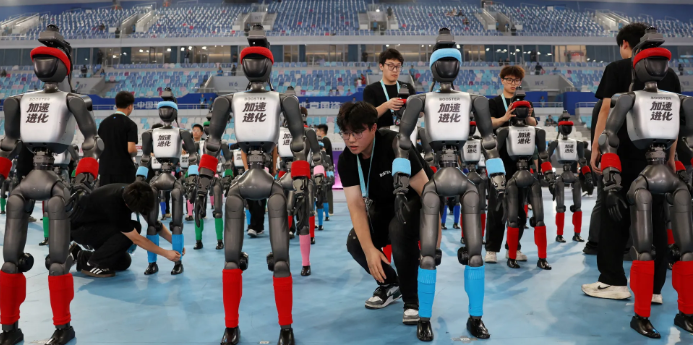
A Chinese humanoid robot has made history after running 100 metres in 9.39 seconds at the World Humanoid Robot Games in Beijing, beating Jamaican sprint legend Usain Bolt’s 9.58-second human world record.
Tiangong Ultra, developed by the Beijing Humanoid Robot Innovation Center, achieved the feat during a preliminary heat on the opening day of the second edition of the games.
Bolt has held the men’s 100-metre world record since running 9.58 seconds at the 2009 World Athletics Championships in Berlin.
In Beijing, Tiangong Ultra initially fell behind another humanoid robot, Lightning, developed by Chinese smartphone maker Honor. It eventually overtook its rival near the finish line to win the heat in 9.39 seconds.
Lightning also finished inside Bolt’s human record, crossing the line in 9.47 seconds. The race, however, demonstrated that the robots still have significant challenges when it comes to stopping. After completing the sprint, both machines crashed into a thick safety mat designed to bring them to a halt.
Tiangong Ultra stumbled towards the sidelines, forcing spectators and officials to move out of its path, while Lightning collapsed and had to be carried away on a stretcher.
Despite the dramatic finishes, the performances represented a major improvement from last year’s inaugural World Humanoid Robot Games. Tiangong Ultra won the 100-metre event in 21.50 seconds during the first edition, meaning its latest official race time was more than 12 seconds faster.
Earlier on Saturday, Chinese state media reported that Honor’s Lightning had recorded an even faster time of 9.32 seconds during a preparatory test, reaching a peak speed of 14.5 metres per second. However, that was a test run rather than the official race result.
Also Read: Usain Bolt reveals struggles with life after sprinting
The 100-metre sprint is only one of dozens of events being contested at the World Humanoid Robot Games in Beijing.
The competition features humanoid robots taking part in activities including football, boxing, table tennis, dancing, martial arts and other sporting and industrial challenges.
More than 2,000 robots from hundreds of teams are participating, highlighting China’s growing ambitions to become a global leader in humanoid robotics.
The progress is not limited to sprinting. Lightning also won a humanoid robot half-marathon earlier this year, finishing in 50 minutes and 26 seconds, a performance reported to be faster than the pace of the human men’s world record.
The games come as China continues to invest heavily in artificial intelligence, robotics and advanced manufacturing.
The country has identified humanoid robots as a strategic industry, with companies developing machines designed for industrial, commercial and entertainment applications.
The World Humanoid Robot Games provide a public platform for companies and research institutions to demonstrate improvements in robots’ speed, balance, movement and physical coordination.
However, the robots’ impressive athletic performances do not mean they can outperform humans in every area. Experts note that completing a controlled sporting task on a prepared course is considerably different from operating independently in unpredictable real-world environments.
The Beijing competition nevertheless marks another milestone in the rapid development of humanoid robots, with machines increasingly capable of performing physical tasks once considered exclusive to humans.
For now, Usain Bolt remains the fastest human over 100 metres with his 9.58-second record. But in Beijing, a machine has officially run the distance faster — opening a new chapter in the race between human athletic achievement and robotic technology.
BBC