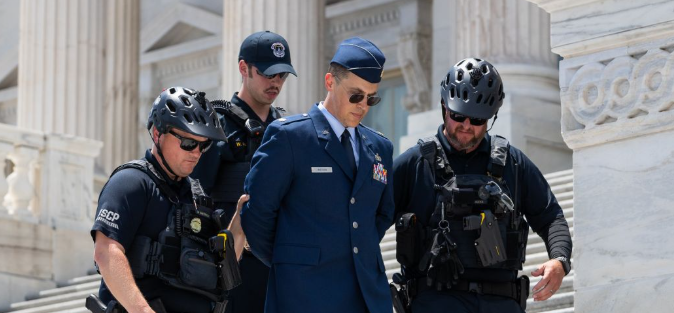
US Air Force Maj. Jason Watson has been formally charged under the Uniform Code of Military Justice, UCMJ, over remarks about President Donald Trump and alleged violations of military orders.
Watson faces 10 charges: three counts under Article 88 for allegedly making “contemptuous” remarks about Trump, five under Article 92 for allegedly disobeying orders and two under Article 133 for alleged conduct unbecoming an officer. The charges stem from his public criticism of Trump, including a protest in uniform at the US Capitol.
The rare Article 88 charges are linked to a June interview with the Defenders of Our Republic Substack newsletter, Watson’s July 1 protest at the US Capitol and an August 17 interview with CNN.
Under the UCMJ, military personnel can face disciplinary action for participating in overtly partisan political activities while in uniform or for using “contemptuous words” against the president and certain other senior civilian officials.
Lower-level violations of these rules are often handled administratively, but Watson’s case has attracted significant attention because of his public profile.
Watson was first arrested in July while protesting in uniform at the US Capitol. He was arrested again last week, days after criticizing Trump during his CNN interview.
One of Watson’s attorneys, Chris Mutimer, told CNN that his client had been ordered into pretrial confinement, an action that is broadly comparable to being denied bond in civilian court.
During the interview with Erin Burnett, Watson said: “Not only is Trump a failure as president, he is flagrantly violating the Constitution, breaking the law, engaged in rampant corruption, and is killing Americans. And that is unacceptable to me.”
In July, Air Force Secretary Troy Meink said in a social media post that he expected all airmen to comply with laws and policies governing personal conduct, political participation and the wearing of military uniforms. “Americans place their trust in us,” Meink said. “We cannot, and will not, compromise the trust of the nation.”
The Article 92 charges allege that Watson violated Defense Department regulations prohibiting service members from speaking in support of partisan causes.
They also allege that he wrongfully wore his uniform during a Capitol press conference, violated leave regulations by travelling to Washington, DC, and refused to wear his uniform to work the morning after his CNN interview.
Air Force prosecutors further allege that Watson’s Capitol protest and interview amounted to conduct unbecoming an officer under Article 133.
Also Read: Trump threatens Oman over Hormuz talks
“He truly believes in everything about our Constitution and what it represents, and the oath that he swore, and he stands by the fact that he did this so others wouldn’t have to, and to share that to anyone who’s scared and feels alone,” Mutimer said.
Jessica Denson, founder of the Removal Coalition, which organized the July protest, said Watson was aware of the potential consequences of his actions and had contacted the organization by email.
“We started having conversations and took this desire that he had to come out very seriously and thought about the best way to make his sacrifice worth it,” Denson told CNN at the time.
Courts-martial resulting in convictions for contemptuous remarks against senior officials are rare. A review found only two such convictions since the modern UCMJ was enacted in 1951.
In 1965, Army Lt. Henry Howe was convicted after participating in an off-base protest against the Vietnam War in El Paso, Texas.
He was sentenced to dismissal from the service — the equivalent of a dishonorable discharge for an officer — and one year in the military prison at Fort Leavenworth, Kansas. Defense Secretary Robert McNamara later granted Howe parole, ending his sentence early.
The most recent Article 88 conviction came in 2021, when former Marine Corps Lt. Col. Stuart Scheller pleaded guilty to contempt of officials and other charges over a series of social media videos criticizing the Biden administration’s handling of the US military withdrawal from Afghanistan.
Scheller, who was held in the brig before his trial, was sentenced to forfeit $5,000 in pay and resigned from the Marine Corps without a pension under a plea agreement.
The Trump administration later appointed Scheller as a senior adviser to the Pentagon’s undersecretary for personnel and readiness.
Frank Rosenblatt, a retired Army judge advocate and associate law professor at Mississippi Christian University, told CNN that the standard for determining what constitutes “contemptuous” speech under Article 88 is not precisely defined in guidance available to military judges and panel members.
Rosenblatt said remarks must amount to “insulting, rude, and disdainful conduct” or otherwise disrespectfully attribute to another person a quality of “meanness, disreputableness, or worthlessness.”
He said a pretrial hearing, known as an Article 32 proceeding, could be necessary to determine whether Watson’s statements instead constitute truthful or fair criticism of the president.
It remains unclear whether Watson’s case will be referred to trial or whether it would proceed as a special or general court-martial.
Special courts-martial are broadly comparable to misdemeanor proceedings, while general courts-martial can impose more severe penalties.
CNN