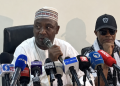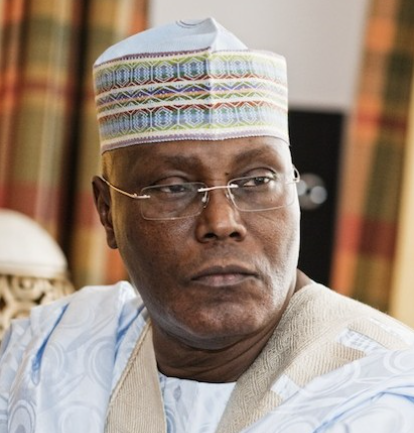
Former Vice-President and African Democratic Congress, ADC, presidential candidate Atiku Abubakar has accused those in power of “stealing” Nigeria’s economy and reiterated his pledge to restore fuel subsidy if elected president in 2027.
Atiku made the remarks in a video shared on his social media platforms while addressing supporters amid an escalating political debate over the removal of petrol subsidy and the economic reforms of President Bola Tinubu’s administration.
“We are competing with thieves. They stole the election. Now they have stolen the economy. They have stolen everything,” Atiku said.
His comments came as he sought to clarify his position on petrol subsidy after remarks attributed to one of his media aides, Paul Ibe, suggested that an Atiku administration would restore the subsidy temporarily and eventually phase it out.
Atiku rejected that characterization, saying Ibe was not speaking on his authority and insisting that his position was to restore the subsidy.
“So many Nigerians have been calling me to say that one of my aides had contradicted me in my policy statement as far as subsidy is concerned,” he said.
“I want to repeat categorically that what I said is I will return subsidy. Nigeria is rich enough to look after the welfare of its citizens.”
He argued that the removal of petrol subsidy had increased economic hardship and pushed more Nigerians into poverty, maintaining that the primary responsibility of government was to protect the welfare of citizens.
“Let it be clearly stated that he was not speaking on my own authority because the removal of subsidy has driven more Nigerians into poverty than at any other time,” Atiku said.
The former vice-president also pledged to prioritize national security, saying, “Two, I will make sure we secure this country.” The disagreement over Ibe’s comments has exposed an important distinction in Atiku’s proposed energy policy.
In a statement issued by his Senior Special Assistant on Public Communication, Phrank Shaibu, Atiku’s camp said the former vice-president was not proposing a return to the previous import-dependent subsidy regime.
Instead, the campaign said his proposal would involve a targeted, capped and transparently budgeted intervention focused on supporting domestic refining and production.
It said the mechanism would be independently audited and would contain conditions for reducing government support as domestic refining, supply stability and competition improve.
Ibe had earlier suggested that the intervention would give Nigerians and businesses room to recover before being gradually removed.
Atiku’s subsequent clarification, however, indicated that there would be no predetermined date for ending the proposed intervention.
Also Read: Atiku’s subsidy pledge is ‘outright deception’ – Shehu Sani
Atiku has linked the proposal to the wider cost-of-living crisis, arguing that higher petrol prices feed into transportation costs, which in turn affect food prices and household expenses. “When fuel rises, transport rises. When transport rises, food rises. When food rises, families suffer,” he said.
He said his objective would be to reduce production and transportation costs, support domestic production and improve the purchasing power of Nigerians.
Responding to Atiku’s pledge last week, Tinubu described the proposal as evidence of “serious ignorance on governance and economy.”
Speaking at the State House in Abuja while receiving Osun State Governor Ademola Adeleke, Tinubu said that 27 states were struggling to meet salary and pension obligations before he assumed office.
He argued that rather than returning to fuel subsidies, government resources should be channelled into roads, housing, education, healthcare and other public services.
The Federal Government has also cited the fiscal benefits of subsidy removal. Finance Minister and Coordinating Minister of the Economy Taiwo Oyedele said in August that the removal generated ₦15.8 trillion in resources for the Federation between June 2023 and December 2025.
He clarified that the figure represented resources mobilized through subsidy savings and was not a separate credit labelled “subsidy savings” in the Federation Account.
The subsidy debate has remained one of the most contentious aspects of Nigeria’s economic reforms. The World Bank previously warned that the removal of the subsidy would temporarily increase inflation, while noting that eliminating the costly subsidy could reduce fiscal pressures.
Its 2023 assessment also projected that the combined effect of higher inflation and weak economic growth would increase the number of Nigerians living in poverty.
More recent assessments have acknowledged improvements in Nigeria’s fiscal position while noting that elevated inflation and the cost-of-living crisis continue to weigh on households.
The World Bank reported that macroeconomic reforms had helped stabilize parts of the economy but that high inflation remained a significant challenge.
The Tinubu administration has maintained that the reforms were necessary to prevent a deeper fiscal crisis, while opposition politicians, including Atiku, have argued that the immediate burden of the policies has fallen disproportionately on ordinary Nigerians.
Atiku’s renewed subsidy pledge is therefore likely to remain a major issue as political parties prepare for the 2027 presidential election.
His latest comments seek to position the proposed intervention as a means of easing living costs while supporting domestic production, whereas the Tinubu administration maintains that returning to subsidy would undermine the fiscal gains achieved since 2023.
For Atiku, however, the central argument remains that government must prioritize the welfare and purchasing power of Nigerians, with subsidy restoration forming part of his broader promise of economic and physical security.
Daily Trust