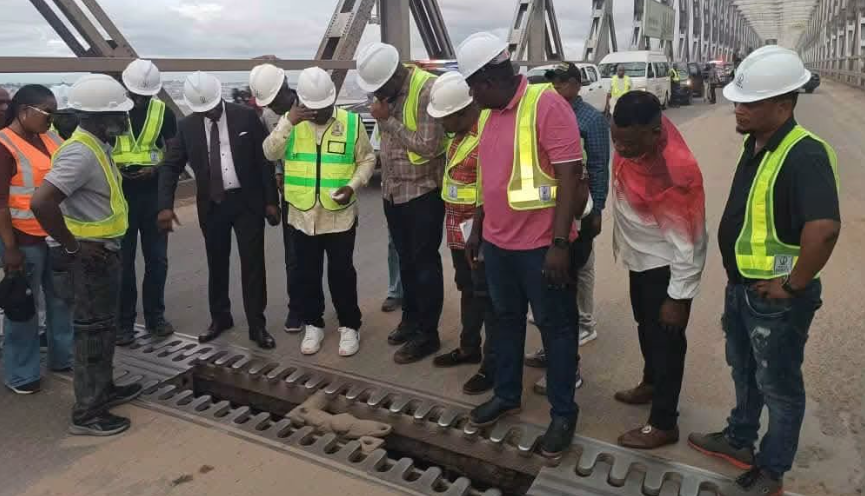
The Federal Ministry of Works is temporarily closing the First Niger Bridge in Onitsha to motorists from Monday to enable engineers conduct emergency maintenance and rehabilitation works.
The two-week intervention follows concerns over the deteriorating condition of the bridge’s carriageway and the vandalization of some structural components, with the ministry directing motorists and other road users to use the Second Niger Bridge through Obosi and Asaba, Delta State, during the closure.
The Acting Federal Controller of Works in Anambra, Mr Timothy Emenike, disclosed the planned closure in an interview with the News Agency of Nigeria in Awka on Friday.
Emenike urged motorists, commuters and other road users who ordinarily use the First Niger Bridge to take note of the closure and make alternative travel arrangements to avoid disruptions.
According to the ministry, the decision follows a recent inspection of the bridge by the Minister of Works, David Umahi, who expressed concern about its condition and directed the immediate commencement of emergency maintenance and rehabilitation works.
Emenike said the intervention is necessary because of deterioration on the bridge, particularly the carriageway surface, as well as damage to some of its components through vandalization.
The affected components include portions of the expansion-joint steelwork and nuts and bolts on the bridge’s stanchions and steel trusses.
The damage has raised concerns about the condition and safety of the infrastructure, prompting the emergency intervention.
The contractor handling the Km 0+000 to Km 20+000 section of the Onitsha-Enugu Dual Carriageway, SKECC, has been directed to undertake the emergency works on the bridge.
Also Read: NDDC begins work to fix 15.4km Benin-Sapele road
The planned rehabilitation will include milling and removing the deteriorated asphalt surface before laying an approximately 40-millimetre asphalt wearing course. Associated maintenance and safety works will also be carried out.
The ministry also plans to install solar-powered streetlights and closed-circuit television cameras on the bridge. The surveillance equipment is expected to strengthen monitoring and help deter further vandalization of critical bridge components.
The ministry said traffic diversion arrangements, road signs, safety barriers and traffic-control personnel would be deployed to guide motorists and construction workers and ensure safer movement around the affected areas.
Motorists have also been advised to obey temporary traffic signs and diversion instructions, reduce speed around construction and diversion zones, avoid reckless overtaking and follow directions from traffic-control personnel and security agencies.
They are further encouraged to allow additional travel time and plan their journeys ahead of the closure, particularly because the First Niger Bridge is a major route for commercial and private traffic between the South-East and other parts of the country.
Emenike said the maintenance activities would be carried out during the day and at night to accelerate completion and minimize the period of disruption.
The Federal Ministry of Works said the intervention is intended to restore a safe, smooth and durable riding surface, improve the bridge’s motorability and ease traffic difficulties around the First Niger Bridge axis.
The ministry acknowledged that the closure would cause inconvenience to motorists, commuters, businesses and other road users but said the intervention was necessary in the public interest.
It appealed to motorists and other stakeholders to cooperate with traffic-management authorities and comply with diversion arrangements throughout the two-week period to facilitate the speedy completion of the works.
If the scheduled timeline is maintained, the First Niger Bridge is expected to reopen to traffic on Monday, Sept. 21, 2026.
Voice of Nigeria