The United States-led international military coalition is set to conclude its mission in Iraq by September 30, marking a major transition in the country’s security relationship with Washington and raising questions about Baghdad’s ability to manage its security independently.
Lieutenant General Abdul Amir al-Shammari, director of the Office of the Commander-in-Chief of the Armed Forces, confirmed the date in a statement to the Iraqi News Agency on Monday, saying September 30 would mark the end of the international coalition’s military mission in Iraq and the beginning of a new phase of relations and cooperation between Baghdad and the coalition members.
The announcement followed an earlier confirmation by Iraqi Prime Minister Ali al-Zaidi’s security adviser, Qasim al-Araji, that the US-led coalition would complete its mission in the country this month.
The planned exit is part of a 2024 agreement between Baghdad and Washington that set out a timetable for ending the coalition’s military mission in Iraq.
The withdrawal also includes the removal of US air defence systems stationed in Erbil, the capital of Iraq’s autonomous Kurdish region.
The systems have played an important role in intercepting Iranian ballistic missiles and drones targeting the region amid the ongoing conflict involving the United States, Israel and Iran.
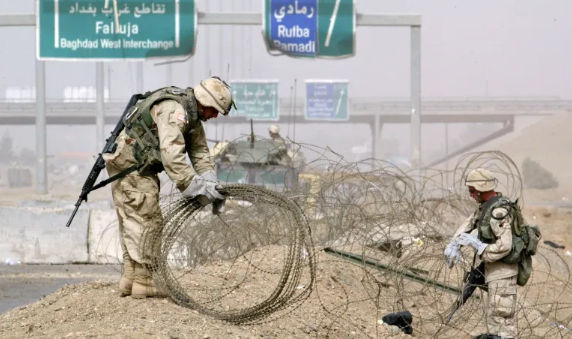
Iraq has experienced a long and turbulent relationship with US military forces. American troops led the 2003 invasion of Iraq, an intervention that was followed by years of conflict and civil unrest.
After US forces withdrew in 2011, they returned in 2015 as part of an international coalition established to fight the ISIL, ISIS, armed group.
The Iraqi government has described the end of the coalition’s military mission as an important step towards restoring the country’s full sovereignty.
The prime minister’s office said September 30 would be the fixed and final date for ending the military mission of the Global Coalition to Defeat ISIS in Iraq and completing the departure of its forces.
It said October 1 would mark a new phase for the Iraqi state, describing the absence of foreign military forces as an important condition for Iraq to move towards development and prosperity.
However, analysts say the practical significance of the withdrawal may be more limited than the political symbolism suggests.
Also Read: Iraqi PM calls emergency meeting after US-Saudi strikes
Iyad al-Anbar, a political science professor at the University of Baghdad, described the withdrawal as largely a formality.
He said the concentration of US forces in Iraq had already been significantly reduced, with much of the remaining presence centred around Harir base in Erbil.
According to al-Anbar, American troops have already left several locations where they previously maintained a military presence, including Camp Victory near Baghdad airport and other support facilities.
He therefore argued that the September 30 deadline would largely represent the formal conclusion of a process that has been underway for some time.
Despite the planned departure of foreign troops, Iraq continues to face major domestic security challenges.
One of the most important issues confronting the government is its effort to bring weapons held by non-state armed groups under state control.
Prime Minister al-Zaidi recently reiterated a deadline for non-state armed groups to disarm or potentially face terrorism-related charges.
Al-Anbar said the government’s insistence on maintaining the September 30 deadline was closely linked to questions of credibility and public trust.
He noted that discussions had increasingly shifted towards how weapons would be “regulated”, but said the precise mechanism for achieving this remained unclear.
He also pointed to increasingly strong rhetoric from armed political groups, including Kataib Sayyid al-Shuhada, Harakat al-Nujaba and Kataib Hezbollah.
The ability of the Iraqi government to manage security after the coalition’s departure could also be affected by vacancies in key positions within the defence and interior ministries. Al-Anbar said the two ministries were central to the government’s plans to restrict weapons to the state.
Their capacity to coordinate security policy and enforce government decisions will therefore be closely watched as Iraq enters the post-coalition phase.
The challenge for Baghdad is not simply to end the presence of foreign troops but to ensure that the state has sufficient authority and capacity to maintain security across the country.
The departure of US troops does not necessarily signal a complete American disengagement from Iraq. Former US diplomat Marlin Hardinger said Washington was likely to maintain a security relationship with Baghdad through residual counterterrorism and intelligence activities.
He said some of these efforts could continue around the US embassy and consulate, even after the formal military mission ends.
Hardinger also suggested that the Trump administration could place greater emphasis on economic and development cooperation, potentially giving Iraq greater economic benefits while strengthening the position of its prime minister.
The withdrawal could appeal to supporters of President Donald Trump’s America First approach, who have long advocated reducing US military involvement in overseas conflicts.
However, the move could also concern some US allies in the Middle East, particularly amid continuing tensions involving Iran, Israel and the United States.
Hardinger warned that groups supporting stronger US involvement in the region could view the withdrawal negatively.
He also said Gulf states could face additional concerns if the security situation deteriorates or terrorist organisations exploit any emerging gaps.
According to him, the region is now more unstable and turbulent than it was when negotiations over the withdrawal of US forces began.
The planned removal of US Patriot missile batteries has also raised questions about Iraq’s ability to defend its airspace against external threats.
Hassan al-Barari, an international relations professor at the University of Jordan, said northern Iraq could become particularly vulnerable if Iran continues to launch missiles and drones towards Erbil.
He questioned who would intercept such attacks if the American Patriot systems and interceptor missiles were withdrawn.
Al-Barari also said Iraq’s current capabilities may not be sufficient to protect its airspace against a sustained external missile and drone threat.
Ultimately, the success of Iraq’s transition will depend largely on the government’s ability to address its domestic security challenges while maintaining control over the country’s territory and weapons.
Al-Barari said Iraq’s sovereignty was not dependent solely on the departure of American forces but also on the government’s ability to ensure that weapons were controlled by the state.
He warned that failure to achieve this could create a dangerous security vacuum and potentially increase Iranian influence in Iraq.
The end of the coalition’s military mission therefore represents both an opportunity and a significant test for Baghdad as it seeks to strengthen its sovereignty while navigating a volatile regional security environment.
Al Jazeera