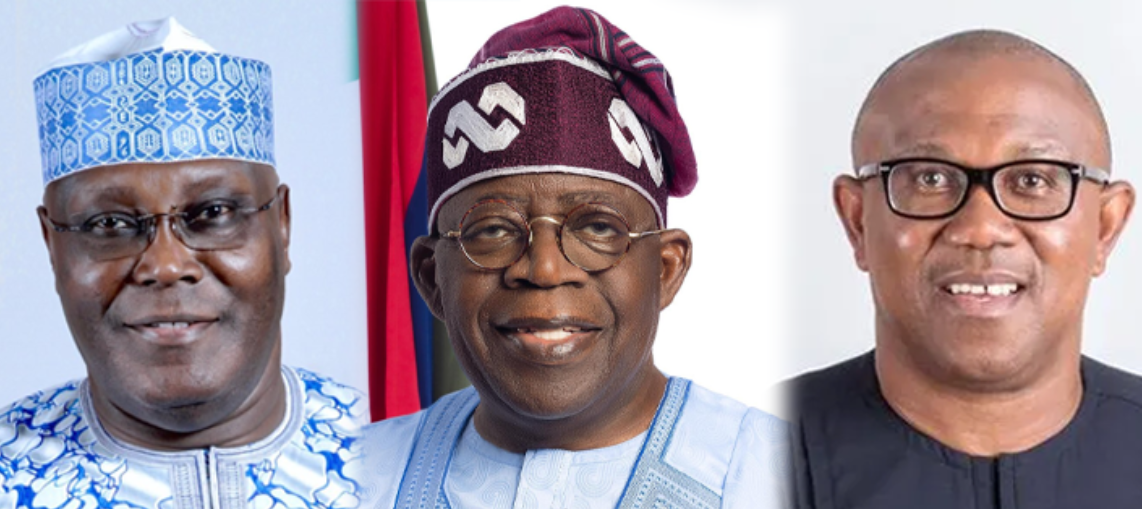
President Bola Tinubu leads Peter Obi by 1,067 responses in the Oxford–Metro Analytics National Trust Poll, which closed on September 7.
The poll recorded 69,110 approved and unflagged responses in its final analytical dataset, with Tinubu receiving 24,469 responses, representing 35.41 per cent of the total.
Obi polled 23,402 responses, or 33.86 per cent, while former Vice-President Atiku Abubakar came third with 18,430 responses, representing 26.67 per cent.
Tinubu’s margin over Obi translates to approximately 1.54 percentage points, although the poll’s regional distribution suggests a significantly different electoral map from the outcome of the 2023 presidential election.
Tinubu, who won 12 states in the 2023 presidential election, leads in 20 states and the Federal Capital Territory in the online poll. Obi and Atiku record the highest number of responses in eight states each.
The strongest shifts are recorded in parts of Northern Nigeria, where the poll indicates increased support for Tinubu.
Tinubu leads in Kaduna, Katsina and Gombe, states won by Atiku in the 2023 presidential election. He also leads in Kano, where the New Nigeria Peoples Party candidate, Rabiu Kwankwaso, won the presidential vote in 2023.
At the geopolitical-zone level, Tinubu leads in the South-West, North-West and North-Central. Obi records his strongest performances in the South-East and South-South, while Atiku leads in the North-East.
In the South-West, Tinubu receives 10,968 responses, representing 43.53 per cent of the region’s total participation. He also leads in the North-West with 4,129 responses, accounting for 43.10 per cent of responses from the zone. In the North-Central, Tinubu secures 6,370 responses, representing 36.97 per cent of the regional total.
Obi’s strongest regional performance comes from the South-East, where he receives 5,796 responses, representing 63.97 per cent of participation in the zone.
The Labour Party candidate also leads in the South-South with 2,389 responses, accounting for 41.48 per cent of participants in the region.
Also Read: INEC posts final list of presidential contenders
Atiku dominates the North-East, where he receives 1,235 responses, representing 55.46 per cent of the region’s total.
Despite Tinubu’s wider geographical spread, the national contest remains close between the leading candidates, with only 1,067 responses separating Tinubu and Obi.
Some state-level contests are considerably tighter than the broader regional figures suggest. In Kogi, for instance, Tinubu receives 39 responses, Atiku 38 and Obi 33 out of 110 responses recorded.
The one-response difference between Tinubu and Atiku highlights the need to consider the relatively small participation base when interpreting the figures.
In the FCT, Tinubu secures 5,599 responses against Obi’s 5,278, giving him a lead of 321 responses, while Atiku receives 3,954.
In Rivers, Tinubu polls 975 responses, compared with 892 for Obi and 568 for Atiku, leaving an 83-response margin between the two leading candidates.
Beyond the three leading candidates, Omoyele Sowore receives 1,016 responses, followed by Seyi Makinde with 519 and former President Goodluck Jonathan with 284. Anita Zugwai-Chukwu receives 18 responses, Sandy Onor records six, while Prince Kennedy Ahanotu gets two.
Another 638 participants select the option, “I Do Not Trust Any Candidate Yet,” while 204 respondents are undecided and 122 select “Other Candidate.”
The distribution shows that leading the overall tally does not necessarily translate into dominance across every geopolitical zone or state.
Tinubu’s national lead and dominance across three geopolitical zones contrasts with Obi’s strength in the South-East and Atiku’s lead in the North-East.
However, participation is heavily concentrated geographically, with Lagos and the FCT alone accounting for 54.44 per cent of all responses. The final dataset also contains 56 diaspora responses, which are excluded from the six domestic regional tallies.
The Conclave