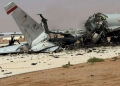
A Pentagon watchdog report has revealed that the United States suffered significant military and infrastructure losses during its conflict with Iran, including the destruction or damage of dozens of aircraft and hundreds of buildings and structures.
The report, published by the US Department of Defense inspector general, provides the first official account of the losses incurred by Washington during the conflict from February 28 to June 30.
It also acknowledges shortages in US munitions and supply-chain bottlenecks, contradicting repeated claims by President Donald Trump that the country has virtually unlimited ammunition and is producing weapons at unprecedented levels.
According to the report, the US Department of Defense recorded at least 11 military personnel killed in action and seven deaths classified as resulting from non-hostile events during the conflict.
At least 417 US military personnel were also wounded in Iranian attacks through June 30. Some of the deaths occurred during attacks on US-linked facilities in Kuwait, Saudi Arabia, Jordan and Iraq.
The report also recorded deaths from separate military aviation accidents, including the crash of a KC-135 tanker in Iraq on March 12 and an MH-60S helicopter crash in the Arabian Sea on July 1.
The losses covered a wide range of American military aircraft, from fighter jets and attack aircraft to aerial-refuelling tankers, surveillance platforms and helicopters.
Also Read: Iran, Gulf states delay Hormuz talks amid Yemen crisis
Among the aircraft listed in the report are:
F-15E: At least four aircraft were destroyed. Three were lost to friendly fire over Kuwait on March 1, while another was shot down during combat over Iran in April. All aircrews were recovered.
F-35A: At least one of the US military’s advanced stealth fighters sustained damage from Iranian fire in March.
A-10: At least one ground-attack aircraft was shot down by Iranian fire.
KC-135: At least seven aerial-refuelling tankers were damaged or destroyed. One crashed in Iraq, killing all six crew members, while others sustained damage from Iranian missiles and drones.
E-3 Sentry: At least one airborne early-warning aircraft was damaged at Saudi Arabia’s Prince Sultan airbase.
HH-60W: At least one rescue helicopter sustained damage during a combat search-and-rescue operation.
MQ-4C Triton: At least one high-altitude surveillance aircraft crashed in April.
AH-6: Four small helicopters were destroyed after being deemed unrecoverable during a combat search-and-rescue operation in Iran.
AH-64 Apache: At least one attack helicopter was shot down near the Strait of Hormuz on June 8.
MH-60S: At least one Navy helicopter crashed in the Arabian Sea on July 1.
MQ-9 Reaper: As many as 30 long-endurance armed drones were destroyed.
Iranian authorities have claimed responsibility for additional attacks on US surveillance and combat drones near the Strait of Hormuz.
Tehran has also claimed to have captured a US unmanned underwater vehicle, the Dive-LD. The Pentagon report, however, focuses on losses and damage officially recorded by US authorities.
The report also confirms that Iranian attacks damaged or destroyed hundreds of buildings and structures at US military installations across Kuwait, Bahrain, Qatar, the United Arab Emirates, Saudi Arabia, Iraq, Oman and Jordan.
The Pentagon watchdog did not provide a detailed breakdown of the individual structures affected. Previous reports indicated that several US facilities were temporarily shut down or relocated because of Iranian attacks.
American diplomatic facilities in Iraq, Kuwait, Saudi Arabia and the UAE also sustained damage, with the State Department estimating total losses at about $184 million.
The report said the US incurred an additional estimated $24.5 million per month in construction project delays because of ordered departures and travel restrictions affecting several cities, including Baghdad, Jerusalem, Tel Aviv, Cairo, Amman, Kuwait City and Muscat.
The US mission in Iraq faced more than 600 attacks through the end of June, according to the State Department. The attacks resulted in costs of up to nearly $157 million, the report said.
The US Consulate General in Erbil sustained damage to multiple buildings at its new compound, while the US Embassy in Baghdad also suffered damage.
The Baghdad Diplomatic Support Center, located near Baghdad International Airport, sustained extensive damage.
The US Embassy in Kuwait City suspended operations on March 5 because of regional tensions, attacks and damage to embassy facilities. The resulting cost was estimated at nearly $14.75 million.
Two Iranian drones struck the US Embassy in Riyadh on March 3, causing material damage. The State Department estimated the cost of the damage at about $11.5 million.
The US Consulate General in Dubai also suffered damage when a utility building was hit. The State Department estimated the cost at nearly $120,000.
Beyond direct battlefield losses, the Pentagon report highlighted difficulties in maintaining US military logistics across the region.
It said establishing adequate naval bases and support ports presented significant challenges because of uncertainty surrounding host-country access and permissions for fleet resupply.
The Pentagon report also cited CENTCOM’s concerns over shifting logistics support and infrastructure to Diego Garcia, noting that the distance created extended sea-transit times and 14- to 18-day logistics cycles.
The findings highlight the scale of the military, financial and logistical costs Washington incurred during its campaign against Iran, while also exposing pressure on US weapons stocks and regional infrastructure.
Al Jazeera