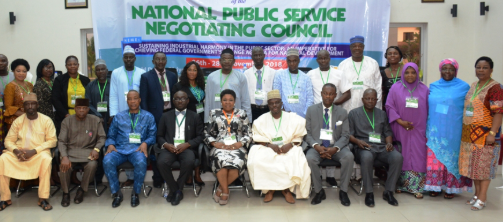
Public sector workers, under the Joint National Public Service Negotiating Council, JNPSNC, Trade Union Side, have given the Federal Government until September 30, 2026, to intervene in the worsening cost-of-living crisis and address rising fuel prices.
In a letter to President Bola Ahmed Tinubu at the State House, Abuja, the council demanded that petrol prices be reduced to N500 per litre, while also calling for a N500,000 minimum wage, immediate wage awards and allowances, and the commencement of negotiations for a new national minimum wage.
The council said rising inflation, petrol prices, transportation costs and the increasing cost of food, housing, healthcare and education had eroded workers’ purchasing power and affected morale and productivity across the public service.
It said petrol prices, which had risen to N1,430 per litre or more in some locations, had intensified the economic hardship and increased the cost of essential goods and services.
The JNPSNC argued that a reduction in petrol prices would have a wider effect across the economy, urging the Federal Government to establish an intervention fund for the oil sector to help stabilize pump prices.
The council said such an intervention would provide broader relief than food palliatives, which it described as unsustainable and inaccessible to many Nigerians.
The council also proposed a minimum salary of N500,000 per month for an officer on Grade Level 01, Step 1, under the proposed 2027 salary structure.
It called for the immediate approval of a wage award and allowances across the public service, describing the wage award as an interim measure ahead of the proposed new national minimum wage expected to take effect in January 2027.
The JNPSNC further urged the government to establish a committee immediately to negotiate the new national minimum wage, saying an early start would help prevent delays in implementation.
It also demanded harmonized wages across Ministries, Departments and Agencies, periodic salary and allowance reviews linked to inflation, subsidized transportation and affordable housing for public servants.
Also Read: NLC fears King’s College concession may trigger wider takeover
The council urged the President to direct the National Salaries, Incomes and Wages Commission to begin discussions with the Nigeria Labour Congress, NLC, Trade Union Congress, JNPSNC and other relevant stakeholders.
It said the measures should be implemented on or before September 30 to ease what it described as growing tension among workers and Nigerians.
The NLC expressed support for the council’s call, saying the surge in petrol prices had increased pressure on workers and households.
Benson Upah, NLC spokesman, said rising fuel prices had triggered increases in transportation costs, rents, school fees and other essential expenses while workers’ salaries remained largely unchanged.
He urged the government to intervene, including by making crude oil available to local refineries in naira, which he said could help reduce the cost of petroleum products.
Political analyst Atah Pine said reducing petrol to N500 per litre would be difficult under the market-based pricing regime introduced after the removal of the fuel subsidy.
Pine said the government could influence workers’ wages through existing institutional mechanisms but could not simply impose a lower petrol price without undermining the principles of the current pricing system.
He advocated increased investment in local refining, including modular refineries, saying greater domestic supply could eventually put downward pressure on petrol prices.
Lab Friday Odeh, Country Director of Accountability Nigeria, also said the proposed intervention amounted to a return to fuel subsidy, regardless of the terminology used.
Odeh estimated that such a subsidy could cost between N4 trillion and N6 trillion annually, depending on production and import volumes, potentially putting additional pressure on government finances.
He, however, said the workers’ wage demand reflected concerns over the erosion of purchasing power and supported the proposal to sell crude oil to local refineries in naira and expand national storage capacity.
The NLC spokesman said the JNPSNC was known to the Congress and was involved in negotiations on allowances for public sector workers.
However, the Association of Senior Civil Servants of Nigeria, Federal Ministry of Education headquarters, distanced itself from the council. Its chairman, Sampson Chigozie Ngadi, said the association was not aware of the group.
Daily Trust