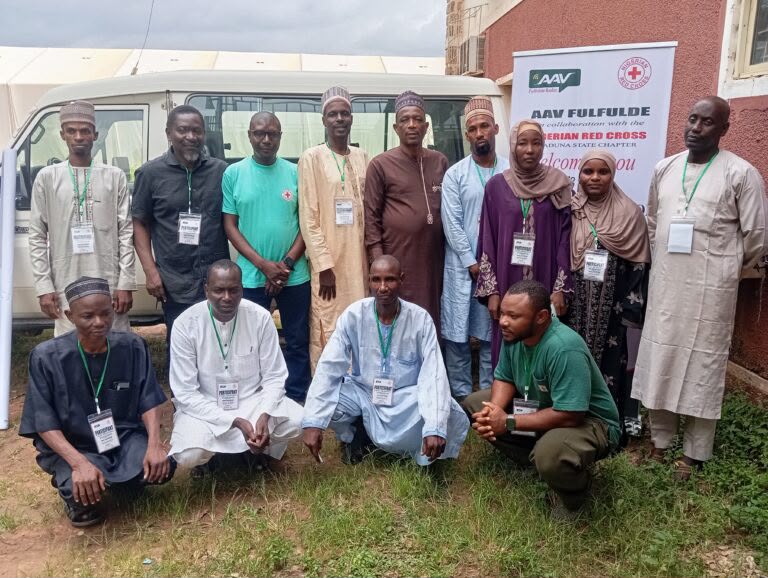
The Nigerian Red Cross Society and AAV Fulfulde Radio have trained media practitioners from five locations on Restoring Family Links to support efforts to reconnect families separated by conflict, displacement and other emergencies.
The two-day training workshop, organised in collaboration with AAV Fulfulde and supported by Borderline Europe and Aynool Adilaaku Vision, focused on ethical and responsible reporting of missing persons, particularly among pastoralist communities.
The training, with the theme “Displaced But Not Defeated: Helping Pastoralists Find Their Missing Loved Ones”, brought together Fulfulde-oriented media practitioners from Kaduna, Adamawa, Taraba, Gombe and the Federal Capital Territory.
Speaking at the event on Tuesday in Kaduna, Administrative Secretary, Nigerian Red Cross Society, Kaduna State Chapter, Muhammad Aminu, urged participants to apply the knowledge acquired to their professional assignments.
Aminu said the training was important because the Red Cross regularly received reports involving missing persons and people separated from their families.
“We receive a lot of reports of missing persons and tracing cases. The knowledge you have gained here is therefore very important and should have an impact on your work.
“I urge all of you to make good use of the knowledge acquired,” he said.
Aminu commended AAV Fulfulde for partnering with the Red Cross to organize the training and appreciated the facilitator, Mr Andrew Dalbe, for his contribution.
Umar Aliyu, Station Manager, AAV Fulfulde, said the organization was the charity arm of African Audiovisual Ltd., a media production and broadcasting company.
Aliyu said the training was designed to equip journalists with skills to support efforts to reconnect families separated by conflict and displacement, with particular attention to herder communities.
He said conflicts often displaced people or separated them from their loved ones, but the experiences of herders were not sufficiently reflected in available stories and statistics.
Aliyu said AAV Fulfulde intended to use its media platforms to support herders in locating missing relatives across Nigeria and neighbouring countries.
“We want to focus specifically on herders, helping them to rediscover or find their loved ones across Nigeria and neighbouring countries.
Also Read: First Lady lifts Red Cross with N100m
“Before you undertake such an assignment, you need to be armed with the right skills and knowledge. Otherwise, you may end up compromising or conflicting with the data,” he said.
Aliyu said the training was also part of preparations for the implementation of a Borderline Europe-supported programme, “Displaced But Not Defeated”.
He said the programme would engage herder communities on resilience, climate change, skills acquisition and opportunities within the livestock value chain.
Aliyu explained that resilience would involve helping herders understand that livestock rearing was not the only livelihood option available to them.
He said they could acquire skills in fodder production, meat processing, transportation and other activities within the livestock value chain.
He also urged journalists to adhere strictly to professional ethics when reporting conflict and other sensitive issues.
“Journalism is a very sensitive profession because our work can either foster or hinder peace.
“We have to be objective, balanced and humane, particularly at a time when we are witnessing divisions along political, religious and ethnic lines,” he said.
Andrea Staritz, a representative of Borderline Europe, in a virtual goodwill message, commended the initiative and expressed hope that the programme would contribute to the reunion of families in the coming months.
She urged participants to apply the knowledge gained and work towards achieving the objectives of the programme.
Aisha Jalo, a participant from Gombe State, said the training had broadened her understanding of how to report stories from ethical and objective perspectives.
Another participant, Adam Jada from Adamawa State, said the training had improved his approach to news reporting.
He said the workshop had equipped him with better skills for producing well-structured and responsible reports.
He also said the training also exposed participants to safety measures journalists should observe when covering sensitive stories.
NAN