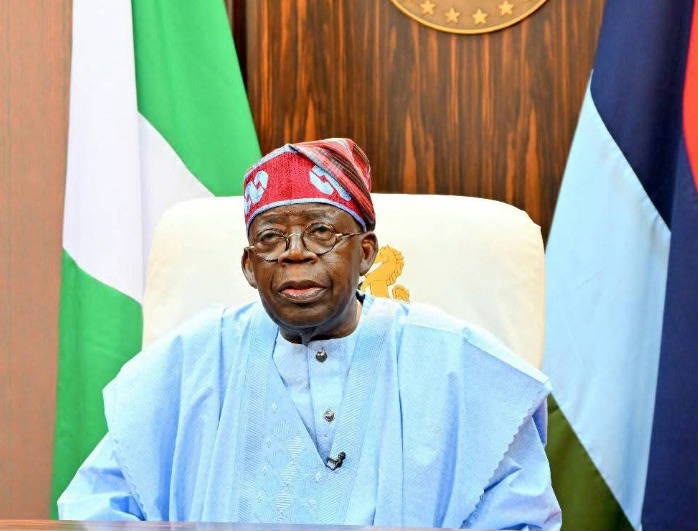
President Bola Tinubu has declared that Nigeria is moving from an era of difficult economic reforms into what he described as an “age of prosperity”, with his administration now focused on reducing living costs, creating jobs and spreading economic opportunities.
Tinubu made the declaration on Thursday in his Independence Day address to Nigerians as the country marked its 66th anniversary.
The President said Nigeria’s journey since independence had been marked by war, military rule, economic crises, insecurity and political upheaval, but maintained that the country had survived because of the resilience of its people.
He said farmers, traders, teachers, entrepreneurs, members of the Armed Forces and security services, among others, had continued to sustain the country through difficult periods.
Tinubu said the promise of independence went beyond raising a national flag, adopting an anthem or gaining recognition among nations.
He said, independence gave Nigerians the freedom to shape their destiny and build a country capable of providing opportunity, dignity and better living conditions.
He said the responsibility of fulfilling that promise now rested with Nigerians.
Why Tinubu defended his reforms
Tinubu said Nigeria’s economic situation had deteriorated significantly before his administration assumed office in 2023, with rising poverty and declining hope forcing the government to make difficult decisions.
He compared the country’s economic condition to a patient diagnosed with cancer who must choose between undergoing painful treatment or using medication that merely suppresses the symptoms.
The President said previous administrations had, in his view, treated the symptoms of Nigeria’s economic problems without addressing their underlying causes.
“For too long, Nigeria’s leaders chose morphine while praying for a miracle that never came,” he said.
Tinubu said his administration instead chose to confront what he described as deep-rooted economic distortions, even though the reforms created significant short-term hardship.
He maintained that the reforms did not create Nigeria’s economic weaknesses but were introduced to address them.
The President also criticized calls to abandon the reforms and return to what he described as unsustainable subsidies.
He urged Nigerians to remember the reasons the reforms were introduced and the progress he said had been recorded since then.
Tinubu cites economic gains
The President said Nigeria’s economic outlook had improved after three and a half years of reforms.
He said the economy had grown by more than four per cent in 2026, with both oil and non-oil sectors contributing to the growth.
Tinubu also cited a reduction in oil theft, a substantial decline in inflation from its peak, rebuilt foreign reserves and greater stability in the foreign exchange market.
He said Nigeria recorded more than $6 billion in non-oil export revenue in 2025, describing it as the highest figure in the country’s history.
“This is real money being made by real Nigerian businesses,” he said.
Tinubu said international observers, journalists, non-governmental organizations and multilateral institutions had recognized improvements in Nigeria’s economic stability and resilience.
He also said rising foreign direct investment showed increasing confidence in the Nigerian economy.
The President declared that the country had reached a turning point, saying the government’s economic priority had changed from correcting the nation’s course to delivering “shared and widespread prosperity.”
Lower cost of living
Tinubu said reducing the cost of living would remain a major priority of his administration.
He said the government would pursue this by reducing the cost of producing and transporting goods.
The President said Nigeria had sufficient land and human resources to feed itself and outlined plans to expand mechanised irrigation and dry-season farming.
He also listed improved access to seeds and fertiliser, greater mechanisation, storage facilities and better transportation among the measures being pursued to strengthen agricultural production.
Tinubu said the government was also building and completing roads, railways and ports to connect farms and factories with markets.
He explained that increased productivity and lower operating costs should eventually translate into cheaper goods for consumers.
Tinubu said, farmers producing at lower costs, reduced post-harvest losses, lower electricity expenses for manufacturers, faster movement of goods and fairer competition would all help reduce market prices.
Also Read: Tinubu vows to build judicial dignity, independence
Jobs, industry and digital economy
Tinubu said prosperity would require more than cheaper goods, stressing the need to create productive employment.
He described Nigeria as a young country with millions of people entering adulthood every year with talent, energy and ambition.
The President said the government’s responsibility was to turn the country’s demographic strength into an engine of production rather than a source of frustration.
He said jobs, enterprise and industrial growth would therefore remain at the centre of government policy.
Tinubu said Nigeria would use its gas resources to power new industries and support businesses seeking to revive factories in major industrial centres.
He also promised to expand digital connectivity to communities that had been left behind by the modern economy.
The government, he said, would invest in skills demanded by employers and support Nigerian businesses with infrastructure and finance.
“I want to see more Nigerians making things,” Tinubu said.
He also expressed his desire to see Nigerian farms feeding cities and supplying factories, while Nigerian businesses sell locally produced goods to international markets.
The President said he wanted young Nigerians to build major technology companies and create employment opportunities within the country.
Poverty and vulnerable Nigerians
Tinubu acknowledged that millions of Nigerians were still struggling with food, school fees, medical bills and transportation costs.
He said their difficulties predated his administration and were the accumulated result of decades of low productivity, inadequate infrastructure, insufficient opportunities and weak institutions.
“We cannot erase in four years what accumulated over generations. But we can change its course,” he said.
The President said his administration would continue building an economy capable of lifting people out of poverty while protecting vulnerable Nigerians during the transition.
He said the government was strengthening direct support for the poorest households and improving the National Social Register to ensure that assistance reaches people who genuinely need it.
NELFUND, CREDICORP and social support
Tinubu also highlighted the Nigerian Education Loan Fund, NELFUND, as part of his administration’s social intervention measures.
He said the scheme was helping children from low-income families pursue higher education despite their parents’ inability to pay tuition and other costs.
The President also cited the Consumer Credit Corporation, CREDICORP, which he said was giving working Nigerians access to consumer credit.
He said the scheme would allow Nigerians to acquire vehicles, solar systems, digital devices and other essential assets without having to save for years before making such purchases.
Tinubu said the Federal Government would continue working with state and local governments to strengthen primary healthcare, basic education and other essential services on which poorer Nigerians depend.
He also said his administration had paid salaries and pensions on time and in full since 2023 and had reformed the national pension programme to benefit retirees and vulnerable citizens.
‘We will defeat poverty’
The President said social programmes were not intended to replace economic prosperity but to serve as a bridge while Nigerians moved towards better living standards.
“These programmes are not substitutes for prosperity. They are a bridge to aid our nation’s citizens on their path towards it,” he said.
“Our objective is not to manage poverty more efficiently. We will defeat it.”
Tinubu acknowledged that eliminating poverty would take time and require sustained economic growth and the creation of millions of productive opportunities.
He nevertheless said the government was undertaking the task from a stronger position because it had corrected what he described as fundamental weaknesses in the economy.
He said the difficult decisions of the reform period had laid the foundation for what he described as lasting prosperity.
‘The age of prosperous
Tinubu said the next phase of his administration should make the benefits of economic reforms more visible in the lives of ordinary Nigerians.
“The age of reform has done its work. Now begins the age of prosperity,” he said.
He said prosperity should mean a Nigeria where farmers could cultivate their land safely, produce more cheaply and earn decent returns.
He also envisioned a country where factories have reliable power, businesses can access credit, young people can find productive employment, food and transportation are affordable and families can approach the future with greater confidence.
The President said the government’s task was to transform economic stability into tangible improvements in the lives of citizens.
He also called for continued national unity and collective effort, saying Nigeria’s future could not be built by government alone.
Tinubu invokes ‘Red Sea’, ‘Promised Land’
Reflecting on the difficulties Nigerians had experienced, Tinubu said the country had passed through its own “Red Sea” and should now focus on the future.
“Nigeria has corrected its course. We have passed through our own Red Sea. This is not the time to look back,” he said.
The President described Nigeria’s destination as a “Promised Land” of abundance and opportunity where prosperity would be broadly shared.
He said the country should become a nation where children could dream beyond the circumstances of their birth and where Nigeria’s enormous potential would be reflected in the everyday lives of its citizens.
“Our destination is in sight. Our foundations are strong. Our direction is clear. So let us go forward. No looking back,” Tinubu said.
He concluded by congratulating Nigerians on the country’s 66th Independence anniversary and called for continued faith in Nigeria and its future.
“Happy Independence Day, my fellow Nigerians. God bless you all, and God bless the Federal Republic of Nigeria,” he said.
NAN