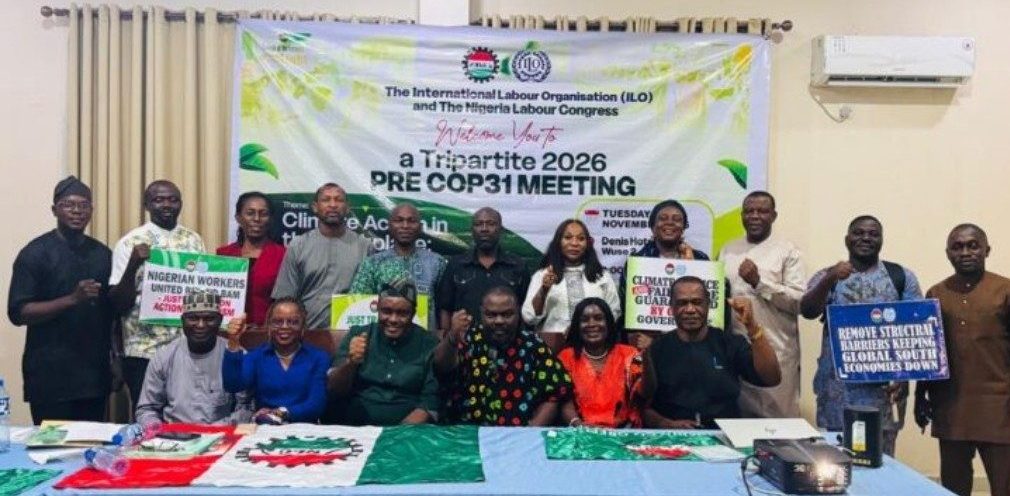
The Nigeria Labour Congress, NLC, has outlined energy sovereignty, fair climate financing and workers’ protection as key priorities ahead of the 31st UN Climate Change Conference, COP31.
The NLC National Coordinator for Climate Change and Just Transition, Eche Asuzu, at the 2026 Tripartite Pre-COP31 meeting in Abuja, said Africa must pursue an energy transition that guarantees affordable electricity, sustainable development and economic independence while ensuring that climate financing does not increase the continent’s debt burden.
“We need energy sufficiency, sovereignty and independence. Energy must also be affordable, accessible and sustainable for communities, workers and businesses.
“Although many African countries have political sovereignty, their energy policies and financing arrangements are still influenced by external interests.
“We must avoid a situation where Africa simply replaces dependence on fossil fuels with dependence on foreign technologies and external financing,” he said.
The NLC coordinator described access to energy as a major development challenge, noting that about 600 million people across Africa still lack electricity.
He explained that unreliable power supply reduces productivity, affects business operations and limits employment opportunities, making energy access both an economic and social development concern.
Also Read: Engineers advocate green cement to fight climate change
Asuzu identified climate financing as another critical priority, emphasising the need to attract sufficient investments for energy infrastructure, technological innovation and renewable energy development.
He listed hydrogen, geothermal, wind, solar and biomass among emerging energy alternatives, stressing that African countries must build their own technological capacity.
The NLC coordinator maintained that negotiations on climate change mitigation must consider the differences between developed and developing nations, particularly their varying levels of industrialisation and economic development.
According to him, developing countries need sufficient opportunities to tackle poverty, unemployment and infrastructure shortages while pursuing climate action and environmental sustainability.
Asuzu recalled that the Dubai Consensus adopted at COP28 stressed that the transition away from fossil fuels must be just, orderly and equitable.
He called on African countries to ensure that their vulnerabilities and development needs receive adequate attention in discussions surrounding the Global Goal on Adaptation, GGA.
“COP31 should advance the GGA framework, particularly the development of indicators for measuring progress in climate change adaptation,” he said.
On loss and damage, Asuzu advocated sufficient funding and effective implementation of the fund to assist countries facing the effects of climate change.
He also urged developed nations to fulfil their commitments under the New Collective Quantified Goal on climate finance, including the proposed mobilisation of 1.3 trillion dollars annually.
“We must distinguish between promises and guaranteed financial commitments.
“We want to know where the money will come from, how it will be mobilised and how developing countries will access it,” he said.
He cautioned that climate financing provided through loans with excessively high interest rates could aggravate the debt crisis facing developing countries, particularly those in Africa.
“Our position is that climate finance should be provided mainly through grants or concessional loans with affordable interest rates,” Asuzu said.
He further called for the implementation of the Just Transition Mechanism adopted at COP30 to ensure its effective integration into the United Nations Framework Convention on Climate Change.
Asuzu emphasised the need for organised labour to be represented in the mechanism, insisting that workers’ involvement in climate policy decisions must be guaranteed.
He added that climate financing should also target workplace emissions, improve working conditions and provide support for employees affected by the shift towards sustainable production.
The NLC coordinator encouraged labour unions to strengthen their advocacy efforts to ensure that climate policies and funding arrangements protect workers and promote decent employment.
He said the congress would continue to defend workers’ interests and ensure that Africa’s development priorities receive adequate consideration during COP31 negotiations.
The ILO National Project Coordinator, Mr Steve Agugua, reaffirmed the organisation’s commitment to workers’ participation, describing their involvement as central to its mandate and climate policy activities.
“Workers are an integral part of the International Labour Organisation, and our work will not be complete without their participation; their voices must shape ILO activities directly,” he said.
Similarly, Ms Rhoda Boateng, a Climate Change Expert with the International Trade Union Confederation, said COP31 would feature thematic discussions on issues such as electrification and green industrialisation alongside the established negotiation tracks.
Boateng noted that African negotiators had encountered resistance in their efforts to promote industrialisation, adding that the new thematic approach offered an opportunity to secure meaningful and consistent outcomes for the continent and its workers.
She disclosed that the Turkish Government was proposing a target to raise global electrification rates to 35 per cent by 2035, urging stakeholders to examine the proposal carefully to safeguard Africa’s interests.
Boateng called on policymakers to incorporate African trade unions’ demands into COP31 resolutions and encouraged greater media participation.
She also described the NLC as an important partner in promoting workers’ interests at the conference.
NAN