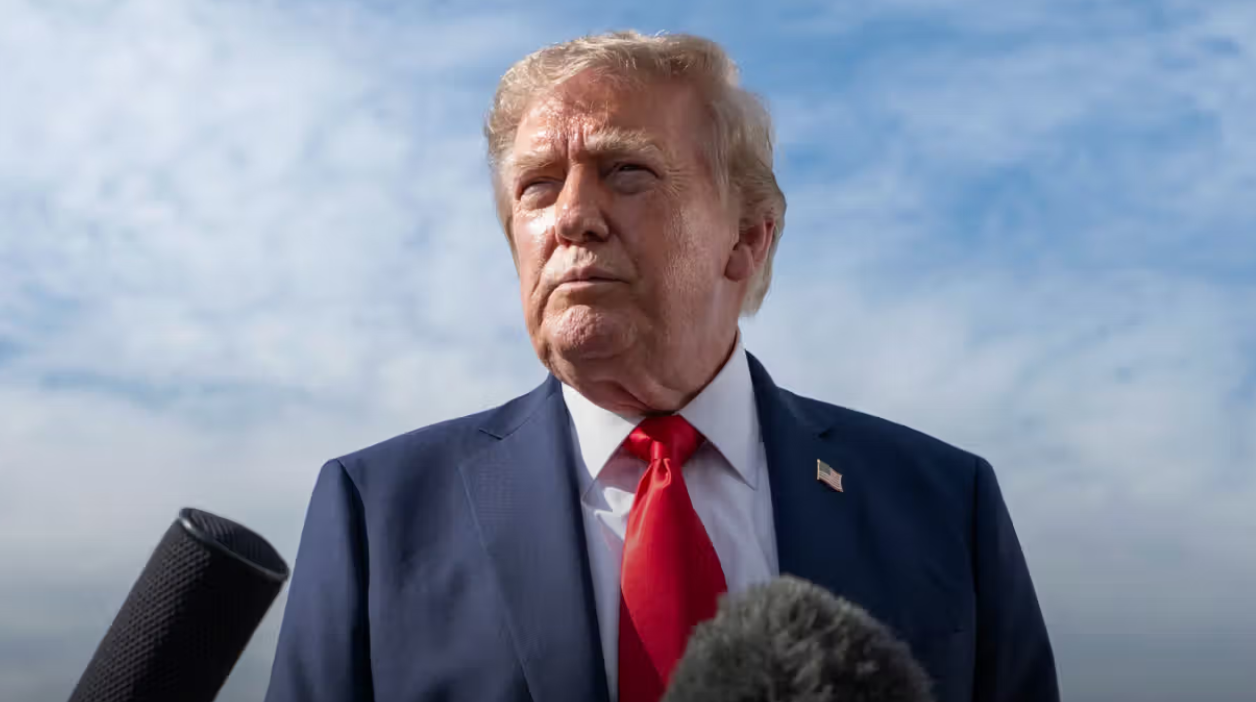
President Donald Trump has said it is “highly unlikely” that the United States will need to resume military action against Iran, provided negotiations over Tehran’s nuclear programme and the reopening of the Strait of Hormuz make progress.
Trump made the remarks during a 20-minute phone interview with CNN’s Jim Sciutto on Sunday, repeatedly expressing confidence that a renewed military confrontation could be avoided while warning that US forces remain prepared to strike if negotiations fail. He said any agreement must contain strong conditions acceptable to Washington.
“It depends on whether or not they sign a very strong agreement,” Trump told CNN, referring to Iran. “The answer is highly unlikely it’s going to be necessary.”
He repeated the assessment several times during the interview, arguing that US military strikes and economic sanctions had significantly weakened Iran’s capabilities.
“They’re a failing nation. It just came out, you saw this year, 301% inflation. Highly unlikely it will be necessary. I would if necessary, but we hit them really hard,” he said.
Trump added that Iran was facing mounting financial difficulties and warned that the US could inflict further military damage if required.
“So it’s highly unlikely I’ll have to. “They’re withering away financially. We’ve hit them militarily. We could finish them off,” he said.
Eight months after the war began, the conflict remains at a stalemate, with limited military activity and little significant diplomatic progress.
Meanwhile, oil tankers transiting the Strait of Hormuz have come under Iranian attacks, raising concerns over global energy supplies.
Iranian and US officials, as well as Qatari authorities mediating the negotiations, have remained largely silent on the state of the discussions.
However, Iranian hardliners have interpreted the results of last week’s US midterm elections, partly influenced by public opposition to the war, as evidence of a weakened Trump presidency that could be more willing to accommodate Tehran’s demands.
Iran has maintained that its nuclear programme is intended for peaceful energy purposes and insists on retaining control of the Strait of Hormuz.
The country is also facing mounting economic pressure from US sanctions, which have restricted its ability to sell crude oil on international markets and led to billions of dollars in assets being frozen in foreign banks.
Also Read: Iran displays billboard threatening Trump
Meanwhile, Washington has intensified pressure on Tehran. The US military has announced a reward of up to $20 million for information about Iran’s nuclear programme and established a task force to prevent the country from using land routes to transport advanced weapons and other materials.
Trump said US forces remained prepared for further military action, citing the deployment of three aircraft carriers to the region.
“We’re ready for it. I’ve got three aircraft carriers here. The other one just arrived. We have three. They’re fully locked and loaded,” he said.
He also disclosed that Washington had identified strategic infrastructure targets in Iran, including power plants and bridges, that could be attacked if hostilities resumed. “We have 38 bridges in our sight that we can knock down in literally one hour. They’ll all be down,” Trump said.
However, he expressed reluctance to destroy the infrastructure, arguing that rebuilding it would take years. “I don’t want to do that because essentially, it’ll take 10 years to rebuild them,” he said, adding that bridges were particularly difficult to construct.
Diplomatic engagements across the Middle East have increased since Tuesday’s US midterm elections, with several regional leaders holding discussions on de-escalation.
On Friday, Qatar announced that Trump had spoken with its Emir, Sheikh Tamim bin Hamad Al Thani, about efforts to reduce tensions.
A day earlier, Iranian Foreign Minister Abbas Araghchi held telephone conversations with his counterparts in Saudi Arabia, the United Arab Emirates, Oman, Pakistan, Kuwait, Jordan, Turkey, Cyprus and Qatar.
Despite the renewed diplomatic contacts, US Secretary of State Marco Rubio said a breakthrough in negotiations did not appear imminent.
Speaking to reporters in Florida on Sunday before departing for the G7 foreign ministers’ meeting in Paris, Rubio described the discussions as largely unproductive.
“I wouldn’t say we’re on the verge of a breakthrough. Right now, it hasn’t been very productive because the Iranian demands are simply not just unacceptable, but in some cases outrageous and ridiculous and really not realistic,” he said
Trump also claimed that previous US strikes had destroyed Iran’s air defence systems, leaving the country vulnerable to further attacks.
He further estimated that Iran retained about 10 per cent of its missile capabilities and 15 per cent of its drone capacity, attributing the reductions to damage inflicted on its military infrastructure and production facilities.
“The only thing they can do is about 10% level — make some missiles and make some drones. Drones at about 15% because much of their factories are gone,” he said.
Despite the military warnings, Trump reiterated his preference for a negotiated settlement, insisting that renewed US strikes were unlikely because Iran was eager to reach an agreement. “Most likely it will not be necessary. “They want to make a deal so badly,” he said.
CNN