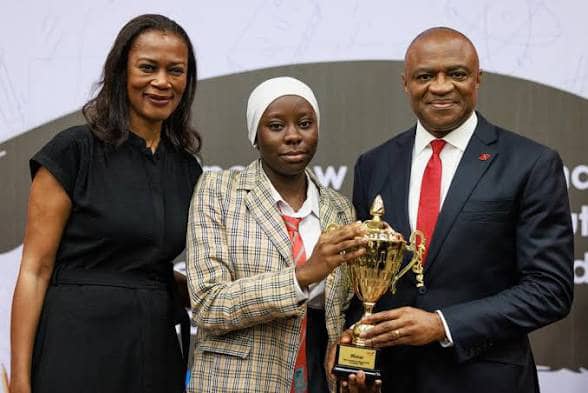
A 15-year-old student, Khaira Bala of Metro International School, Abuja, has emerged overall winner of the 2026 United Bank for Africa, UBA, Foundation National Essay Competition, winning a N15 million university scholarship.
Bala was announced as the winner at UBA’s headquarters in Lagos, alongside four other finalists who also secured scholarships to support their university education.
The second-place winner, Unwanabasi Udom of Topfaith International Secondary School, Mkpatak, will receive N10 million, while Flourish Ndamzi of the University of Port Harcourt Women Association International Secondary School came third with a N7.5 million scholarship.
God’sFavour Udo of Federal Government Girls’ College, Ikot Obio Itong, placed fourth and will receive N5 million, while Uchenna Anyanwu of Coral Impacts International School, Abuja, finished fifth with a N3.5 million scholarship.
The five winners, all girls, emerged from 20 finalists shortlisted from approximately 15,000 entries submitted for the 16th edition of the competition.
In addition to the scholarships, the winners will receive laptops and an educational trip as part of the award package.
Speaking after the announcement, Bala said she was excited and surprised by her victory, adding that her parents encouraged her to participate and supported her throughout the application process.
She said it was her first time entering the competition and described the research and essay-writing process as an interesting experience.
“I was extremely happy. I was speechless, and all I could see were my parents happy,” she said.
The preliminary stage of the competition featured the topic, “No nation can develop without food security. How can Nigeria deal with this problem?”
The 20 finalists were subsequently given another topic for the final stage: “Examine how poverty and other social vices contribute to the prevalence of child marriage in Nigeria.”
Speaking at the event, the Chief Executive Officer of UBA Foundation, Bola Attah, said the number of finalists had increased from 12 in previous editions to 20 this year, reflecting the growing volume and quality of entries.
She added that the number of scholarship recipients had also increased from three to five to enable more students to benefit from the initiative.
Attah said the remaining 15 finalists would receive consolation prizes, funded bank accounts and opportunities for mentorship and further support from the foundation.
She disclosed that the competition, which began in Nigeria, had expanded to six other African countries: Senegal, Burkina Faso, Sierra Leone, Ghana, Chad and Zambia.
The foundation, she said, hoped to extend the initiative to all 20 African countries where UBA operates, transforming it into a continental competition.
Judges raise concerns over AI-generated essays
Meanwhile, one of the competition’s judges, Professor Ini Uko, said the assessment of entries lasted two weeks and involved four professors of English: Asabe Usman, Ini Uko, Emmanuel Omobowale and Samuel Onuigbo.
Also Read: Edu offers Benue IDPs scholarships, medical outreach at 40
Presenting the judges’ report, Uko said the essays were assessed based on content, expression, organisation, vocabulary, depth of analysis and compliance with the competition’s guidelines.
She disclosed that the judges estimated that between 35 and 40 per cent of the submissions displayed characteristics associated with artificial intelligence-generated content.
These included repetitive expressions, similar introductions and conclusions, and a lack of personal voice and locally relevant examples.
The judges also identified duplicate submissions, incorrectly written titles and essays that fell significantly below the required length.
They recommended the introduction of artificial intelligence detection and plagiarism-screening tools, alongside simpler submission guidelines and workshops for teachers and participating schools to improve students’ understanding of essay-writing standards.
Uko, however, cautioned against treating the use of artificial intelligence as inherently wrong, urging students to conduct research, personalise information and critically assess material obtained from such tools rather than reproduce it verbatim.
“The use of AI is not inherently wrong, but I urged students to research, personalise and critically assess information obtained from such tools rather than reproduce it verbatim,” she said.
PREMIUM TIMES NIGERIA