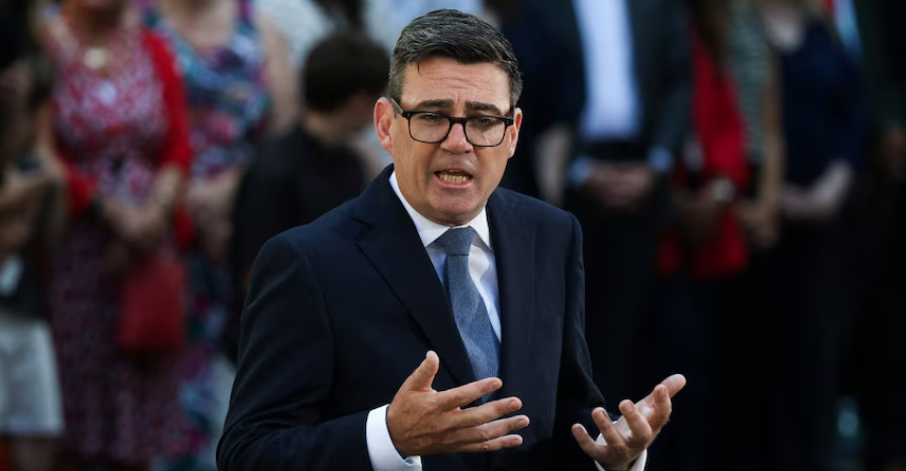
British Prime Minister Andy Burnham will meet European Union, EU, leaders on Friday for a landmark summit aimed at strengthening relations between the United Kingdom and the bloc, a decade after Britain voted to leave the EU.
The talks are expected to focus on agreements covering youth mobility, emissions trading and food trade, as Burnham seeks to reduce post-Brexit barriers and improve economic cooperation without committing Britain to rejoining the bloc or reversing key aspects of its departure.
Burnham, who took office four months ago after replacing Keir Starmer, has adopted a more assertive position on Britain’s relationship with Europe, arguing that the existing Brexit arrangements have failed to deliver the expected benefits.
In his first major foreign policy speech on Monday, he described the current arrangement as inadequate, saying: “The hard Brexit we were given is not good enough.”
Last month, Burnham said he hoped Britain would rejoin the EU within his lifetime but ruled out pursuing membership during his current parliamentary term.
He also maintained Labour’s commitments not to rejoin the EU single market or customs union or restore freedom of movement.
However, he has pledged to begin discussions with Brussels on options for Britain’s long-term relationship with the bloc following Friday’s summit.
Britain’s economic relationship with the EU has become a growing priority for the government amid concerns about the impact of Brexit on economic growth.
Economists estimate that leaving the bloc has reduced Britain’s potential economic output by between 2 and 8 per cent, strengthening calls for closer trade relations with its biggest trading partner.
Labour initially promised to make Brexit work after winning the 2024 general election under Starmer. His administration pursued limited agreements and regulatory alignment to reduce trade barriers, adopting a cautious approach to relations with Brussels.
Friday’s summit was initially scheduled for earlier this year but was postponed amid political upheaval that eventually led to Starmer’s departure.
Nick Thomas-Symonds, a former Europe minister under Starmer, said negotiations had been largely completed before Burnham took office, with about 90 per cent of the proposed agreement already settled.
Also Read: UN raises concerns over EU migration plan to Rwanda
However, outstanding issues include tuition fees for EU students attending British universities, Britain’s participation in the EU’s Made in Europe initiative and the number of people who would be eligible under a proposed youth mobility scheme.
Despite Burnham’s stronger rhetoric, analysts say his government’s approach to Europe remains largely unchanged.
Anand Menon, a professor at King’s College London and director of the think tank UK in a Changing Europe, said the prime minister had not significantly altered the policies pursued by his predecessor.
He argued that further progress would be difficult unless Britain reconsidered its commitments against joining the single market or customs union.
Former EU Brexit negotiator Michel Barnier has also warned that Britain cannot selectively adopt certain benefits of the single market without accepting its wider obligations. Meanwhile, Burnham’s comments have reignited opposition from pro-Brexit politicians and campaign groups.
Conservative leader Kemi Badenoch accused the prime minister of failing to learn from past disagreements, while Reform UK leader Nigel Farage argued that Burnham had no mandate to negotiate closer relations with Brussels.
Former prime ministers David Cameron and Boris Johnson have also cautioned against reopening divisions surrounding Brexit.
However, Morgan Jones, deputy director of Persuasion UK, said public opinion could favour Burnham’s position, with polling suggesting significant support for Britain rejoining the EU.
She noted, however, that support could weaken when voters consider the practical implications, including financial contributions to the bloc and the possibility of adopting the euro.
So far, efforts to reset relations have produced few major outcomes beyond an agreement for Britain to rejoin the Erasmus student exchange programme next year, at a higher cost than its previous participation.
Menon said the government needed to secure the three agreements under discussion at Friday’s summit to demonstrate that its renewed engagement with the EU was producing tangible results.
Burnham has estimated that the proposed agreements could contribute up to 0.4 per cent to Britain’s gross domestic product while reducing administrative barriers for food exporters.
However, Europe Minister Hamish Falconer acknowledged that implementing the agreements would require Britain to comply with EU product regulations without having a direct role in shaping them.
The arrangement highlights one of the central challenges of post-Brexit relations: balancing national sovereignty with the economic benefits of closer integration.
EU foreign policy chief Kaja Kallas recently acknowledged the difficulties created by Britain’s departure, saying the bloc had experienced “a lot of trauma” over Brexit. She also warned that any future negotiations between both sides would not be easy.
CNN