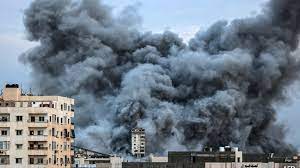
In a devastating escalation, Israel has significantly intensified its offensive on the Gaza Strip, targeting the entire length of the Palestinian enclave and causing hundreds of casualties.
This expanded phase of the war, marked by relentless airstrikes, has led to widespread destruction and an alarming increase in civilian casualties, contradicting Israeli promises to prioritize the protection of non-combatants.
The Israeli military reported striking over 450 targets in Gaza within the past 24 hours, marking a significant escalation since the collapse of a truce last week.
This figure is approximately double the daily average reported in the preceding period.
The intensified bombardment includes attacks from land, sea, and air, leaving Gazans displaced, cut off from aid, and grappling with overwhelmed hospitals and dwindling food supplies.
The United Nations agency in Gaza warned that society is “on the verge of a full-blown collapse” as the majority of the population faces displacement, limited access to aid, and a dire humanitarian crisis. Hospitals are struggling to cope with the influx of casualties, exacerbating the already dire situation.
Both northern and southern areas of Gaza have witnessed intensified fighting, challenging earlier claims by Israel that its troops had largely completed their tasks.
The death toll from Israel’s two-month campaign in Gaza has surpassed 17,170, with thousands more missing and presumed buried under the rubble.
U.S. Secretary of State Antony Blinken expressed concern about the widening gap between Israel’s intent to protect civilians and the actual results on the ground.
He emphasized the imperative for Israel to prioritize civilian protection amid the ongoing campaign.
As Gaza faces unprecedented destruction and a deepening humanitarian crisis, international calls for an immediate ceasefire and a renewed commitment to protecting civilians have gained urgency.
The conflict’s toll on the civilian population is a stark reminder of the urgent need for diplomatic efforts to bring an end to the violence and address the broader issues underlying the Israeli-Palestinian conflict.
“HUNGER, FEAR, AND COLD”
After Hamas militants went on the rampage through Israeli cities on October 7, killing 1,200 people and taking over 240 captives, according to Israeli estimates, Israel began its campaign to destroy the Hamas organisation that controls Gaza.
Since then, most of Gaza’s 2.3 million residents have been forced to flee their homes, with many having to do so three or four times, leaving behind just the possessions they can take.
Residents claim it is now nearly impossible to find safety in the Gaza Strip since the fighting is currently occurring simultaneously in both half of the region.
Israel claims to be giving more information than ever about safe locations and how to get to them. Hamas is accused of causing harm to civilians by operating in these regions, a claim that Hamas disputes.
READ ALSO: Israeli forces escalate airstrikes on Gaza, hitting UN-run schools
As reported by Hamas, the fiercest fighting between Israeli forces and Palestinians was occurring in the Shejaia neighbourhood of Gaza City in the north and in Khan Younis, where Israeli soldiers had advanced to the centre of the enclave’s second-largest city on Wednesday.
A social media report by the Israeli military’s Arabic-speaking spokesman stated that forces were moving “forcefully against Hamas and terrorist organisations in the Gaza Strip, especially in the Khan Younis area and the northern Strip”.
He declared that everyone living in Shejaia, the ancient centre of Gaza centre, and the northern neighbourhoods of Zeitoun and Jabaliya had to depart. Residents in the south should seek refuge along the coast, as the primary route running through the enclave’s spine is now “a battlefield,” he said.
There was no space on the floor for newly arriving patients on Friday, who were splayed on bloodstained tiles, at the main Nasser hospital in Khan Younis, according to Reuters journalists in the southern Gaza Strip.
Mohamed al-Amouri adjusted an oxygen mask for his school-age son, who lay on a hospital bed in football shorts with his legs bandaged and his torso lacerated. “We are staying in an area that is, according to maps, a safe area,” he added.
“Children were on the streets playing, living life normally… we went out after the hit, hearing screams, to find youth, children, women and men in body parts – among them martyrs and injured.”
Thaer Kadeeh and his family are residing in Rafah, which is located further south and close to the Egyptian border. They have constructed a tent out of thin plastic sheets.
“We are not sleepers. He told Reuters, “Fear, hunger, and cold—all three combined—and nobody is watching out for us.” “You try to make the feeling of hunger go away for like an hour, but then the child asks again for food.”
Although Reuters couldn’t access other areas of the enclave, they were able to speak with people over the phone, who recounted similar scenes of desperation. Yamen, who was taking refuge with his family at a school in central Gaza, claimed that there was nowhere left to run because the fighting was now coming from all sides.
“Inside the school is like outside it: the same feeling of fear of near death, the same suffering of starvation,” he said. “Every day we say we somehow survived. But for how long?”
Thomas White, Gaza head of UNRWA, the U.N. aid agency for Palestinians, wrote on X: “Civil order is breaking down in Gaza – the streets feel wild, particularly after dark – some aid convoys are being looted and UN vehicles stoned. Society is on the brink of full-blown collapse.”
Ramy Abdu, head of the Geneva-based Euro-Mediterranean Human Rights Monitor, posted pictures showing severe damage to the vast medieval Great Omari Mosque, the most important landmark in Gaza’s Old City, apparently hit for the first time. There was no immediate comment from the Israeli military.
Crediblenews.ng