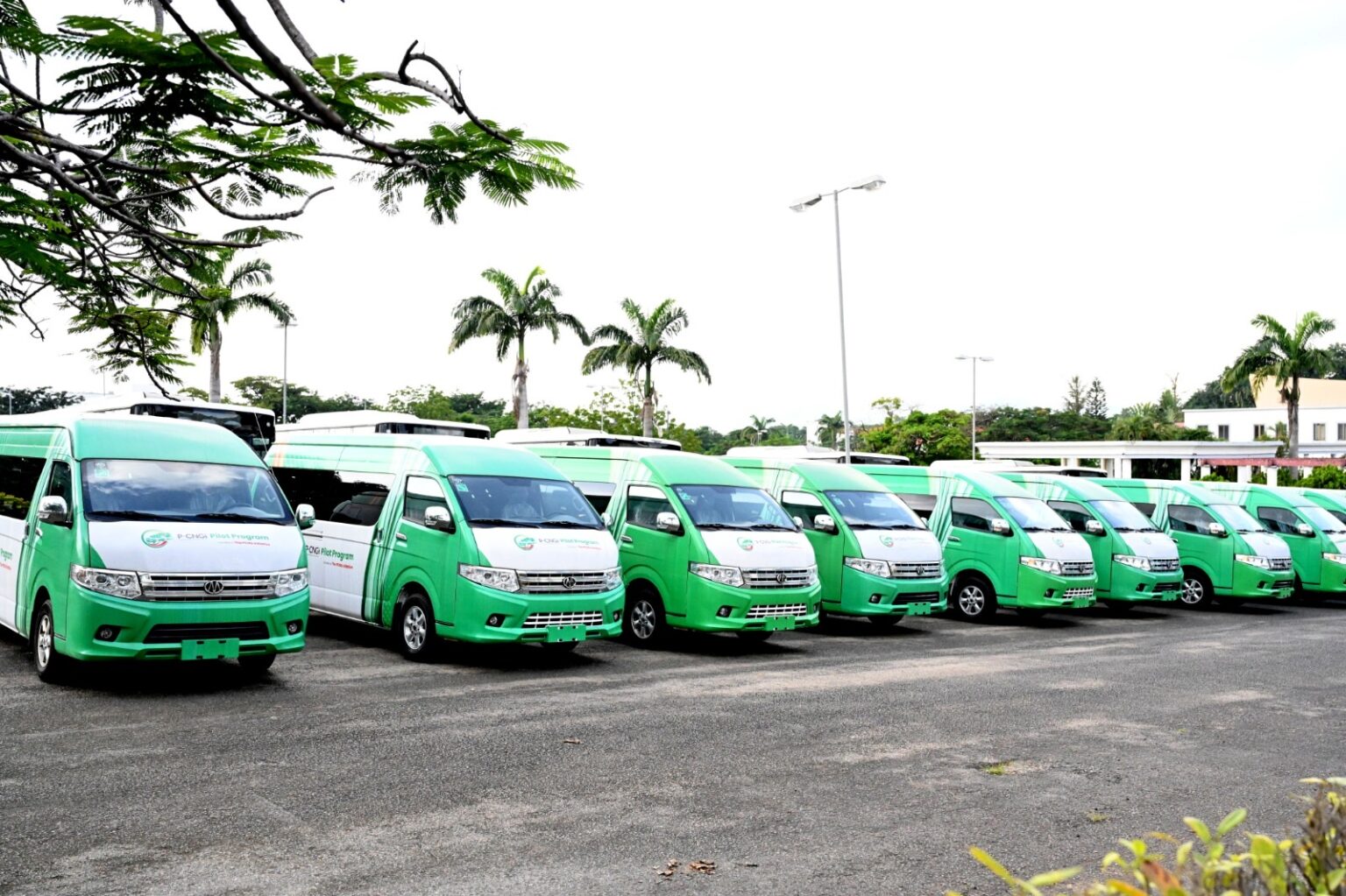
In a bid to alleviate the economic pressure following the removal of the fuel subsidy in 2023, the Federal Government of Nigeria has handed over 64 Compressed Natural Gas, CNG, buses to key stakeholders, including the Trade Union Congress, TUC, Nigerian Labour Congress, NLC, and National Association of Nigerian Students, NANS.
The handover, which took place at the State House in Abuja on Sunday, is part of President Bola Tinubu’s Presidential Initiative on Compressed Natural Gas, PCNGi. The Minister of Information, Mohammed Idris, and Minister of Finance, Wale Edun, announced that an additional 700 CNG buses are expected in the coming months. The government is targeting over 200,000 vehicles and tricycles to be converted to run on CNG, which is a more affordable and environmentally friendly energy source.
The CNG initiative is seen as a key strategy to reduce transportation costs, which have skyrocketed since the fuel subsidy removal. Speaking at the event, Wale Edun emphasized that CNG-powered vehicles cost about one-third of the fuel expense of petrol-powered vehicles, reducing the burden on ordinary Nigerians. He cited that commuters would now pay as little as N15,000 to fill a tank, compared to the previous N50,000 or more for petrol.
The ministers highlighted that the distribution of 64 buses marks the start of a broader national rollout, with plans to distribute over 500 additional CNG buses and 100 electric vehicles in the near future. This move is in line with Nigeria’s commitment to cleaner energy and industrialization, aiming to stabilize the economy and lower inflation.
READ ALSO : Tinubu commissions 20 CNG buses
The government’s efforts were commended by the TUC Secretary-General, Nuhu Toro, and NLC’s Uche Ekwe, though they noted that more buses are needed to meet the demands of the entire Nigerian workforce. Toro also praised the implementation of the N70,000 minimum wage as a vital step toward easing the economic burden on workers.
Student representatives also lauded the initiative, with NANS President, Lucky Emonefe, expressing gratitude for the government’s support, particularly citing the student loan scheme as evidence of the administration’s commitment to education.
The CNG bus initiative is expected to create ripple effects across the economy, with investments in CNG conversion centers, technician training, and infrastructure development already underway. Michael Oluwagbemi, Chief Executive of PCNGi, disclosed that 125 conversion centers have been established, with plans to expand across all 36 states.
As Nigeria celebrates its 64th independence anniversary, the rollout of CNG buses marks a significant step toward easing the economic burden on citizens while transitioning to cleaner energy solutions.
Credible News.ng