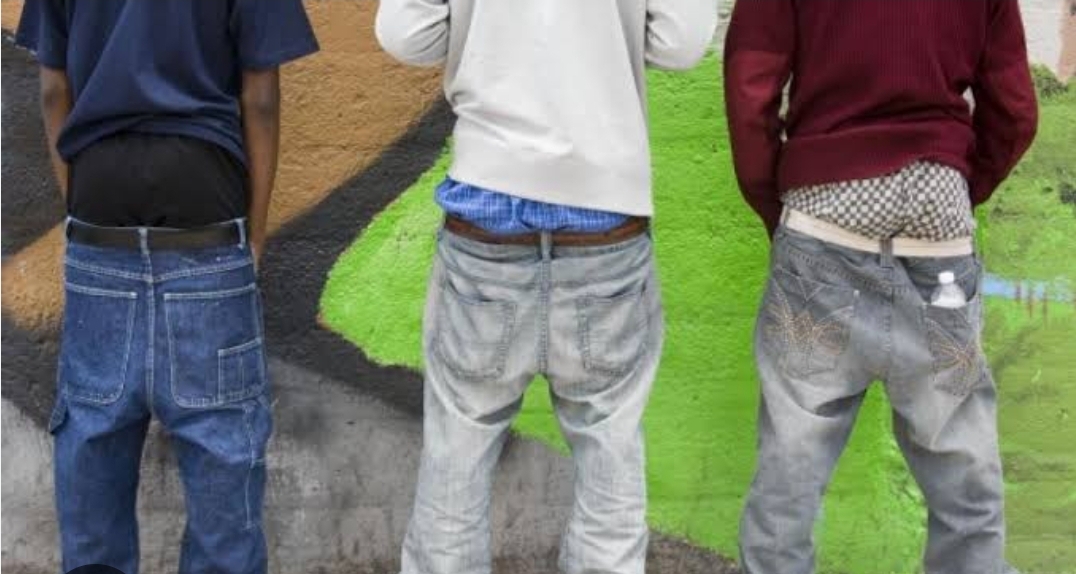
To put it like it really is, fashion among Nigeria’s young men seems to be sagging in more ways than one. What was once a bold statement has now become the default, as trousers hang low and style loses its grip.
Across the streets of Benin City, the Edo State capital and beyond, sagging as a fashion is not just a trend, it is the norm. Young people walk around with their trousers nearly off their body. Literally.
Still wondering, is there still anyone in Nigeria who does not know what sagging as a fashion trend is? Need we paint a picture of what sagging looks like? Okay. Let us try. Wikipedia says: “Sagging is a manner of wearing trousers that sag or droops so that the top of the trousers or jeans is significantly below the waist, sometimes revealing much of the wearer’s underpants.” The online lexicon further indicates, “sagging is predominantly a male fashion.”
Oh well, sagging really needs no introduction. You know it when you see it – trousers clinging for dear life, hanging low enough to give a peek into someone’s choice of boxer briefs.
However, as this fashion choice comes down to new lows, the questions that shoot up like a meteor is: Has style itself started to sag? Or is something more profound happening to the way our youth express themselves?
Sagging is one fashion trend that has an interesting history. In fact, the roots of sagging dates back to the unforgiving prison yards of 20th-century America, where belts were forbidden to prevent self-harm. From there, it trickled into the hip-hop scene, worn like a badge of resilience and non-conformity. The streets of Benin City, Lagos, Aba as well as other nooks and cranny of the federation eagerly adopted the trend, as if to say, “We see you and we sag with you.”
Can you now see that sagging has a serious origin no matter how nonserious anyone wants to tag it?
Nowadays, a blind man can see that a major factor in the persistence of sagging in Benin City which is the focus today happens to be the influence of social media and celebrity culture. Doubt it? Do not please. The rise of influencers and celebrities who continue to promote sagging as a fashionable choice has solidified the trend as an unchallenged part of the modern youth culture. The connection between the global stage and local culture in Nigeria has created a loop of mimicry, where local youth constantly seek to emulate what they see in global fashion, often without considering its relevance to their personal or rich cultural identity.
READ ALSO: Wizkid, Burna Boy thrill fans as Lagos welcomes 2025
Influence of Social Media
Social media platforms, particularly Instagram and TikTok, are often flooded with images of influencers and celebrities sporting sagging jeans and oversized street wear. The idea of ‘fitting in’ or mirroring the success of these figures often drives local youth to adopt the same style, seeing it as a way to gain recognition or status in their own circles. Unfortunately, this creates a cycle of dependence on the validation of external influences rather than nurturing unique and locally relevant expressions of style rooted in rich cultural heritages.
However, unlike other global fashion trends that evolve or fade, sagging has become almost synonymous with the youth in Benin City. Young men, teenagers and even adults are often seen with their trousers or shots hanging precariously below their waists, creating a visual of fashion that seems to resist change. On the streets of the city, it is not uncommon to see this style in every corner, from the popular Ring Road to the busy Ugbowo area, as well as on the campus grounds of the University of Benin and Ambrose Alli University Ekpoma, where youth culture thrives.
Despite its deep roots in urban fashion, sagging in Benin is no longer the rebellious statement it once was. In fact, it has become more of a norm –a routine part of the young men daily ensemble.
Whether on a casual day out or at a social gathering, the sight of sagging jeans, shorts and even track pants is omnipresent.
The trend has spread to the point where those who do not adopt it are considered exceptions rather than the rule.
This, however, is where fashion, both locally and globally, seems to be sagging in a metaphorical sense.
As sagging continues to dominate the streets, it presents numerous challenges, particularly for the youth in Benin City. Beyond the fashion statement, sagging has become synonymous with laziness and disregard for personal grooming. Many believe that sagging reflects a lack of care and seriousness, which are two qualities that should be important in the development of young individuals, especially as they transition into adulthood.
Palpably, the deeper implication of sagging, especially in a city like Benin, is its negative impact on professional and social perceptions. Add this to the reality that conversations in Edo State are wreathed in Pidgin English – a creole language mix of English and local languages, slangs and colloquialism. Yes, it is that bad. In fact, the moment your feet kiss the streets of Benin City, the city hums its welcome in crisp, melodic Pidgin. “How far now?”
Now multiply sagging with Pidgin English among the youth. What answer does it give? The answer is definitely unfavorable!
Culture clash with Fashion
In Benin, sagging tells stories that shift with the beholder. To some, it is a mirror reflecting the shadows of Western influence. To others, it’s just another way of announcing, “I dey kampe!” (I’m doing well!). The older folks? Not so much. To them, sagging is like chewing gum loudly in church. It reeks of disrespect and “lack of home training” as they say it in Nigeria!
Because elders’ eyes see differently, a chat with some of them was quite revealing. Simply identified as Mama Osagie, this elderly woman refuses to mince words about sagging: “Every day I dey tell my pikin, ‘Pull up ya trouser! You think say, this one na fashion?’ But dem no dey hear word.”
Her two teenage boys, unbothered by their mother’s fiery lectures, often respond with a laugh. “Mummy, you no sabi fashion,” they would tease, dragging their trousers even lower for more effect. Mama Osagie can only shake her head, muttering something about “this generation wey no dey hear word.”
Chief Osamede, a father of four, takes an even harder stance. “For my house, no sagging. If your wan sag, no problem. But no return home!”
His philosophy is simple: Sagging equals irresponsibility. “If person see you, wetin dem go think?” he keeps wondering
“Respect dey body language. If you no fit wear, ya trouser well, how you wan fit carry responsibility?” Chief Osamede concluded.
On the flip side, at Play House – the heart of New Benin’s nightlife, sagging is lord and lauded!
The dance floor pulses with beats from the latest Afrobeats anthems and trousers ride low in synchrony. David Osaro, a self-motivated nail technician, stands at the centre of it all. His jeans sag comfortably but he brushes aside any assumptions.
“Na style,” he says plainly. “E no mean say I dey do bad thing. I just like how e be. Na my body, my trouser.”
Another youth, Godwin, chuckles when asked why he sags. “If I pull am up, the trouser no goes fine. How baggy jeans go bag if e dey waist?” He queries.
For Godwin and his peers, sagging is never rebellion. It is aesthetic. Yet, when pressed, he admits with a mischievous smirk, “Abeg, I no be good boy! Nobody expects me to dey wear belt anyhow.”
Really?
Truly, a good and decent dress sense is tapering off in Nigeria and this needs not be. It has, therefore, become expedient to approach the concern creatively and with a mindset that promotes both cultural sensitivity and modern influence.
Ultimately, let us bring in unorthodoxy where a more decent dress sense among the youth is subtly encouraged in order to roll back the persistent sagging trend in Benin City and indeed across Nigeria.
Another unconventional tip to curb sagging among the youth is to host street fashion shows or contests where young people are encouraged to showcase their style through creative, well-fitted clothing rather than sagging. Make the events fun and engaging by incorporating music and other elements of youth culture. With time, the baton will change.
Also, partner popular indigenous figures – musicians, actors, social media influencers and community leaders to set new trends. If they visibly promote well-fitted and stylish clothing, it could inspire followers who are largely made up of the youth. They can use their platforms to discourage sagging, by enthroning a dress code that’s both fashionable and respectful to the rich culture of Edo State.
Go digital too. These days, the youth live in social media. Meet them there and commence a viral social media campaign. Use the hashtag #RespectYourFit or #BeninDecentStyle, where influencers and young people post photos in well-fitted, stylish clothing. Step it up by incentivizing participation with challenges, prizes, or shout-outs for the best-dressed youth.
Again, organize seminars or workshops that focus on the importance of personal grooming and dressing well. Use interactive methods like role-playing, storytelling and visual presentations to highlight the long-term benefits of good fashion choices, career opportunities, self-esteem and social acceptance.
Do not forget to bring in the good, old peer-to-peer advocacy. It has always been a veritable medium to pass strategic information to the youth from time immemorial. Therefore, train a group of well-respected young individuals to become “style advocates.” They can lead peer-to-peer campaigns to teach others the advantages of wearing clothes that fit properly and reflect self-respect, helping create a culture of positive reinforcement within the youth community.
Recall that humans especially the youth thrive on motivations and incentives? Let us toe that path too. Elaborately. Partner local clothing stores to offer discounts or vouchers for young people who choose to wear better-fitting clothes. Providing financial incentives for shopping in a more responsible way can reduce the pressure to follow trends like sagging, especially among those with limited resources.
Once again, knees will bow at the mention of how sagging originated. Think many would still stick to the sagging fashion if they knew sagging were for prisoners let alone when these sag enthusiasts get to know that sagging came to be because these prisoners never had the permission to put on belts? Therefore, launch programmes or segments on local TV and radio stations that tackle fashion trends, discussing the history, culture and benefits of dressing well. These programmes could feature discussions on how fashion can reflect a person’s confidence, self-worth and respect for others.
In truth, while sagging may continue to be prevalent, there is hope for the future of fashion in Benin City and indeed Nigeria. The key lies in encouraging the youth to break free from the comfort zone of conformity and discover new avenues for self-expression which shall strategically translate to bidding the sagging fashion trend the grand ‘bye bye’ that it deserves since the trend is fast becoming a whirlwind that blows the youth of Benin city and entire Nigerians, no good.
By Josse Nna
Crediblenewsng.com