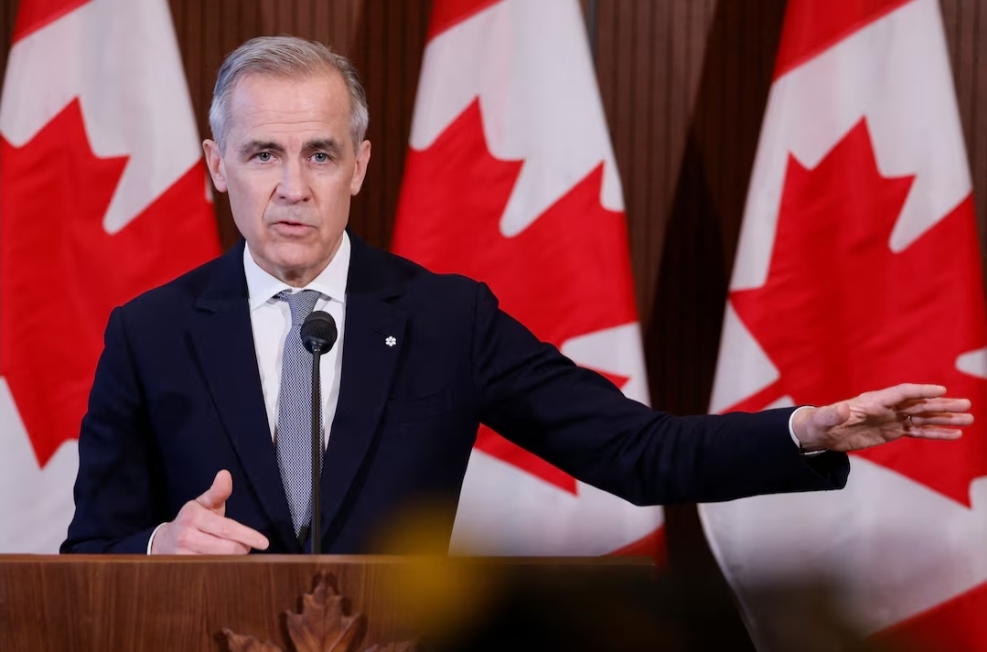
Prime Minister of Canada Mark Carney has vowed to retaliate to tariffs issued by US President Donald Trump soon, “with purpose and with force”.
Carney paused his federal election campaign for the second time in as many weeks to respond to the latest import taxes unveiled by Trump on Wednesday.
A new universal 10% tariff on US imports will apply globally but Canada was exempted because it has already been targeted by Trump with other measures.
But there was no confirmation of any reprieve from a new 25% tax that Trump will charge on Americans importing foreign-made cars, which could hit Canada hard.
Speaking to reporters in Ottawa, Carney said the existing tariffs on Canada would “directly affect millions”.
He added that Canada’s reaction would be hammered out once he meets with province and territory premiers on Thursday.
In his announcement on Wednesday, Trump said the blanket rate of 10% tax would apply to all goods imported by Americans from other countries.
He also unveiled a list of 60 nations facing higher rates – which he described as a “reciprocal” move – though Canada notably was not on that list.
So, after days of anticipation about what Trump’s “Liberation Day” would mean for Canada, the answer seems to be that little has changed. That has not brought relief to America’s northern neighbour.
Much of the American tariff scheme on Canada will stay the same: a blanket 25% on all goods, except those under the existing North American free trade agreement. Energy and potash is tariffed at a lower 10%, while a 25% levy on Canadian steel and aluminium remains in place.
Trump has tied those previously-announced tariffs to the flow of fentanyl and migrants into the US from both Canada and Mexico. Officials signalled that some may be lowered if an “emergency” declaration by Trump is cancelled.
Speaking at the White House on Wednesday, Trump also confirmed that his new 25% tariff “on all-foreign made automobiles” would come into effect at midnight on Thursday.
He did not say whether Canada, whose car industry is heavily intertwined with that of the US, would be exempt.
Carney’s response to the tariffs so far has been a political win for Carney and his Liberal party – now ahead in national polls – as the Conservative Party and its leader Pierre Poilievre trail slightly behind.
As the incumbent, Carney has the advantage of playing the role of prime minister while simultaneously auditioning for it, and national polls show Canadians trust him more with handling Trump and the Canada-US relationship.
This success – at least so far – has forced Poilievre to pivot his messaging. On Wednesday, the Conservative leader held an event in Toronto hours ahead of Trump’s announcement to outline his party’s response.
He pushed for immediate, “targeted” retaliation, and said his party would introduce a temporary loan program to support businesses directly hit.
Poilievre urged Canada to renegotiate the existing North American trade agreement with Canada, the US and Mexico as soon as possible. The agreement, known as CUSMA, is up for review in 2026.
“Why wait? Why not get it done now?” Poilievre asked.
Reported by ABC News