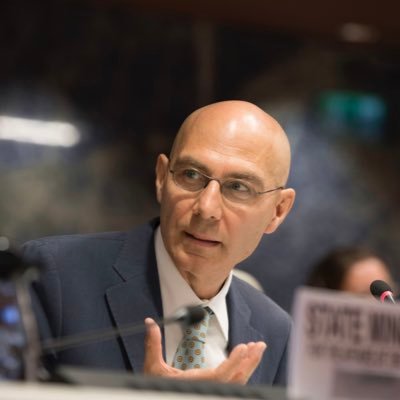
The UN High Commissioner for Human Rights, Volker Türk has condemned the U. S. Government’s announcement of sanctions against four International Criminal Court, ICC, judges.
In a statement on Friday, Türk described the sanctions as “deeply corrosive of good governance and the due administration of justice.”
The measures were announced on Thursday by U.S. Secretary of State Marco Rubio. They target ICC judges overseeing cases involving alleged war crimes.
These include a 2020 case involving U.S. and Afghan forces in Afghanistan, and the 2024 arrest warrants for Israeli Prime Minister Benjamin Netanyahu and Yoav Gallant.
“I am profoundly disturbed by the decision of the U.S. Government to sanction judges of the International Criminal Court,” said Türk.
He noted the four judges are women from Benin, Peru, Slovenia, and Uganda, involved in rulings on Afghanistan and Palestine.
Also Read: ICC issues arrest warrants for Netanyahu, Gallant over Gaza war crimes
Türk urged a prompt reconsideration and withdrawal of the sanctions without delay adding that the sanctions target judges for performing judicial duties, undermining the rule of law and values long upheld by the U.S.
Türk’s remarks follow a strong ICC statement on Thursday condemning the move as an attempt to undermine judicial independence.
The ICC operates under the authority of 125 States Parties from across the world, reaffirming its global mandate.
On Friday, the Assembly of States Parties — the court’s legislative body — echoed concerns, rejecting the sanctions imposed by the U.S.
They warned that the measures risk damaging global accountability efforts, weakening justice and eroding the rules-based international order.
CREDIBLE NEWS reports that the US Department of State on Thursday imposed sanctions on four individuals currently serving as judges on the International Criminal Court for their involvement with the ICC’s investigations into the US and Israel.
These sanctions were imposed pursuant to Executive Order No. 14,203, titled “Imposing Sanctions on the International Criminal Court,” which President Donald Trump signed on February 6, 2025. The order was originally signed in response to the ICC’s warrants for Israeli Prime Minister Benjamin Netanyahu and former defence minister Yoav Gallant. The stated purpose of this order was to emphasize that the US and Israel are not within the jurisdiction of the ICC under the Rome Statute, and therefore any investigation into the actions of the two countries is invalid.
The sanctions were imposed on Second Vice-President, Reine Adelaide Sophie Alapini Gansou (Benin), Judge Solomy Balungi Bossa (Uganda), Judge Luz del Carmen Ibáñez Carranza (Peru), and Judge Beti Hohler (Slovenia). As a result of the US sanctions, all property and interests in property of the sanctioned persons that are in the US or in possession or control of US persons are blocked, and all transactions by US persons or within (or transiting) the US that involve any property or interests in property of designated or otherwise blocked persons are prohibited unless authorized by a general or specific license.
The State Department explained that Bossa and Ibanez Carranza were sanctioned because of their ruling to authorize the ICC’s reopening of a case involving alleged war crimes by US troops in Afghanistan, while Alapini and Hohler were sanctioned because they authorized the ICC’s issuance of arrest warrants for Netanyahu and Gallant.
The statement emphasized that the US does not take these sanctions lightly, emphasizing that this action “reflects the seriousness of the threat [the US] face[s] from the ICC’s politicization and abuse of power.”
NAN