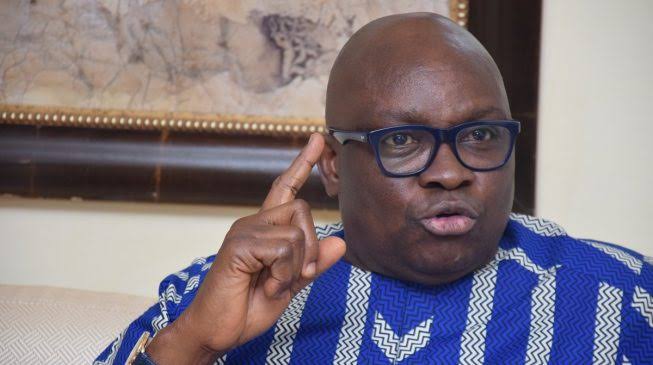
Former Governor of Ekiti State, Ayodele Fayose has been acquitted of all charges related to alleged money laundering and fraud by the Federal High Court in Lagos.
The court ruling on Tuesday marked the end of a prolonged legal battle initiated by the Economic and Financial Crimes Commission, EFCC, which had accused the former governor of embezzling public funds and laundering illicit money during his time in office.
Delivering the judgment, the presiding judge upheld a no-case submission filed by Fayose’s legal counsel, which argued that the prosecution had failed to establish any credible evidence that warranted the continuation of the trial.
According to the court, the EFCC was unable to prove that the former governor committed the alleged offences beyond reasonable doubt.
Fayose had been standing trial since 2018 on multiple counts related to the alleged diversion of N2.2 billion, funds which the EFCC claimed originated from the Office of the National Security Adviser under Col. Sambo Dasuki (rtd).
The anti-graft agency also alleged that parts of the funds were funnelled into Fayose’s political campaign during the 2014 Ekiti gubernatorial election.
READ ALSO: Judge’s absence stalls Fayose’s N6.9bn trial in court
The trial featured testimonies from several prosecution witnesses and the submission of financial documents. However, in his ruling, the judge stated that the evidence brought forward lacked consistency and failed to directly link Fayose to the alleged laundering activities.
“The prosecution has not made a prima facie case against the defendant. There is no compelling basis for the court to call upon the defendant to enter a defence,” the judge ruled, effectively bringing the matter to a close in favour of the former governor.
Fayose, who was present in court, expressed relief and reiterated his long-standing position that the charges against him were politically motivated.
Speaking through his media aide shortly after the ruling, he thanked his supporters and legal team, while urging the EFCC to conduct future investigations with “more diligence and impartiality.”
The EFCC has yet to issue a formal statement on whether it will appeal the ruling, but legal experts suggest the outcome could influence other high-profile corruption cases currently before the courts.
The Conclave