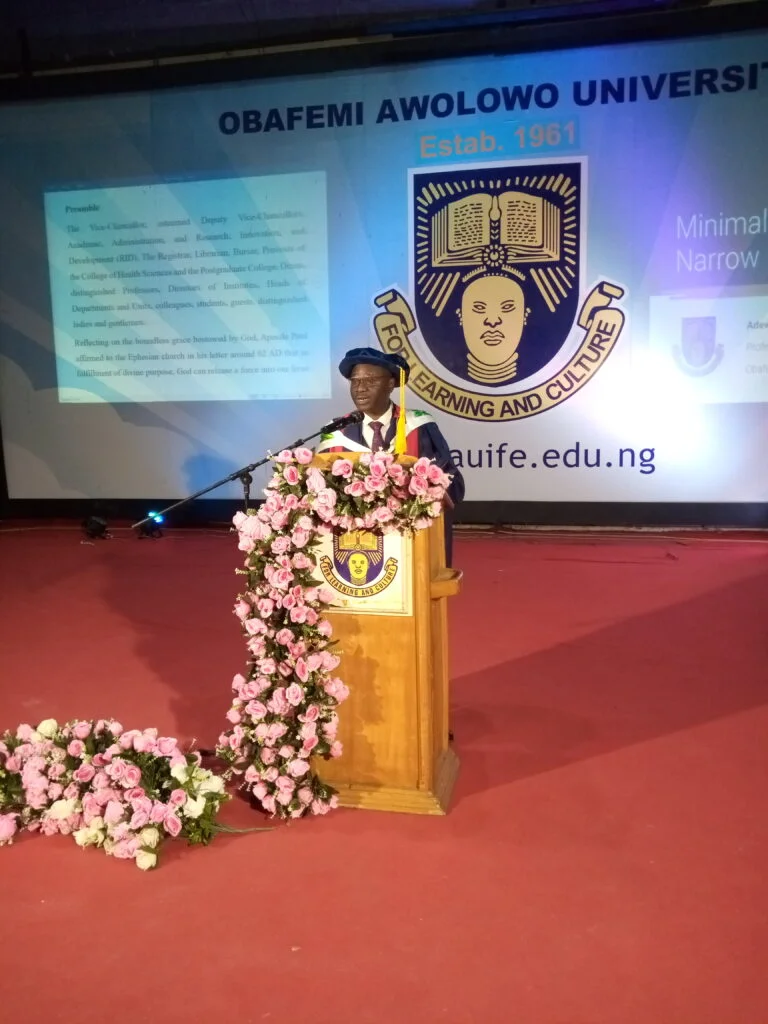
A Professor of Surgery at the Obafemi Awolowo University Teaching Hospital Complex, Ile-Ife, Adewale Adisa has called on Nigerian health policymakers to prioritise the nationwide adoption of Minimal Access Surgery, MAS, also known as keyhole surgery, citing its numerous health and economic benefits.
Speaking during the university’s 402nd inaugural lecture themed “Minimal Access Surgery: Narrow is the Way”, Prof. Adisa highlighted the transformative impact of MAS on patient care and recovery outcomes. Held at Oduduwa Hall, the lecture outlined how MAS has been proven to reduce trauma, post-operative pain, recovery time, and risk of infection compared to traditional open surgeries.
Despite the overwhelming benefits of MAS, Adisa lamented the slow uptake of the technique in Nigeria due to poor infrastructure, lack of training, and limited government investment. “Minimal access surgery offers better outcomes—reduced blood loss, minimal scarring, and quicker return to work. But in Nigeria, open surgery is still used in over 90% of cases due to a lack of trained personnel and insufficient equipment,” he said.
Adisa noted that the cost of acquiring MAS equipment is initially high but justifiable considering the long-term benefits. He added that the technique requires constant electricity, modern image-guided technology, and a highly trained medical team including surgeons, anaesthetists, and perioperative nurses.
ALSO READ: China employs AI system to detect stomach cancer
“In many tertiary hospitals, power supply was a challenge 20 years ago. Today, it’s even worse,” he stressed. “If government can guarantee steady electricity and support proper training, we can democratise access to this superior form of surgery.”
With over 1,400 successful keyhole operations to his name—including procedures for appendicitis, gallbladder removal, colon and gastric cancers—Adisa said Nigeria’s future in surgery hinges on embracing innovation and modern tools like robotic surgery and AI-assisted techniques. “The future is digital. If we don’t act now, we risk being permanently behind the rest of the world,” he warned.
He argued that while wealthy Nigerians travel abroad for common surgeries under the guise of medical tourism, average citizens must endure open surgeries with longer hospital stays and prolonged recovery times. “This deepens poverty and delays productivity, especially for self-employed Nigerians,” he said.
Adisa called for the inclusion of MAS in Nigeria’s public health policy and urged both state and federal governments to invest in infrastructure and human capacity development. “Many private hospitals charge exorbitant fees for laparoscopic surgeries, making it unaffordable for ordinary Nigerians. Surgery shouldn’t be a luxury,” he said.
He concluded by urging health authorities to embrace robotic surgery and other cutting-edge advancements. “Nigeria must move from lagging behind to leading innovation in healthcare. Let’s ensure every Nigerian has access to better, safer surgery.”
NAN