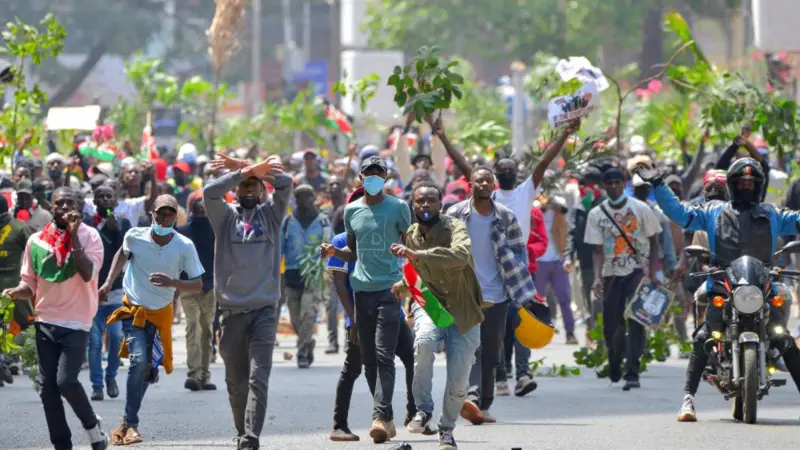
Police have clashed with protesters in Nairobi and other Kenyan cities, as thousands took to the streets to remember those who were killed in the anti-tax protests a year ago today.
Officers used tear gas and water cannon to contain huge crowds, but the streets of central Nairobi are now largely quiet.
Another reason people have been marching today is that Kenya has been gripped by a wave of disappearances, ever since the youth-led protests a series of planned tax rises on 25 June 2024 – exactly a year ago.
More than 80 people were abducted between last June and January this year, according to a state-funded rights group, external.
A few have been released in recent weeks, and there are growing calls for all who have been abducted to be freed.
The abductions generally target government critics and are widely believed to be the work of security agents, although the authorities have not admitted responsibility.
They began in June last year but increased in December, when AI-generated photos of President William Ruto in a coffin were widely shared.
The situation continues to stoke fear across the country, with parents worried about the safety of their children and activists who are critical of Ruto’s government on social media.
Kenya has also been accused of enabling foreign governments to abduct their citizens and carry out forcible extraditions, breaching international law.
In January, prominent Tanzanian activist Maria Sarungi Tsehai was abducted by armed men in Kenya and released after several hours
Last year, Ugandan opposition leader, Kizza Besigye, was kidnapped in Nairobi, allegedly by Ugandan security officials, and taken across the border for trial by a court martial.
One of the thousands of protesters on the streets of Nairobi was Amina Mude, who told the BBC she wanted “to fight for the future of my kids”.
“I feel like as a country we’re not going in the right direction, especially in education and everything happening.
“So I’m here to fight for a better Kenya.
“I feel like it’s high time that the country and the leadership listens to us. We’re here to do it peacefully and to just tell them, you know, listen to us. That’s the biggest thing.
“And not killing us.
“I’m actually very scared. I’m waiting to just run away.”
Also Read: Kenyan grandfather, Reuben Waithaka vanishes day after arriving US
Young people have been protesting to mark the first anniversary of a mass protest that culminated in the storming of Kenya’s parliament and the killing of protesters by the security forces.
Protests against the government’s plan to increase taxes erupted last June, forcing President William Ruto to retract a controversial finance bill.
Since Ruto became president in 2022, taxes on salaries have gone up, the sales tax on fuel has doubled and people are also paying a new housing levy and health insurance tax.
The controversial finance bill was aimed at raising $2.7bn (£2bn) the government said it needed to cut its reliance on external borrowing.
The clampdown by the security forces on a series of protests left at least 65 people dead, the disappearance of 89 others and the arrest of thousands, according to Amnesty International, external. The government put the death toll at 42.
Protests had fizzled out but started again this month following the death in police custody of teacher and blogger Albert Ojwang.
The young Kenyans, labelled Gen Z protesters, are angered by Ruto’s government, accusing it of being arrogant and untrustworthy.
They are demanding President Ruto’s resignation.
The streets of central Nairobi are now largely quiet, with just a few groups of protesters still demonstrating in the centre of the capital.
The BBC observed the debris from earlier demonstrations still littering several of the main roads around Kenya’s parliament and State House, President William Ruto’s official residence.
At around 17:00 local time (14:00 GMT), officers continued to use tear gas against the small number of demonstrators who remained on the streets, with rows of soldiers continuing to protect key civic buildings.
But the larger number of demonstrators seen earlier in the day have moved away from the city centre, leaving the usually packed rush hour streets largely quiet.
The wife of a man who died in police custody earlier this month says she feels very connected to today’s protests demanding justice for those killed in anti-government demonstrations last year.
Pathologists who examined the body of Nevnina Onyango’s husband Albert Ojwang said he died from injuries caused by assault, contradicting initial police claims that he had harmed himself.
Ms Onyango told the BBC the demonstrations were important to “communicate in a way that will be heard”, and if people “air their voices in the street things might change”.
Police have been engaged in running battles with protesters, using tear gas and water cannon.
“They don’t learn,” said Ms Onyango.
“As much as Kenyans are trying to be peaceful, [the police] always find a way of fighting them. I wish they could help people demonstrate peacefully instead of fighting them.”
Three Kenyan policemen have been charged with the murder of Mr Ojwang, a teacher and online blogger.
But Ms Onyango said she wanted to know more about the possible role of deputy police chief Eliud Lagat, who is said to have ordered Mr Ojwang’s arrest because of a social media post criticizing him.
He has stepped aside pending the outcome of investigations.
Reported by BBC