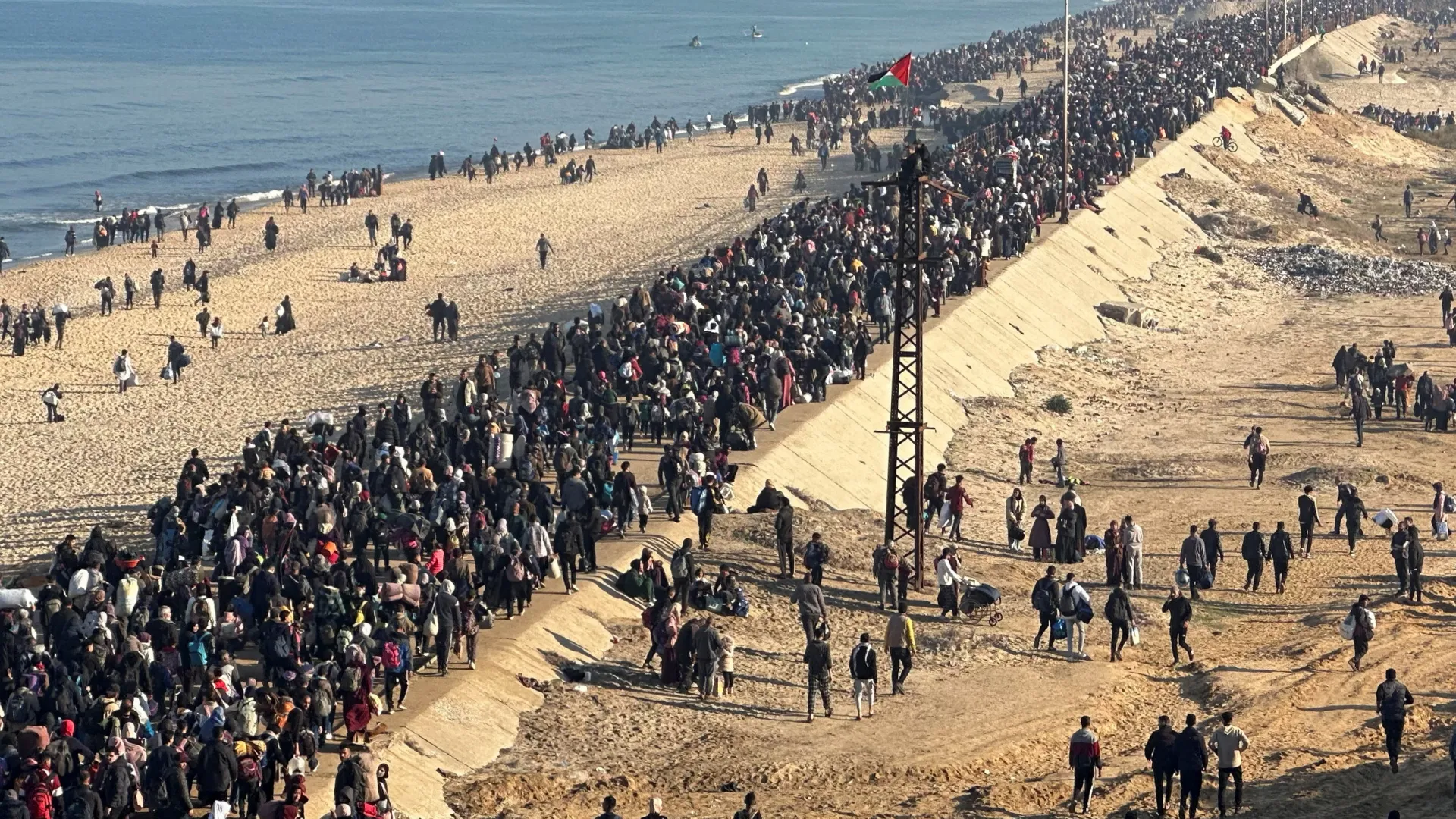
After two years of devastating conflict, thousands of displaced Palestinians began the long journey back to their homes on Friday as a ceasefire between Israel and Hamas took effect.
The truce, announced late Thursday, brought a cautious sense of relief and hope across the Gaza Strip, where war had forced millions from their homes.
Along Gaza’s Mediterranean coast, long lines of men, women, and children walked northward toward Gaza City, waving flags and chanting “God is great.” Many carried plastic bags, small bundles of clothes, or water containers—everything they had left after two years of destruction.
“I’m happy but afraid,” said 40-year-old Ibrahim al-Helou, who left a central refugee camp in Al-Maghazi to return home. “We waited until it was safe to move. Now, the road is open, and we want to see what’s left of our house.”
In the southern city of Khan Yunis, dozens navigated through streets filled with rubble, heading toward their shattered neighborhoods. “Even if we return to ruins, at least it’s our land,” said 32-year-old Ameer Abu Iyadeh, carrying his daughter and a water can. “We’re full of sorrow, but we thank God we can finally go back.”
Israel’s military confirmed that its troops had started repositioning along “updated deployment lines” in preparation for the ceasefire. Gaza’s main north-south road, Salah Al-Din, was reopened, but the army warned residents to avoid contact with remaining Israeli forces.
ALSO READ: Hamas, Israel agree ceasefire, Trump says hostages free on Monday
Government spokeswoman Shosh Bedrosian said the Israeli forces were pulling back to the “Yellow Line,” part of a phased withdrawal plan proposed by U.S. President Donald Trump. For now, Israel is expected to maintain control of about 53 percent of Gaza during the first stage of the truce.
The ceasefire framework also includes a hostage-release agreement, with Israel’s cabinet confirming that Hamas will begin freeing captives held since the October 7 attacks.
In Khan Yunis, 38-year-old Areej Abu Saadeh, who lost two children in the war, said she could not wait to reach her hometown. “We’ve been displaced for two years with no shelter,” she said. “Now we’re running home—I just want to see what’s left.”
BBC