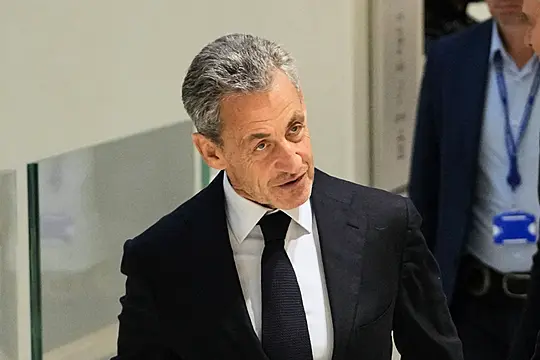
Former French President Nicolas Sarkozy has entered La Santé Prison in Paris to begin a five-year sentence for criminal conspiracy linked to illegal campaign funding.
The conviction stems from allegations that Sarkozy sought financial support from the regime of the late Libyan dictator, Muammar Gaddafi, to fund his 2007 presidential campaign.
Sarkozy, who led France from 2007 to 2012, becomes the first former head of an EU country to serve time in prison, and the first French postwar leader to be jailed.
The 69-year-old entered La Santé Prison in southern Paris on Monday, where he is expected to be held in solitary confinement for his own security.
His nine-square-metre cell is equipped with a shower, toilet, and small television, but he will be denied access to a mobile phone. He will, however, be allowed two family visits a week and a security-controlled phone line to communicate with his lawyers and relatives.
Before leaving his home in western Paris, Sarkozy made a public appearance with his wife, singer Carla Bruni, and their daughter Giulia, to greet supporters who gathered on the street.
His son, Louis Sarkozy, who is running for mayor in Menton next spring, had called for sympathisers to demonstrate in solidarity. As he departed, Sarkozy’s social media account carried a message insisting, “I am innocent,” describing his imprisonment as a “judicial scandal.”
A Paris court last month found Sarkozy guilty of conspiring to obtain campaign funding from Gaddafi’s regime for his successful 2007 presidential bid. Presiding judge Nathalie Gavarino said the crime was of “exceptional gravity” and “likely to undermine citizens’ trust.”
READ ALSO: Israel thanks Trump for support amid attacks in Gaza
During the three-month trial, prosecutors accused Sarkozy of entering a “Faustian pact of corruption” with one of the world’s most notorious dictators to secure financial support. He was, however, acquitted of three other charges—corruption, misuse of Libyan public funds, and illegal campaign financing.
Sarkozy has maintained his innocence and appealed the conviction. A retrial is expected in about six months, but under French law, he must begin serving his sentence while the appeal process unfolds. His lawyers are expected to request his release, a move the appeals court will review within two months.
In an interview with Le Figaro, Sarkozy said he had packed family photos and three books for his time in prison, including a biography of Jesus and The Count of Monte Cristo, a novel about a wrongfully imprisoned man who escapes to seek revenge. “I was advised to take earplugs,” he added. “At night you hear lots of noise, shouting, screaming.”
A poll by Elabe found that six in ten French citizens view Sarkozy’s sentence as fair. Still, he retains strong backing among conservatives. President Emmanuel Macron defended his decision to host Sarkozy at the Élysée Palace days before his imprisonment, saying, “It was normal, on a human level, for me to receive one of my predecessors in this context.”
Socialist Party leader Olivier Faure criticised the meeting, calling it “pressure on the justice system” and warning that it created the impression that certain individuals were “different before the law.”
Justice Minister Gérald Darmanin, one of Sarkozy’s protégés, has pledged to visit the former president in his ministerial capacity.
La Santé Prison, which has housed notorious inmates such as Venezuelan militant Carlos the Jackal and model agent Jean-Luc Brunel, has drawn attention for overcrowding, with many inmates reportedly sleeping on mattresses on the floor. Prison wardens staged a protest outside the facility as Sarkozy began his sentence, denouncing what they described as inhumane conditions.
Sarkozy’s incarceration marks a dramatic fall for one of France’s most influential political figures—and a defining moment in French judicial history, as a former president begins life behind bars while still declaring his innocence.
The Guardian News