Nosmot Gbadamosi/ Africa Brief
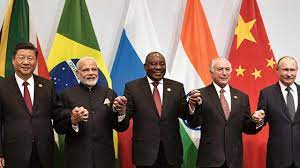
South Africa is considering the possibility of China hosting the BRICS summit in August, officials say. South African media reports suggest the government was considering a proposal to move the summit to China, or neighboring Mozambique, to eliminate diplomatic pressure on Pretoria.
Pretoria is attempting to resolve the dilemma of hosting Russian President Vladimir Putin at the BRICS summit while also, as a member of the International Criminal Court,ICC, being obliged to arrest and send him to The Hague following the ICC’s issuance of a warrant for his arrest for war crimes in Ukraine.
Should Putin attend the summit, it would further strain relations with the United States, the country’s biggest trade partner after China. Of the five BRICS members, Brazil and South Africa are signatories to the Rome Statute, whereas China, India, and Russia are not. There has been speculation that the South African government is exploring moving the summit to another BRICS member nation.
“We will have to assess what happens over the next couple of weeks or so but whatever decision we make will be in line with our obligations to international law and our own domestic law,” said South Africa’s international relations director-general, Zane Dangor.
South Africans worry that their country could lose out on future foreign investment and trade because of the close ties that the ruling African National Congress maintains with Russia amid a country beset with domestic issues including a chronic energy shortage, high unemployment, and an economic slump.
South African President Cyril Ramaphosa’s administration has claimed a neutral stance on the Ukraine war, abstaining on numerous U.N. votes to condemn Russia. The ANC has long championed a nonaligned, multipolar world, but its perceived bias toward the Kremlin has left its messaging looking confused and inconsistent.
Pretoria’s initial response to Russia’s invasion of Ukraine was to call on Moscow to “immediately withdraw” its forces. But it later hosted joint naval exercises during the first anniversary of the invasion and has sent its army chief to Moscow on a “combat readiness” trip.
U.S. Ambassador to South Africa Reuben Brigety last month claimed Pretoria loaded weapons and ammunition onto a Russian vessel, sparking a diplomatic row between Pretoria and Washington that sent the rand’s value plummeting. Pretoria’s issuance last week of diplomatic immunity to attendees of the BRICS summit further damaged the currency.
The notice about immunity was “standard” practice to protect the conference, the Foreign Ministry said. “These immunities do not override any warrant that may have been issued by any international tribunal against any attendee of the conference.”
But some experts suggest it highlights that Pretoria may be looking for a loophole under diplomatic immunity and avoid sanctions from Washington that would impact preferential trade agreements.
Article 98 of the ICC Rome Statute states: “The Court may not proceed with a request for surrender or assistance which would require the requested State to act inconsistently with its obligations under international law with respect to the State or diplomatic immunity of a person or property of a third State, unless the Court can first obtain the cooperation of that third State for the waiver of the immunity.”
But analysts say no form of immunity is possible for a sitting president or head of state under the ICC and the Rome Statute.
South Africa’s international relations minister, Naledi Pandor, confirmed on Friday during a two-day planning meeting of BRICS foreign ministers that Putin was still invited to the August summit to be held in Johannesburg. She told her BRICS counterparts that since the war in Ukraine, global leaders “no longer share an understanding of the greatest global challenge.”
“A regional conflict has not replaced eradicating global poverty as the world’s greatest global challenge. How do we bring the world’s attention and resources back to this fact?” she said. “This is not the world we hoped for when the Cold War ended.”
Former South African President Thabo Mbeki has previously said that the summit was unlikely to take place in South Africa. “Because of our legal obligations, we have to arrest President Putin, but we can’t do that,” Mbeki said late last month in an interview with the radio station 702.
“We can’t say to President Putin, please come to South Africa, and then arrest him. At the same time, we can’t say come to South Africa, and not arrest him—because we’re defying our own law—we can’t behave as a lawless government,” Mbeki told SABC.
South Africa will again be in the spotlight when it hosts the G-20 summit in 2025. Moving or hosting the BRICS summit virtually may resolve Pretoria’s diplomatic dilemma but would damage its relationship with Eastern allies. Simply reaching an agreement among other BRICS members to dis-invite Putin may be the only way to protect South Africa’s already faltering economy from more serious harm.
For the first time since Ramaphosa took office in 2018, South Africa was not invited to the G-7 summit held in Japan last month, marking the possible beginning of the country’s ostracization by the West.