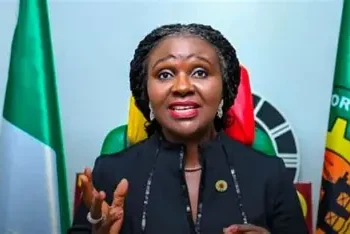
Special Adviser to the President on Energy, Mrs. Olu Verheijen has disclosed that more than 70 percent of the nation’s gas reserve remains undeveloped, causing a setback in the Compressed Natural Gas powered vehicles project.
Verheijen, at a ministerial press briefing in Abuja on Friday emphasized the necessity of addressing fundamental issues within Nigeria’s oil and gas sector, with insufficient gas supply being a primary concern.
Despite the existence of a fund earmarked for investments in gas infrastructure, she highlighted the challenge of attracting investors without adequate gas reserves.
“There are lots of investors who are very interested in making investments in infrastructure, but it’s like building a road without having a car to drive on it. You cannot invest in infrastructure to compress gas if there is no gas.
Read also:Benue : Again, armed herdsmen attack community, kill 16, set over 50 houses ablaze
“We need to address the fundamental issues in sectors so that we can attract capital to the infrastructure, and there is no one who is going to invest in midstream infrastructure if they don’t have assurance or line of sight to the attractiveness of gas supply.
“So if the gas suppliers are not making investments because the fiscal terms or the business environment is a very difficult one in which to invest, then it will be very difficult to continue to mature midstream projects and downstream projects because you have to deal with the Abinitio problem, which is gas supply,” she said.
She noted that to address the bottlenecks in the Nigerian oil and gas sector, President Tinubu recently issued some policy directives, including the introduction of fiscal incentives to deepen compressed natural gas, and liquefied petroleum petrol penetration.
Others include streamlining of contracting processes, procedures and timelines and local content practice reform.
“These incentives were designed to ease the impact of fuel subsidies on transport and enable the displacement of PMS and diesel, it also aims to stabilise the price of cooking gas in the market and support the transition to clean cooking.
“That is exactly what President Bola Ahmed Tinubu has done with fast-tracking this policy directive to ensure that we have sufficient gas supply whether we’re trying to export to a Trans Sahara gas pipeline, whether we’re trying to compress natural gas or liquefied for domestic use, whether we’re trying to have floating LNG as an alternative way of getting gas into the market. All of those things are enabled by these policies that unlock supply,” she said.
Verheijen further maintained that the government had stopped the payment of subsidy following the pronouncement of President Tinubu on May 29, 2023.
She, however, said that the government has the prerogative to maintain price stability and prevent social unrest. “So if prices are moving, they reserve the right to intervene. It was done in the US during COVID-19, there were a lot of interventionist moves that were also subsidies.
In her words: “All governments reserve that right, and so if for whatever reason the Tinubu-led administration has reviewed that it is not the right time to have prices continue to fluctuate, given the level of hardship in the country, given inflation, the government has the right to intervene intermittently, all governments do so but it does not negate the fact that the subsidy was removed.
“The cost of renewable energy sources was twice the cost of gas; given the level of energy poverty in the country, gas remains the short- to medium-term plan of the government to deliver power to Nigerians, and the government was not yet ready to diversify the energy mix on the grid for electricity, due to some underlying structural issues that needed to be addressed.”
Noting the challenges in the generation, transmission, and distribution sections of the nation’s power sector, she said: “Until we address those fundamental issues, ensuring that the Disco’s for example, make sure that all customers are metered and we have a level of assurance and revenue in the electricity value chain.
“Then we will not be able to attract capital into distribution, not be able to attract capital into transmission, and definitely not be able to pay the current gas suppliers or potential solar or hydro suppliers of generation capacity.
“So the fundamental issue that we’re addressing at the moment is to focus on financial liquidity with technology interventions through the presidential metering initiative. For example, reviewing policies and structural issues that allow capital to flow into that value chain, and then allow us to diversify beyond gas on the grid,” she concluded.