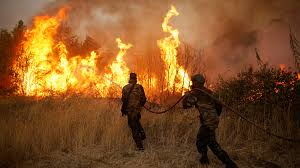
The major wildfire that raged for almost three days near Athens, Northeast Attica in Greece has been extinguished, officials said on Wednesday.
Fire-fighters continued to monitor the area to prevent any re-ignition of smouldering hotspots in the charred fields, forests and outlying neighbourhoods.
A broken electricity pylon may have triggered the fire on Sunday afternoon, according to the Kathimerini newspaper. The report said investigators have examined the site and collected evidence. It noted that there was still disbelief about how rapidly the fire spread and how close it got to the city.
“It was like an atomic bomb,’’ a resident told the newspaper.
Some have criticized the fire service, complaining on social media of a slow response when it came to tackling the blaze with water bombing aircraft.
READ ALSO :Wildfire forces evacuation in Athens, Greece
But the Civil Protection Minister Vassilis Kikilias said the first fire fighting helicopter was on site just four minutes after the fire broke out. He posted a video on social media to back up his claim.
Others have praised the work to extinguish the flames that had raged across an area of around 100 square kilometres in hot and windy conditions.
It was still unclear how many people lost their homes and how many businesses and farms were damaged as at the time of report. Dozens of communities that were evacuated are now covered in black ash. Many houses were set ablaze and destroyed in Nea Penteli as well. The city’s closed gym and a school next to it have suffered serious damage.
The wildfire which burned into the northern suburbs of Athens, triggered multiple evacuations and left at least one person dead, a woman working at a garden center who was unable to get to safety. Other employees managed to flee the burning complex, with some jumping from the balcony.
With strong winds that had fanned the flames on Sunday and Monday dying down overnight, the fire department said the fire no longer had any active, advancing fronts and firefighters focused on extinguishing hundreds of slow-burning areas.
The European Union’s Copernicus Emergency Management Service, which provides mapping services for natural disasters using satellite images, said that by Monday the blaze had burned 8,500 hectares.
Credible News.ng