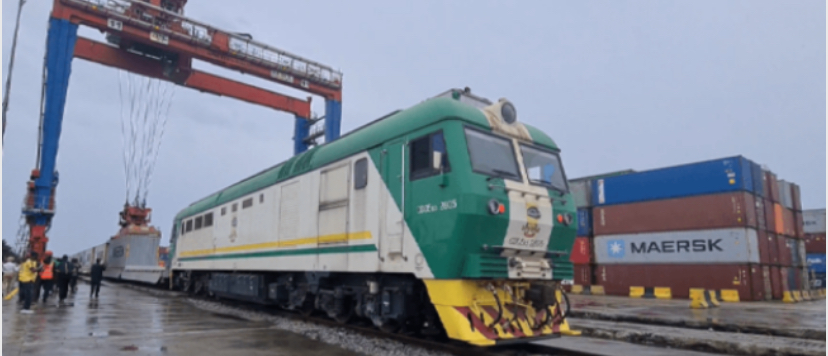
The $1.5 billion Lagos-Ibadan cargo train has been stranded at Apapa Port for weeks due to multiple handling charges, leading to delays in its operations.
During a visit by the Nigerian Tribune last week, the locomotive and its wagons were observed parked in the terminal with very few cargoes on board.
A port worker, who wished to remain anonymous, explained that the train has been sitting idle for weeks with cargoes still on it.
“Sometimes, the train waits weeks to be fully loaded. It doesn’t get fully loaded on time due to high costs and issues with door-to-door delivery,” the worker stated.
“When cargoes arrive, many importers prefer road haulage over rail haulage because of the high costs associated with rail. The train won’t leave unless it has a specific amount of cargo. So, at times, the Lagos-Ibadan cargo train spends weeks waiting for cargoes.
“If prices can decrease further, more cargo owners will choose rail haulage, and the train will fill up faster than it currently does,” the worker added.
In response to these claims, Engineer Augustine Arisa, the Lagos District Manager of the Nigerian Railway Corporation , NRC, stated that the charges for using the Lagos-Ibadan cargo train are not high.
READ ALSO : Borno State unveils Maiduguri rail project with 12 terminals
“It’s not true that our charges are high. Our charges are the lowest. Our issue is the other charges imposed on cargoes using rail haulage,” Engineer Arisa clarified.
“It’s true that we don’t provide door-to-door delivery services like trucks do, and it’s also true that a specific number of containers must be loaded onto the train before it can depart. We operate on diesel and cannot leave with just one, two, or even five import units of containers.
“To balance our operating costs with our earnings, the train needs to have a certain number of containers loaded before it can move.
“However, we won’t compel cargo owners to choose rail haulage. When the cargo arrives, the owners have the freedom to select which mode of transport they prefer for their cargoes to exit the port. Many cargo owners opt for road haulage because it provides door-to-door delivery options.
“Moreover, the issue of multiple handling charges is dissuading others who might want to use rail haulage. Consider this, if you have to pay rail handling charges after already paying for cargo handling charges, it adds up.
“When the cargo arrives, the terminal operator loads the container onto either a truck or the rail, depending on the importer’s preference. If the cargo is loaded onto a truck, the cargo owner only pays for cargo handling and settles with the truck owner. But if it’s to be loaded onto a train, the cargo owner pays both cargo handling and rail handling charges”, he explained.
After paying these charges, the train transports the containers to a rail station near the destination, where they are then transferred to a truck. Here, the cargo owner also pays for loading the container onto the truck for final delivery. Because of these multiple handling charges, importers tend to prefer trucks when they have just one or two containers.
It’s primarily importers with large quantities of containers who frequently use rail haulage. Those looking to clear only one or two containers typically opt for road haulage.
Reported by Nigerian Tribune