Fatima Damagum
A few weeks ago, a neighbour knocked on my door with a request. Her almajiri, who helped with the sweeping of her compound in exchange for food, was having recurrent headaches and fever.
When the boy did not show up for three days, she inquired from the other almajirai and heard that he was very ill. She wanted me to accompany her to the boy’s school to check up on him. I was apprehensive at first, but my curiosity got the better of me. I had never entered the traditional ‘tsangaya’ where Mallams teach almajirai boys.
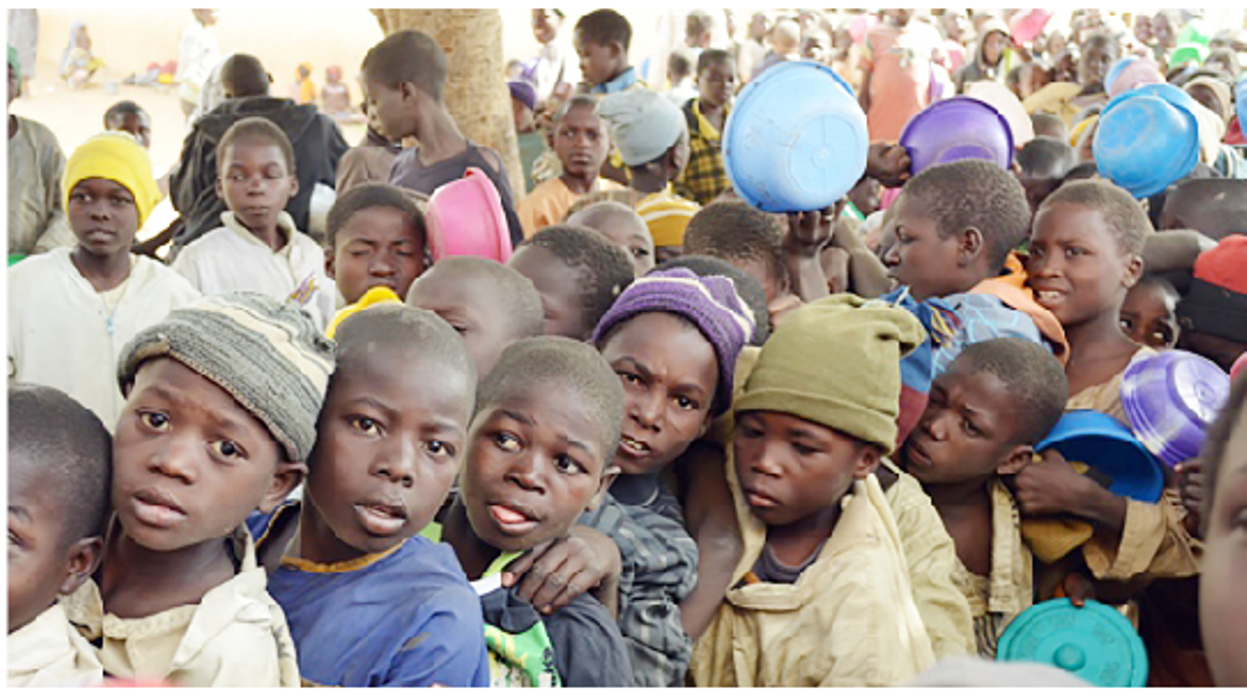
The Mallam was not at home when we arrived, so we sought the audience of his wife. He had three wives and 17 children. Each wife slept with her children in their respective rooms while the husband had a room to himself. When I asked where Mallam’s students slept, I was directed to an abandoned building opposite the house. None of the wives knew the particular almajiri we were looking for, so they appeared lost when my neighbour complained about him being ill.
Hassan was lying in a pool of his vomit when we arrived at the uncompleted building. There was no roof and he lay on the barely cemented floor in his filthy clothes. He looked to be about six years old and was writhing in pain when we arrived. He had the characteristic patches of ring worm on his scalp and the rash of scabies on his hands and torso. Some of his friends sat beside him, looking helpless. They had bought Paracetamol from a nearby patent medicine store, which he had promptly thrown up. His tiny body shook from fever and his hands felt clammy and cold, his pulse weak. I knew immediately that he was in big trouble. I told my neighbour that I suspected he was in septic shock and that he needed to get to a hospital as soon as possible.
Waiting for the Mallam, who was the boy’s rightful guardian was out of the question as we did not know when he would return, and asking for the wives’ support was an exercise in futility. My neighbour, a primary school teacher and mother of four, immediately took up his responsibility. We left a message for the Mallam and took the boy to the nearest general hospital.
READ ALSO: Kebbi studies Indonesian model to transform Almajiri education scheme
In the emergency department, I was able to convince them to start resuscitation immediately. Further examination and investigations revealed that he most likely had a perforated bowel due to typhoid fever, and so, would require surgery. Till this day, I marvel at the miracle those surgeons performed in the theatre. His intestines had perforated in up to six places and had been slowly leaking feaces into his abdominal cavity, causing an overwhelming infection (sepsis).
The prognosis was not good and I cautioned my neighbour against getting too involved. In her bid to help, she would be implicated if anything happened to the child. Thankfully, she understood the magnitude of the situation and decided to return to the Mallam’s house at night.
The next day, Hassan was still drowsy but appeared to be out of the woods. His fever was subsiding and his pulse was stronger.
The Mallam had been informed and he promised to send word to Hassan’s parents, who lived in a village in Gombe. He (the Mallam) never showed up throughout Hassan’s hospital stay. My neighbour spent up to N100,000 in the two weeks that Hassan was on admission.
Hassan’s mother eventually showed up six days after the surgery and her story was even more pitiful. I saw her thin frame, lines of poverty etched on her face, the brownish hue of her hair and immediately summarised the situation. She and Hassan’s father were divorced. She had remarried with other children and was in her fourth order of marriage after a series of divorce.
Hassan’s father, who sold firewood for a living, had two wives and 13 other children. Six of his boys had been sent to Kano, Maiduguri and Bauchi for Almajiranci, Hassan being the last. His daughters helped their mothers by hawking groundnuts at traffic junctions, markets and motor parks. The father had sent message that he could not come because he had no money to pay for transportation. To say the situation was pathetic is a gross understatement.
Every few years, the quest to end ‘Almajiranci’ in northern Nigeria resurfaces with very limited progress. When Emir Muhammadu Sanusi II, advocated the implementation of the Islamic Family Law that would make parents responsible for their wards, the collective outcry and rebuke he received would make one wonder if there was something wrong in the DNA of our northern leaders. Maybe it is something in the water we drink because I honestly cannot fathom any benefit of the Almajiri system of education in 2024 as currently implemented. I am sure it existed centuries ago, but in the present light of insecurity, overwhelming poverty and infectious diseases, those benefits have ceased to exist, and instead, constitute a menace and remain an issue of national disgrace.
I remember listening to a radio programme where one of the teachers of the ‘tsangaya’ system of Almajiri education was vehemently defending their right to continue the archaic system of learning, where a child as young as three years is made to leave home to live with an older Mallam in his home, along with hundreds of other children, for the purpose of receiving Quranic education. He argued that what the North needed was additional government support of the Almajiri system. After all, he reasoned, if the government could build schools for western education, why could they not do the same for the Almajiri system? Why were they (the almajirai) not included in various school feeding programmes? Were they not also the responsibility of the Nigerian government?
The problem with this line of thinking is that it is misleading and very inaccurate. It aims to promote rivalry and bigotry in the mind of the common man, while severely undermining the efforts of the government. There are many public schools in the North that incorporate Islamic education in their curriculum. Additionally, there are many purely Islamic schools that are supported by the State Universal Basic Education Board (SUBEB) and other beneficiary donor programmes. So, what is the problem?
The truth is simple: While the above-mentioned schools are government-owned, and therefore, free, the Almajiri system of education is owned solely by an individual; meaning he (the Mallam) alone stands to benefit from this system. Paltry as it may seem, these Mallams gain from the constant trickle of ‘alheri’ (funds) the parents sometimes send to them in return for their ‘kindness’ in teaching their children. Additionally, these boys serve as free labour to their masters, who make them do all manner of household chores, as well as farming their lands in villages. The Mallam also benefits from the ‘sadaqa’ (charity) he gets from well-meaning individuals in the form of foodstuff or money, which he uses solely for his family while the almajirai are left begging for food in the streets.
The night after Hassan’s surgery, I kept imagining him alone in that hospital bed in pain. We had returned to our respective homes to the warm embrace of our families, leaving him without the warmth of a mother or someone to hold his hand while he recovered; someone to wipe his tears and clean up a six-year-old boy; a boy whose parents were alive but had chosen to shirk their God-given responsibility and had instead left him at the hands of strangers.
Through my neighbour’s magnanimity, Hassan eventually healed and returned home with his mother to recuperate. I was able to convince her not to allow him return to Almajiranci but rather to enrol him in school. Funds were contributed by members of the neighbourhood for his education and upkeep.
There should be no more long talk—it is time to abolish this Almajiranci system. And the time is now.
Published by Daily Trust
Credible News.ng