Pope Francis, who died Monday at 88, will be buried Saturday after a funeral at St Peter’s Square attended by world leaders and mourners.
Preparations have reached their peak in Rome as the Vatican prepares to host the funeral of Pope Francis, scheduled for 10 a.m. local time on Saturday at St Peter’s Square.
The open-air service will be led by Cardinal Giovanni Battista Re, the dean of the college of cardinals.
Delegations from 170 countries are expected at the event. Leaders confirmed to attend include Donald Trump and Melania Trump from the United States; President Emmanuel Macron of France; President Volodymyr Zelenskyy of Ukraine; President Sergio Mattarella and Prime Minister Giorgia Meloni of Italy; King Felipe and Queen Letizia of Spain; President Michael D. Higgins and Taoiseach Micheál Martin of Ireland; UK Prime Minister Keir Starmer and Prince William; President Andrzej Duda of Poland; President Marcelo Rebelo de Sousa and Prime Minister Luís Montenegro of Portugal; and President Luiz Inácio Lula da Silva of Brazil.
President Javier Milei of Argentina, despite past criticism of the late pope, will also be in attendance. Mexico will be represented by Interior Minister Rosa Icela Rodríguez.
From Asia, President Ferdinand Marcos Jr of the Philippines will attend. Russia is sending Culture Minister Olga Lyubimova, while President Vladimir Putin, who is under an ICC arrest warrant, will not be present.
Among opposition leaders expected are Alberto Núñez Feijóo of Spain’s People’s Party and Jordan Bardella of France’s National Rally.
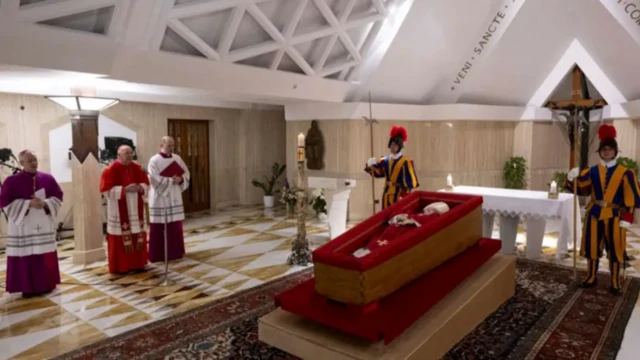
Since Wednesday morning, tens of thousands have filed past the pope’s body laid in state inside St Peter’s Basilica in a simple wooden coffin. Over 50,000 people viewed the body in the first 24 hours alone.
Security in Rome has been heightened. Over 2,000 officers are deployed around the Vatican, supported by 400 traffic officers managing diplomatic movements. Barriers are in place inside and outside the basilica.
The skies are restricted under a no-fly zone with anti-drone systems, fighter jet patrols, and electronic jamming technology. Anti-terrorism and anti-sabotage teams have been activated.
Pope Francis had previously approved simplified funeral rites, differing from traditional papal funerals.
READ ALSO: Cardinal Farrell administers Vatican after Pope’s death
He declined the customary three-coffin method and opted for a single coffin made of wood and lined with zinc.
He also rejected being placed on an elevated bier with cushions, calling for simplicity and dignity.
His burial will also break with papal tradition. Rather than the Vatican grottoes, Francis will be buried in Santa Maria Maggiore Basilica in Rome’s Esquilino district.
The basilica, one of the oldest Marian shrines in Rome, houses an icon of the Virgin Mary and relics of Jesus’s manger.
It was a frequent place of prayer for Francis during his pontificate. He had previously stated the location was chosen and ready.
Following Saturday’s mass, a procession will escort his coffin to the basilica, where the public will be allowed to visit his tomb starting Sunday morning.
The tomb will be marked with his papal name in Latin: Franciscus, with no elaborate decorations, as per his request.
The funeral initiates the Novemdiales—a nine-day mourning period with daily masses offered for the repose of the pope’s soul.
Within 15 to 20 days after his death, the college of cardinals will convene a conclave in the Sistine Chapel to elect a new pope.
Only cardinals under 80 years of age—135 in total—are eligible to vote. They will swear oaths of secrecy and cast votes daily.
Black smoke from the chapel chimney indicates inconclusive voting, while white smoke signals the election of a new pope.
Although predicting a successor is uncertain, widely discussed contenders include Cardinal Matteo Zuppi of Italy, Cardinal Pietro Parolin, the Vatican’s Secretary of State, and Cardinal Luis Antonio Tagle from the Philippines.
Theguardian.com