Nosmot Gbadamosi/ Africa Brief
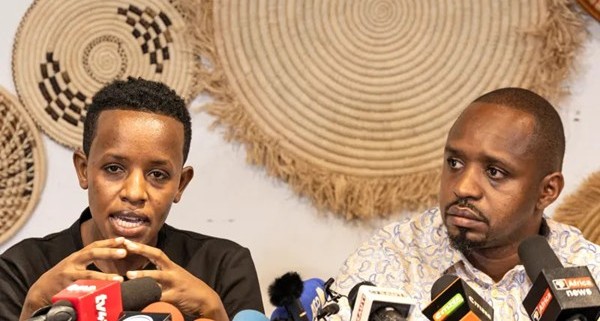
Two activists from Uganda and Kenya said on Monday that they were sexually assaulted by Tanzanian security forces while detained in the country last month.
The two travelled to the country in May to attend the trial of opposition leader Tundu Lissu in the capital, Dar es Salaam. The allegations come as Tanzania cracks down on dissent ahead of an October general election, in which Lissu hopes to run. He is being tried on several charges, including treason.
Agather Atuhaire of Uganda and Boniface Mwangi of Kenya were arrested at their hotel on May 19 before being driven to an unknown location, where they say they were tortured and “subjected to unimaginable cruelty” until May 23, according to Amnesty International. Following their detention, the activists said that officials dumped them near their countries’ borders with the country.
Atuhaire said that she was stripped, raped, and smeared with excrement. The entire ordeal was filmed—“to humiliate, instil fear, but also [to] silence you,” she told AFP. “[But] I am not that victim … I am not the one who should be ashamed.” Back home, Atuhaire has also campaigned against the nearly 40-year rule of Ugandan President Yoweri Museveni.
Atuhaire’s and Mwangi’s cases were not isolated events. Former Kenyan Justice Minister Martha Karua was detained at the Dar es Salaam airport on May 19 and subsequently deported from Tanzania; she also sought to attend Lissu’s trial. Karua accused Tanzania’s government of “subverting the law to lock up the main contenders so that they can sail through unopposed” in the election.
“[L]et them not come here to meddle. Let’s not give them a chance,” Tanzanian President Samia Suluhu Hassan said at a May 19 event, speaking about activists from other East African countries seeking to visit Tanzania. “I have seen clips circulating on social media criticizing my approach,” she added, “but it is my responsibility to uphold and protect the constitution.”
Also Read: Tanzanian police detain Chadema leaders ahead of protest
Lissu leads Tanzania’s main opposition party, Chadema. He was arrested in April after calling for Tanzanians to boycott the October vote; he argued that the elections could not be free or fair as long as Samia directly appoints members of Tanzania’s National Electoral Commission. Lissu has also demanded electoral reforms.
Chadema was subsequently banned from participating in the contest, and Lissu was charged with treason and sedition. The Electoral Commission said that Chadema was barred because it had failed to sign an electoral code of conduct.
Influential Christian faith leaders have faced similar crackdowns for joining calls for electoral reforms. “Arresting people and detaining them does not silence the people’s grievances; it only deepens the divisions and drives people further apart,” Jacob Mameo Ole Paul, an Evangelical Lutheran bishop, said last month.
On Monday, armed police shut down a church in Dar es Salaam after its leader criticized a recent spate of politically motivated abductions. Chadema activist Mdude Nyagali was abducted on May 2 by unidentified assailants; his whereabouts remain unknown. And Lissu survived an assassination attempt in 2017 and then spent several years in exile before returning to Tanzania in 2020.
Samia took office in March 2021 as a transitional leader to finish the term of President John Magufuli, whom many believe died from COVID-19. She earned praise from international rights groups in her first term for her pandemic response and expansion of political freedoms. But critics say that Samia has adopted Magufuli’s authoritarian tactics to ensure her re-election.
Tanzania restricted social media access in May after hackers targeted government accounts on X. Last year, Samia’s administration temporarily suspended online licensing for three major newspapers after they published a cartoon that criticized her over rising forced disappearances in the country. Samia’s Chama Cha Mapinduzi party has governed Tanzania for more than five decades.
Lissu appeared in court on Monday, chanting slogan, “No reforms, No election.” His lawyers have asked the United Nations Working Group on Arbitrary Detention for help ensuring his release, but the group’s advisory opinions cannot be legally enforced.