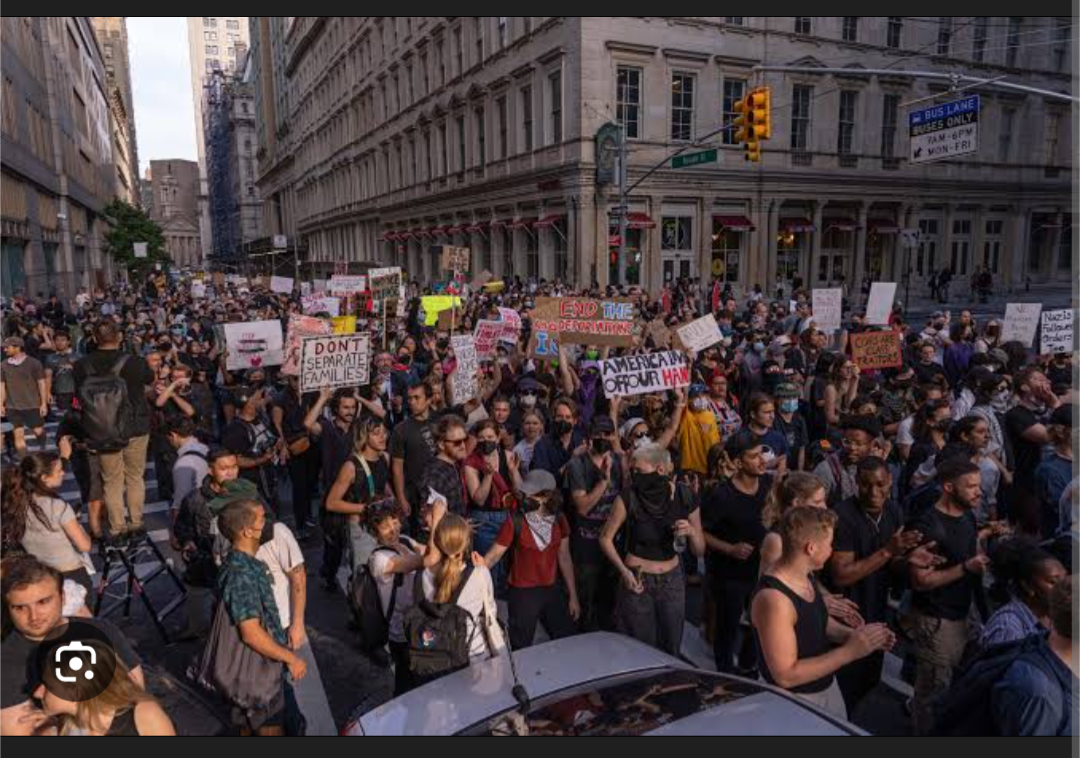
Coordinated “No Kings” protests are taking place across the United States as part of a “national day of peaceful protest” against the Trump administration. Organizers expect millions to participate nationwide.
In various regions, demonstrators braved wet weather to raise signs and chant slogans in support of immigrant rights and in opposition to what they describe as a power grab by former President Donald Trump.
While some protests had a festive tone, others were more intense, with several confrontations reported between demonstrators and counter-protesters. In Atlanta, members of the far-right Proud Boys appeared at a “No Kings” protest, donning the group’s signature black and yellow attire.
In Minnesota, planned protests were cancelled due to safety concerns following a series of shootings that targeted local lawmakers, according to authorities.
In Florida, marchers approached Mar-a-Lago, Trump’s Palm Beach estate, as closely as police would permit and were met by Trump supporters. Meanwhile, tens of thousands of protesters marched into Philadelphia, the historic site of the Declaration of Independence.
Why Americans are protesting
It was not only President Trump’s immigration crackdown that drew thousands of Americans to protests around the country on Saturday, or just the military parade that Mr. Trump had planned for the evening. In dozens of interviews over the course of the day, protesters in more than 20 cities shared many other reasons they had shown up to speak against the president and his policies.
For Vinnie Walsh, 82, of Auburn, Mass., it was “the whole nine yards — the loss of decency, courtesy, compassion, democracy.” Laurae Carpenetti, 54, a physician from the Atlanta suburbs, said that Mr. Trump’s appointment of Robert F. Kennedy Jr. as his top health official was her motivating factor.
Jerry Herrejon, 38, of Chicago, said he was protesting proposed cuts to Medicaid, and Meredyth Sparks, 53, an artist from Queens, said she was most concerned about policies that limited the rights of transgender people.
For many, it was not their first time protesting since Mr. Trump took office in January. Tony Font, 70, of Dallas, said it was his fourth such protest. He was born in Cuba and came to the United States as a child in the 1960s, and he said the events of the past few months had reminded him of the authoritarian government that caused him to flee his native country.
“What I’m seeing going on now is exactly the same thing that I saw in Cuba when I was a kid,” said Mr. Font, a retired teacher. “People getting arrested on the street for no reason, neighbors watching neighbors and telling on them, and the government concentrating power.”
Also Read: Americans protest Trump’s denial of rights
Others attending protests said that being with like-minded people was giving them a burst of energy and enthusiasm after a long period of gloom. In Waukesha, Wis., which leans conservative, Becky Gilligan, 44, said she was exhilarated by the size of the crowd there.
“To see this many people is absolutely incredible in such a red place,” she said. “Around here, I mean, I feel like I definitely do keep my politics more to myself, unless I know that the person is trusted.”
Some protesters were sombre, like the woman in Austin wearing a long red dress and white bonnet inspired by “The Handmaid’s Tale,” the dystopian Hulu series based on the novel by Margaret Atwood. Others were festive, like those drumming and dancing despite steady rain in Springfield, Mass., or blowing bubbles in Culver City, Calif.
In Portland, Ore., where several demonstrations merged into one and protesters marched peacefully downtown, the mood was serious but also laced with a kind of buoyant joy. Terrill Grubbs, a 66-year-old resident of the city, paused to take in the crowd, saying, “We the people are the government, and it is thrilling to be part of this.”
The news that a Democratic state representative in Minnesota was assassinated overnight horrified protesters like Mitch Atias, 71, of Queens, but it did not deter them from making their voices heard. Mr. Atias, a retired high school science teacher, said he was motivated by the domestic policy bill moving through Congress, a top priority for Mr. Trump, which would slash taxes while cutting health, nutrition, education and clean energy programs.
“I don’t think we’ll be listened to here,” Mr. Atias said. “But if enough people come out across the country, maybe the elected leaders will listen. What else can I do?”
With reports from NY Times