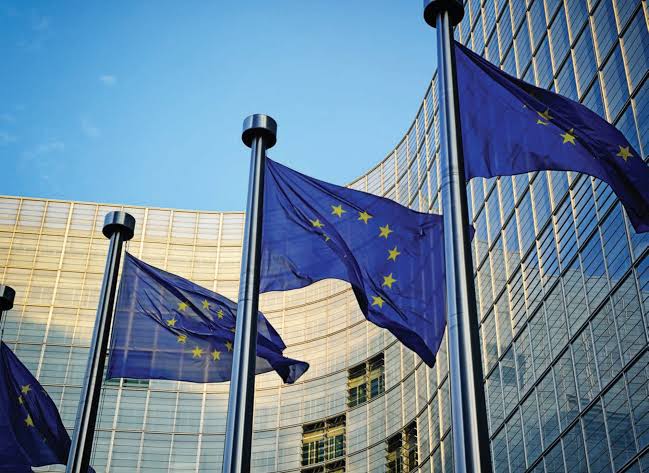
The EU is preparing to bring forward its ban on Russian gas imports, in a move designed both to weaken Moscow’s war economy and to align more closely with U.S. President Donald Trump’s push for a harder stance against the Kremlin.
On Friday, the European Commission unveiled its latest sanctions package — the 19th since Russia launched its full-scale invasion of Ukraine in 2022.
Central to the proposal is a plan to accelerate the phase-out of Russian liquefied natural gas (LNG), setting a new cut-off date of January 1, 2027. This deadline advances the bloc’s previous commitment by one full year.
“Russia’s war economy is sustained by revenues from fossil fuels. We want to cut these revenues. So we are banning imports of Russian LNG into European markets. It is time to turn off the tap,” said Commission President Ursula von der Leyen while presenting the package.
The timing of the announcement underscores the influence of Washington on European policy. President Trump, who has so far adopted a cautious approach toward Russian President Vladimir Putin, recently signaled that his administration could tighten its stance if Europe demonstrated stronger resolve.
He has urged EU states to halt fossil fuel imports from Russia and to impose tariffs on China, which continues to trade heavily with Moscow.
For Brussels, the proposal serves a dual purpose: it responds to mounting U.S. pressure while also showing European citizens that the bloc is determined to speed up its energy independence strategy.
Before the Ukraine war, the EU was deeply reliant on Russian gas, with imports accounting for about 45 percent of its total supply. That dependence has sharply fallen in the past three years.
By mid-2025, Russian oil imports into Europe had been slashed from 29 percent of the bloc’s supply in early 2021 to just two percent, after successive rounds of sanctions.
Natural gas dependency has been more complicated to unwind. Russia still supplied 19 percent of the EU’s gas in 2024, largely due to LNG imports delivered by sea, which compensated for the steep decline in pipeline deliveries. By contrast, pipeline flows through Nord Stream and other routes have collapsed since the war began.
ALSO READ: Russia warns, Ukraine may drag NATO to war
According to European Commission data, 32 billion cubic metres of gas entered Europe in 2024 via the TurkStream pipeline, while 20 billion cubic metres arrived as LNG shipments.
Major LNG terminals in France, Spain, Italy, the Netherlands, and Belgium handle most of these imports, although some shipments transit onward to other countries.
Despite the bloc’s determination, challenges remain. Hungary and Slovakia, both seen as friendly to Moscow and politically aligned with Trump, continue to purchase Russian oil and gas.
Their opposition could complicate efforts to secure unanimous approval for the new measures, as EU sanctions require full member-state backing.
Nonetheless, foreign policy chief Kaja Kallas struck a firm tone, stating that the bloc was determined to make Russia “pay the price” for prolonging the war.
She stressed that bringing forward the gas ban was a clear message that Moscow’s assumption of Europe’s continued dependence was misplaced.
The shift also opens new opportunities for the United States, already the largest supplier of LNG to Europe.
In 2024, American LNG accounted for about 45 percent of all EU imports, cementing the U.S.’s role as Europe’s dominant energy partner.
This reliance on American gas underscores the strategic dimension of the EU’s sanctions: while they aim to deprive Moscow of revenues, they also deepen the continent’s integration with U.S. energy markets.
For Trump, this represents not only a geopolitical win but also an economic one, boosting American exports.
The decision to accelerate the gas phase-out is not without risk. Energy prices in Europe remain volatile, and although storage levels are healthier than in 2022, the bloc still faces seasonal pressures and infrastructural bottlenecks.
Policymakers must balance the economic pain of higher energy costs with the political imperative of cutting Russian revenues.
Even so, officials in Brussels argue that the long-term benefits outweigh the short-term costs. By reducing dependence on Moscow and aligning with Washington, the EU hopes to strengthen its geopolitical leverage while avoiding the vulnerabilities exposed by Russia’s invasion of Ukraine.
As von der Leyen concluded: “Europe must prove that it can lead with resolve. Turning off the tap to Russian LNG is not just about economics — it is about defending our security and standing with Ukraine.”
Punch