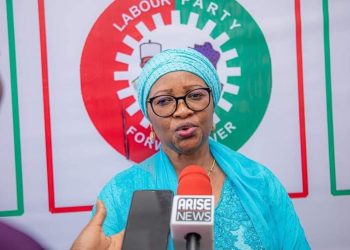
![Senator Natasha Akpoti-Uduaghan. [PHOTO CREDIT: Business Day]](https://crediblenewsng.com/wp-content/uploads/2025/04/download-1.jpeg)
Suspended Kogi Central Senator, Natasha Akpoti-Uduaghan has once again become the focus of a high-profile legal battle, as her cybercrime trial before the Federal High Court in Abuja failed to commence on Monday.
The delay followed a preliminary objection raised by her lead counsel, Chief Ehiogie West-Idahosa, SAN, challenging the jurisdiction of the court to hear the case.
The senator is standing trial on a six-count charge under the Cybercrimes (Prohibition, Prevention, etc.) (Amendment) Act, 2024. The Federal Government claimed that she disseminated false and injurious claims via electronic communication that had the potential to incite violence, endanger lives, and disrupt public order.
Specifically, the charges stem from remarks she allegedly made on April 1 and April 4, 2025, both at a community gathering in Ihima, Kogi State, and later during a television interview.
The prosecution claims she accused Senate President Godswill Akpabio of instructing former Kogi State Governor, Yahaya Bello, to ensure her assassination in Kogi rather than Abuja, so that it would appear to be a local attack.
One of the charges reads: “…and Akpabio told Yahaya Bello, I am saying, standing by what I have said. He told him that he should make sure that killing me does not happen in Abuja, it should be done here, so it will seem as if it is the people that killed me here…”
The prosecution argues that such a statement not only maligns the reputation of the Senate President but also constitutes an offence under Section 24(2)(c) of the Cybercrimes Act.
Another count alleges that the same statement similarly injured the reputation of former Governor Bello.
ALSO READ: Natasha prepares for resumption at the Senate
Both Akpabio and Bello are listed as individuals affected by the claims, which the government insists amount to unlawful electronic communication designed to threaten public peace.
At the resumed sitting, the prosecution, led by David Kaswe, announced readiness to open its case by calling its first witness.
A television screen had been mounted in the courtroom in preparation, suggesting that video evidence might be part of the proceedings.
However, this plan was disrupted when the defence objected to the court’s jurisdiction.
West-Idahosa argued that the objection was not about the substance of the charges but about what he described as “an abuse of the prosecutorial powers of the Attorney-General of the Federation.”
He also noted that the defence team had not been served with copies of the prosecution’s witness statements, a development he said would deny his client a fair trial.
Kaswe countered, insisting that the objection should not prevent the prosecution from opening its case, as the matter had already been scheduled for trial commencement. But Justice Mohammed Umar disagreed. He maintained that the objection must be addressed first, stressing that jurisdictional issues go to the very foundation of any trial.
Justice Umar therefore adjourned the case to October 20, 2025, for the hearing of the preliminary objection and the possible commencement of trial.
The case has attracted nationwide attention not only because of the personalities involved but also because it falls under Nigeria’s recently amended cybercrime legislation, which broadens the scope of offences linked to digital communication.
For Akpoti-Uduaghan, this legal battle adds to her turbulent political journey. Elected as senator for Kogi Central in 2023, she was suspended from her duties earlier this year amid the cybercrime allegations.
Her camp insists that the case is politically motivated, targeting her outspokenness and criticism of powerful figures within and outside Kogi State.
Meanwhile, the prosecution maintains that the case is about accountability and protecting public figures from dangerous falsehoods.
Should the trial proceed, it is expected to feature both documentary and digital evidence, as well as witness testimonies that could either strengthen or weaken the government’s case.
As the October 20 date approaches, legal analysts say the ruling on the preliminary objection will be pivotal. If the court upholds the objection, the case could collapse at an early stage.
If dismissed, the trial will proceed, potentially setting a precedent for how Nigeria’s courts interpret and enforce cybercrime laws in cases involving high-ranking political figures.
NAN