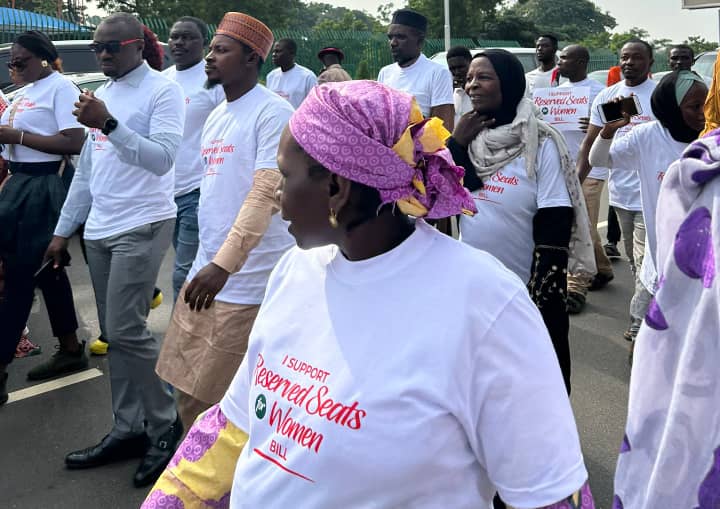
Hundreds of women converged in Abuja on Monday in a spirited protest demanding the creation of women-only seats in Nigeria’s National Assembly.
The demonstration, which drew participants from across the country, was part of a growing campaign to address the chronic underrepresentation of women in Nigerian politics.
The protesters, organized under various women’s rights and advocacy groups, rallied behind the “Special Seats Bill” — a proposed legislation that would reserve one female-only seat in both the Senate and the House of Representatives for each of Nigeria’s 36 states and the Federal Capital Territory.
If passed, the measure would require a constitutional amendment, as Nigeria’s laws currently provide no quota or reservation system for female legislators.
Nigeria’s representation of women in parliament remains among the lowest globally. According to the Policy and Legal Advocacy Centre, only four women currently serve in the Senate out of 109 members, while just 16 women occupy seats in the 360-member House of Representatives.
Advocates argue that entrenched gender roles, financial barriers to campaigning, and the dominance of male power brokers have kept women largely on the margins of political decision-making.
The demonstrators arrived in Abuja in a caravan of buses, vans, and even a truck blaring Afrobeats music, filling the city’s boulevards with chants and placards. Dorothy Njemanze, one of the organisers, told reporters that more than 1,000 women participated.
“We want the legislature to work for women,” she said. “This bill is about ensuring our voices are heard where decisions are made.”
ALSO READ: Youths protest kidnappings, bad governance in Kwara State
At the end of their march, the protesters presented thousands of signatures to a House committee currently reviewing proposals for constitutional reform.
Support for the initiative has come from some quarters of government, including the Minister of Women’s Affairs, Hajiya Imaan Sulaiman-Ibrahim, who has publicly endorsed the legislation.
However, constitutional amendments in Nigeria face an uphill task, requiring approval from two-thirds of the National Assembly and ratification by at least 24 state legislatures.
Still, participants at the protest expressed hope. “I want that seat, because tomorrow, I may be the one contesting for it,” said Onu Ihunania, a 50-year-old civil servant who joined the march.
Another protester, Nyiyam Ikyereve, who travelled from Benue State, said increasing women’s representation would bring greater focus to maternal health, education, and economic inclusion.
The issue of women’s participation in politics came to national attention earlier this year after Senator Natasha Akpoti-Uduaghan was suspended from the Senate, sparking debates about gender discrimination in the chamber.
While the Senate leadership insisted the suspension was unrelated to gender, women’s groups cited the incident as evidence of the challenges female politicians face.
Advocates say Nigeria has much to learn from countries like Rwanda and Senegal, where quota systems have significantly increased the number of women in parliaments.
For many of the protesters in Abuja, the Special Seats Bill represents not just political reform, but a chance to reshape the nation’s future.
Punch