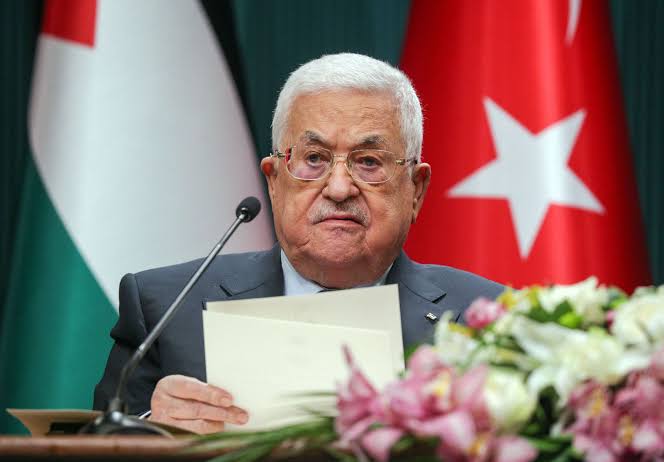
President Mahmoud Abbas has called on the international community to urgently recognise Palestinian statehood and support a two-state solution, while distancing the Palestinian cause from the October 2023 Hamas attack on Israeli civilians.
Speaking in a recorded video address to the United Nations General Assembly on Thursday, Abbas painted a grim picture of the situation in Gaza, describing it as a “war of genocide, destruction, starvation, and displacement” inflicted by Israeli military operations.
He said more than 220,000 Palestinians had been killed or injured in nearly two years of conflict, with women, children, and the elderly making up the majority of victims.
He further revealed that two million people were facing starvation due to Israel’s blockade, while more than 80 per cent of Gaza’s homes, schools, hospitals, churches, mosques, and public infrastructure had been destroyed.
“What Israel is carrying out is not merely an aggression,” Abbas said. “It is a war crime and a crime against humanity—one of the most horrific chapters of humanitarian tragedy in modern history.”
Turning to the West Bank, Abbas highlighted rising settler violence, continued land confiscations, and what he described as Israel’s “Greater Israel” expansion strategy.
He warned that these moves threatened to divide the West Bank, isolate occupied Jerusalem, and permanently undermine prospects for a two-state solution.
Religious sites, he added, had not been spared, citing attacks on mosques, churches, and cemeteries.
ALSO READ: Italy gives condition on recognition of Palestine
In a significant move, Abbas unequivocally condemned Hamas’s October 7, 2023, attack on Israeli civilians, stressing that such actions “do not represent the Palestinian people, nor their just struggle for freedom and independence.”
He insisted that Gaza remained an inseparable part of Palestine and said the Palestinian Authority was ready to assume full governance and security responsibilities there under the principle of “one state, one law, and one legal security force.”
“We do not want an armed state,” he said, outlining his vision of a democratic Palestine built on the rule of law, peaceful transitions of power, and respect for human rights, including the empowerment of youth and women.
Abbas lamented that more than 1,000 United Nations resolutions on Palestine remain unimplemented, despite Palestinian leaders recognising Israel and committing to peace since the Oslo Accords of 1993.
He accused Israel of systematically undermining these agreements while Palestinians kept to their commitments, including rejecting violence and reforming national institutions.
The Palestinian leader welcomed outcomes from a high-level conference in New York earlier this week, co-chaired by France and Saudi Arabia, and thanked the growing number of countries recognising Palestine. He urged others to follow suit and back Palestine’s bid for full UN membership.
“Peace cannot be achieved if justice is not achieved, and there can be no justice if Palestine is not freed,” Abbas said, pledging cooperation with the United States, Saudi Arabia, France, the UN, and other partners to implement the latest peace plan.
In closing, he vowed that Palestinians would never surrender their homeland or abandon their rights.
“No matter how long the suffering lasts, it will not break our will to live and survive,” Abbas declared. “The dawn of freedom will emerge, and the flag of Palestine will fly high as a symbol of dignity and steadfastness.”