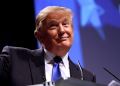
United States President Donald Trump has escalated his protectionist trade agenda by announcing a 100% tariff on all foreign-made films imported into the country.
The move, disclosed on Monday marks an unprecedented extension of trade tariffs into the cultural sector, threatening to upend Hollywood’s global business model.
In a post on his Truth Social platform, Trump argued that foreign film industries have eroded America’s dominance in movie-making. “Our movie-making business has been stolen from the United States of America, by other Countries, just like stealing candy from a baby,” he wrote.
The announcement immediately triggered anxiety across the entertainment industry. Shares of major studios, including Paramount Skydance and Warner Bros Discovery, dropped by 2.1% and 1.3% respectively, as investors worried about higher costs and market disruptions. Streaming giant Netflix and Comcast, parent company of Universal Pictures, declined to comment.
Paolo Pescatore of PP Foresight said: “There is too much uncertainty, and this latest move raises more questions than answers. For now, as things stand, costs are likely to increase, and this will inevitably be passed on to consumers.”
What remains unclear is how the tariffs will be enforced. Modern film production often involves complex international collaborations — with financing, visual effects, and post-production spread across multiple countries.
A superhero blockbuster, for instance, may be shot in Canada, edited in the UK, and finished with special effects in Australia. Industry executives fear that such integrated processes make it nearly impossible to define which films qualify as “foreign-made.”
ALSO READ: German pharma warns Trump tariffs risk global crisis
Trump had floated the idea of tariffs on foreign movies as far back as May 2025, but his latest statement is the first to outline a blanket 100% duty on all imports.
The decision comes at a time when Hollywood has become increasingly dependent on overseas markets and collaborations.
Production hubs in Canada, the UK, and Australia have attracted U.S. studios with lucrative tax incentives, while co-productions with partners in Asia and Europe have provided new financing and expanded global reach.
Executives warn that the tariffs could jeopardize not only studio profits but also thousands of U.S. jobs tied to overseas shoots, from visual effects artists to technical crews.
“This policy risks hurting the very American workers it is supposed to protect,” one studio executive told Reuters.
For Trump, however, the measure plays into his broader message of restoring American dominance in industries he believes have been hollowed out by globalization.
It also reflects his campaign strategy of appealing to cultural nationalism while taking a combative stance on trade.
As the film industry braces for impact, the world will be watching closely to see whether Trump’s tariff threats materialize into enforceable policy — or become another bargaining chip in his wider trade wars.