The Federal Government has reaffirmed its partnership with the World Bank-funded Agro-Climatic Resilience in Semi-Arid Landscapes, ACReSAL, project to tackle land degradation, promote sustainable agriculture, and strengthen livelihoods in northern Nigeria.
The joint effort, spanning 19 states, is designed to mitigate the adverse impacts of climate change while promoting ecosystem recovery and food security across the region.
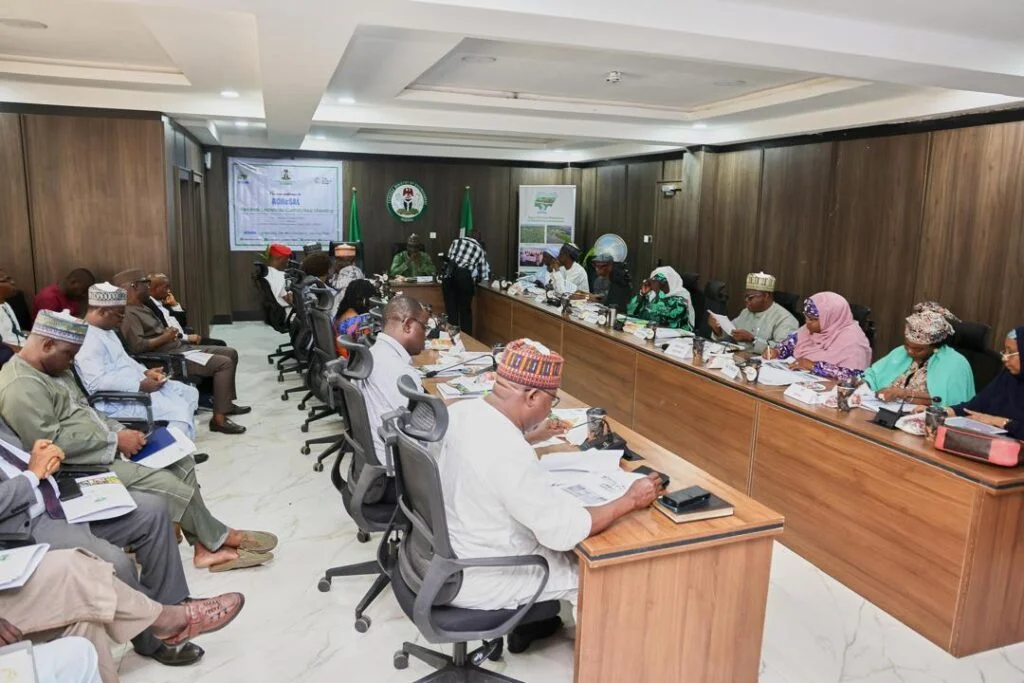
At the Federal Technical Committee meeting in Abuja, key stakeholders from the Ministries of Environment, Agriculture, and Water Resources gathered to review ACReSAL’s progress and chart a new course for the coming year.
Permanent Secretary of the Federal Ministry of Environment, Mr. Mahmud Kambari, described the initiative as a landmark step in Nigeria’s pursuit of climate resilience and sustainable land management.
“As we confront drought, desertification, and food insecurity, our collaboration with ACReSAL is turning vision into measurable progress,” he said.
Dr. Marcus Ogunbiyi, Permanent Secretary of the Ministry of Agriculture and Food Security, noted that the project aligns with the government’s strategy to enhance food production through climate-smart agriculture.
He explained that ACReSAL supports drought-tolerant crops, soil restoration, and adaptive farming practices that enable smallholder farmers to withstand environmental shocks. “We are empowering farmers and protecting rural livelihoods, ensuring that agriculture remains viable despite climate pressures,” Ogunbiyi said.
ALSO READ: World Bank lauds ACReSAL as successful project
On his part, the Permanent Secretary in the Ministry of Water Resources and Sanitation, Mr. Richard Pheelangwah, highlighted ACReSAL’s integrated approach to water conservation and ecosystem management.
He noted that the project’s interventions in watershed rehabilitation, irrigation management, and rainwater harvesting are not only improving agricultural productivity but also enhancing public health outcomes in semi-arid communities.
National Project Coordinator, Mr. Abdulhamid Umar, presented data showing that ACReSAL has successfully restored over 800,000 hectares of degraded land, benefiting approximately 8.7 million people — 4.1 millions of whom are women.
The initiative, he said, has transformed previously degraded areas such as the Nguru Wetlands and Hadejia axis into thriving ecosystems, providing a model for sustainable land restoration.
The project’s comprehensive strategy includes afforestation, reforestation, erosion control, water management, livelihood empowerment, and policy reform.
By integrating technology-driven interventions with community participation, ACReSAL is demonstrating how coordinated environmental action can yield both ecological and economic dividends.
The meeting ended with a collective pledge to deepen inter-ministerial collaboration and ensure that the project delivers measurable results for communities most affected by desertification and drought.
NAN
![Nnamdi Kanu, the leader of the proscribed Indigenous People of Biafra, IPOB.[PHOTO CREDIT: Ripples Nigeria]](https://crediblenewsng.com/wp-content/uploads/2025/04/Nnamdi-Kanu--75x75.jpg)