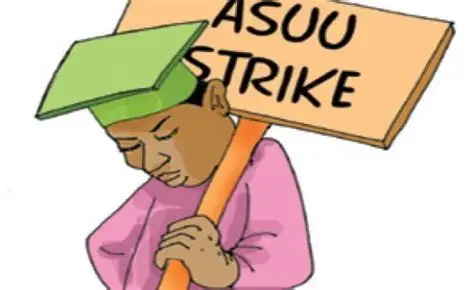
The Academic Staff Union of Universities, ASUU, has declared a two-week warning strike across all public universities in Nigeria, marking another chapter in the long-standing standoff between the union and the Federal Government over unresolved issues affecting the tertiary education sector.
The National President of ASUU, Professor Chris Piwuna, announced the industrial action during a press briefing held on Sunday at the University of Abuja, stating that the union had exhausted all avenues for dialogue before resorting to the strike.
“Compatriots of the press, it goes without saying that there is nothing sufficient on ground to stop the implementation of the ASUU-NEC’s resolution to embark on a two-week warning strike at the expiry of the 14-day notice given on the 28th of September, 2025,” Piwuna declared.
He explained that the decision to proceed with the strike followed the failure of the Federal Government to meet several long-standing demands, including the renegotiation of the 2009 ASUU-FGN Agreement, the payment of withheld salaries and earned academic allowances, and the release of revitalization funds for public universities. According to him, the government’s persistent neglect of these issues has left the union with no other option but to take industrial action once again.
Piwuna directed all ASUU branches across the country to withdraw their services effective midnight, Monday, October 13, 2025, stressing that the action would be “total and comprehensive”, meaning that all teaching, research, and administrative duties are to be suspended for the duration of the strike.
READ ALSO:FG, ASUU enter final phase of strike negotiations
“The strike is to serve as a warning to the government that ASUU will no longer tolerate the continued decay of the university system, the casualization of academic staff, and the disregard for collective agreements. We are committed to defending the integrity of the Nigerian university system and the welfare of our members,” he added.
The ASUU president further noted that the union had engaged in numerous meetings and consultations with relevant government bodies in recent months, but all efforts to resolve the lingering disputes had been met with delays and unfulfilled promises. He expressed disappointment that despite repeated assurances, the necessary actions to address the union’s concerns were yet to be implemented.
Piwuna also called on students, parents, and members of the public to understand the union’s position, explaining that the strike was not intended to punish students but to safeguard the future of public education in Nigeria. “We are fully aware of the inconvenience this may cause our students and their families, but this action is necessary to compel the government to do what is right for the system,” he said.
He concluded by reaffirming ASUU’s commitment to the advancement of quality education and warned that if the government fails to take decisive steps within the two-week window, the union may be forced to escalate its actions.