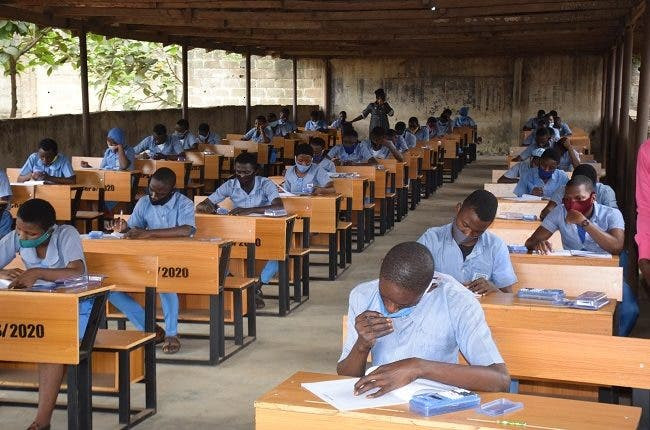
The West African Examinations Council, WAEC, has announced a major reform in its subject combinations for the 2026 West African Senior School Certificate Examination.
It introduced new restrictions that prevent Science and Arts students from registering for Economics.
Under the updated structure, only Commercial students will be allowed to include Economics in their exam list, marking a significant shift in WAEC’s academic categorization for secondary school candidates across Nigeria and West Africa.
The new guideline stipulates that every student must register for a minimum of seven and a maximum of nine subjects, with English Language, Mathematics, and Civic Education remaining compulsory for all categories.
Science students
Science students will continue to take subjects with both theory and practical components. Schools without standard laboratories are permitted to use the approved alternative-to-practical system.
The core subjects for this category include English Language, Mathematics, Civic Education, Physics, Chemistry, and Biology. Optional subjects include Further Mathematics, Geography, Agricultural Science, Technical Drawing, or a Nigerian language such as Yoruba, Igbo, or Hausa.
Arts students
Arts students will focus on languages, social sciences, and humanities. Their core subjects include English Language, Mathematics, Civic Education, Literature in English, Government or History, Religious Studies (CRS or IRS), and a Nigerian language. Economics is now restricted and can only be taken under specific WAEC-approved conditions at the local level.
READ ALSO: WAEC rectifies errors in School Certificate exam results
Commercial students
Students in the Commercial category will specialize in business and finance-related disciplines. Their core subjects include English Language, Mathematics, Civic Education, Economics, Accounting, Commerce, and Office Practice. Optional subjects include Further Mathematics, Book Keeping, Agricultural Science or Biology, and a Nigerian language.
Trade subjects
WAEC reaffirmed the inclusion of trade subjects, designed to promote entrepreneurship and self-reliance. Students must take at least one trade subject out of 35 available options. These include Animal Husbandry, Carpentry and Joinery, Catering Craft Practice, Data Processing, Garment Making, Photography, Welding and Fabrication, GSM Phone Repairs, Marketing, Plumbing, Tourism, and Upholstery.
Guidelines for selection
WAEC emphasized that students must register for the three compulsory subjects—English Language, Mathematics, and Civic Education—select one trade subject, and choose two to five additional subjects from their respective categories, bringing the total to eight or nine subjects per student.
Purpose of the reform
The 2026 reform aims to streamline academic focus, promote specialization, and better prepare students for their future careers or entrepreneurial pursuits. Education analysts view the move as part of a broader effort to align secondary education with modern curriculum reforms and evolving global standards.
The new subject combination framework is expected to take effect from the 2026/2027 academic session, reshaping school timetables, curriculum planning, and students’ career pathways.
WAEC urged students and parents to consult school counselors or visit its official website for detailed registration guidelines.
Crediblenewsng.com