Nigeria has issued a strong and expansive clarification on the nature of its ongoing security challenges, describing them as complex, multi-layered and driven by ideological extremism, criminal economies, and regional instability—not religious persecution or genocide.
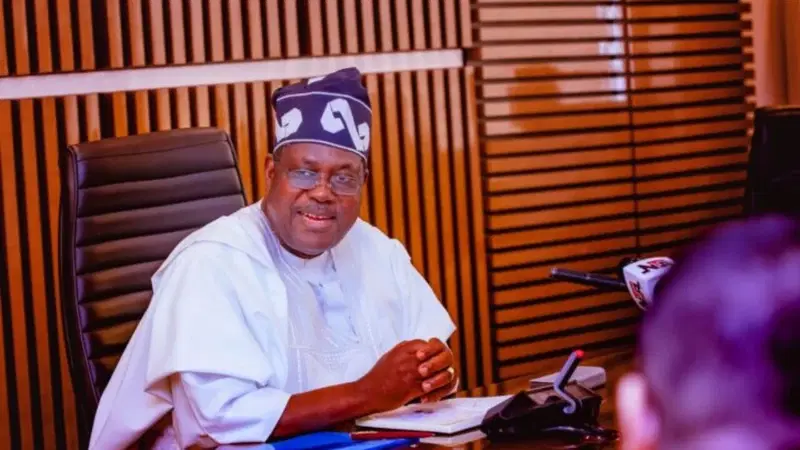
This position was outlined in a comprehensive statement released in Abuja by the Secretary to the Government of the Federation,SGF, Senator George Akume.
In the document, the Federal Government traced the contemporary crisis to two distinct but overlapping fronts: the long-running ideological insurgency in the North-East and the increasingly commercialised banditry across the North-West.
These, the SGF explained, have developed through years of external influence, internal vulnerabilities, weapons proliferation, and economic pressures accelerated by climate and resource competition.
The two-pronged nature of the conflict
Akume said Nigeria’s current security landscape cannot be understood without acknowledging its dual roots.
The first is the ideological insurgency that began in 2002, initially as a fringe extremist movement in Borno State but gradually transforming into a full-scale terrorist campaign under the influence of global jihadist networks.
This culminated in Boko Haram’s evolution into the ISIS-backed Islamic State West Africa Province,ISWAP, which now operates across Nigeria, Chad, Cameroon, and Niger.
The second dimension, he explained, is the purely economic-driven banditry that escalated from 2018, particularly in Zamfara, Katsina, Kaduna, Sokoto and parts of Niger State.
These groups, he insisted, are motivated by control of resources, profit from illegal mining, cattle rustling, kidnapping-for-ransom, extortion, and the seizure of fertile farmlands. Their activities, he stressed, have no religious agenda.
Regional shockwaves from Libya, Egypt
Akume tied the escalation of Nigeria’s insecurity to the destabilisation of North Africa following the 2011 uprisings in Libya and Egypt.
He stated that Libya’s collapse opened a vast armoury to traffickers aligned with Al-Qaeda in the Islamic Maghreb.
These weapons eventually flowed through the Sahel into West Africa, strengthening Boko Haram, ISWAP and criminal networks. Egypt’s instability, he added, facilitated the spread of extremist ideologies and foreign fighters who influenced militant groups across the region.
Nigeria’s pre-2010 legal weaknesses
The SGF recalled that prior to 2010, Nigeria lacked the legal infrastructure to effectively respond to terrorism. The 2010 Independence Day bombing in Abuja exposed this gap and triggered sweeping legislative action, including the Terrorism Prevention Act of 2011 and its 2013 amendment.
These laws, he said, expanded intelligence cooperation, strengthened mechanisms for tracing terrorism financing, criminalised extremist recruitment, and established the foundational architecture of modern counter-terrorism operations.
A detailed timeline of the insurgency
Akume provided a chronological breakdown of the insurgency’s evolution:
2002–2009: Formation of Boko Haram under Mohammed Yusuf, who propagated hardline doctrines that later inspired violent extremism.
2009: The group radicalised further following clashes with security forces and Yusuf’s death.
2010–2014: Under Abubakar Shekau, Boko Haram intensified attacks, deploying suicide bombers, targeting churches, mosques, markets, security formations, and carrying out high-profile operations such as the bombing of the UN Building in Abuja (2011) and the abduction of the Chibok schoolgirls (2014).
2015–2016: The group pledged allegiance to ISIS, becoming ISWAP. Internal disagreements led to a split, with ISIS endorsing a more structured leadership.
2016–2025: ISWAP reorganised into a regionally coordinated faction operating across borders, while Boko Haram under Shekau weakened until his eventual death.
Akume described this evolution as part of a broader ideological pipeline connecting Al-Qaeda influences from the Sahel to the global surge of ISIS-backed networks.
Economic foundation of north-west banditry
The SGF stressed that the North-West crisis is not a religious conflict but a war economy rooted in survival, profit and resource control.
He listed major economic drivers including:
• Competition for grazing routes and water sources worsened by desertification
• Cattle rustling connected to cross-border livestock markets
• Gold and mineral exploitation in Zamfara, Kaduna, Niger, Benue and Katsina
• Kidnapping-for-ransom, which has become a highly organised industry
• Illegal taxation imposed on rural communities
• Territorial control of agricultural belts and transport corridors
He warned that these conditions have created entrenched criminal networks with significant financial incentives to perpetuate violence.
READ ALSO: Senate suggests massive recruitment to tackle insecurity
Recent attacks, humanitarian impact
Akume drew attention to the mass killings in Yelewata community, Guma Local Government Area of Benue State, where at least 100 people were killed between June 13 and 14, 2025. The incident displaced thousands and destroyed homes across several settlements.
Following the attack, the President deployed the SGF to the area with relief materials and financial support.
Days later, the President personally visited the victims in hospitals and ordered a thorough census of casualties and damaged property. Funds for the reconstruction of affected communities were subsequently approved.
Rejection of “christian genocide” claims
The SGF addressed recent statements describing the crisis as a genocide against Christians, calling them inaccurate and harmful.
He stated that:
• No reputable global organisation has classified Nigeria’s situation as genocide
• Boko Haram and ISWAP attack both Christians and Muslims
• Bandits target anyone irrespective of faith
• Victims include Christians, Muslims and traditional worshippers
• The drivers are ideological extremism and economic factors, not religious extermination
He warned that mischaracterizing the conflict risks inflaming sectarian tensions, emboldening extremist groups, damaging international relations, and undermining ongoing counter-terrorism cooperation.
The armed forces, need for partnership
Akume reaffirmed the capability of the Nigerian Armed Forces, noting they have reclaimed territories, dismantled insurgent enclaves, and disrupted terrorist leadership structures.
He insisted Nigeria does not require foreign troops but needs targeted assistance in intelligence sharing, technology and advanced combat equipment—especially from the United States.
Impact of recent foreign statements
The SGF expressed concern that recent public pronouncements from the U.S. have unintentionally encouraged violent actors to stage attacks in an attempt to attract global attention.
He noted that prior to these remarks, the insurgency had been significantly weakened and reduced largely to isolated bandit operations.
Nigeria’s official position
Akume reiterated that Nigeria is a secular state under the 1999 Constitution, which prohibits any adoption of a state religion. Current federal appointments, he said, reflect national diversity, with Christians and Muslims holding key positions across ministries, security agencies and the National Security Council.
The way forward
The SGF outlined several priority strategies for the Federal Government:
• Intensifying nationwide security operations
• Deepening intelligence-sharing with allies
• Strengthening financial surveillance to disrupt illegal mining and transnational crimes
• Enhancing rural and border security
• Upholding strict human-rights standards
He emphasised that Nigeria and the United States, as two of the world’s largest democracies, share a responsibility to uphold stability in West Africa and counter the spread of violent extremism.
A call for national unity
In his concluding remarks, Akume urged Nigerians to rise above religious and ethnic divisions and unite against insurgents, bandits and extremist networks threatening national security.
He stated that this moment requires one voice, one purpose, and one commitment to defend the nation’s territorial integrity and protect every citizen.
Crediblenewsng.com